Case Capacity - acceptable variance?

Kelly Timoffee

BANNED
BANNED
BANNED
EE Expired
Rating - 100%
52   0   0
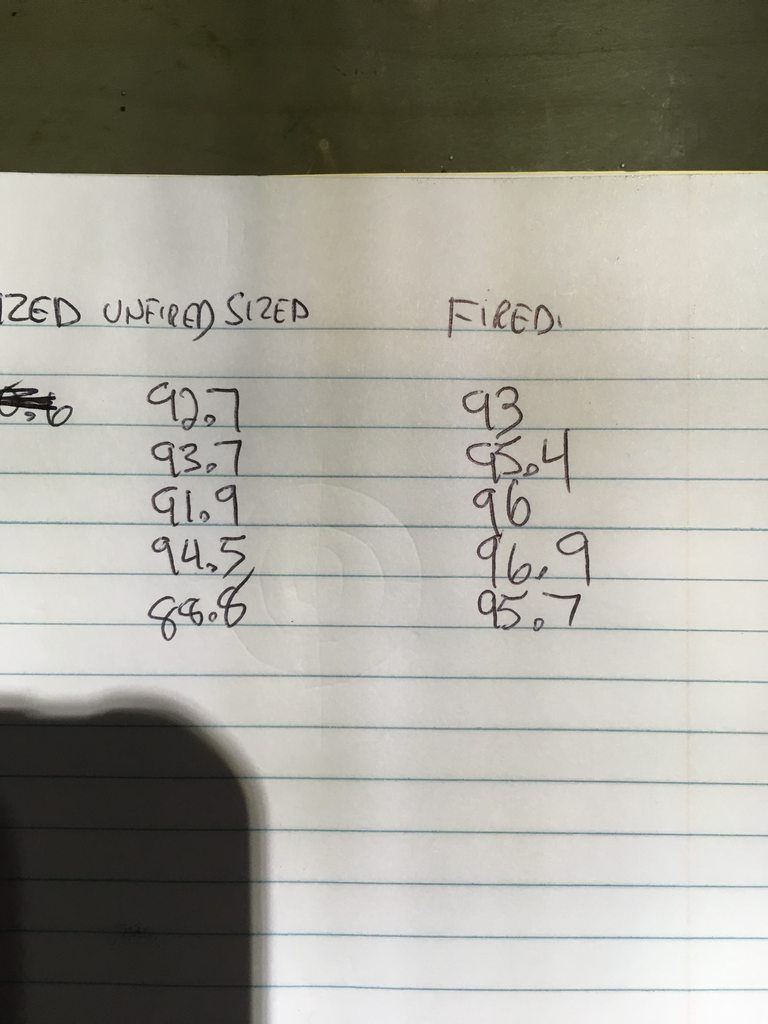
So, as I continue my saga with my 300 WM Vanguard I figured I better just go and check the case capacity of the Hornady brass I have been using.

Here is the measured capacity of 5 fired and 5 sized , un-fired and ready to load.

What do the knowledgeable ones say to these differences?


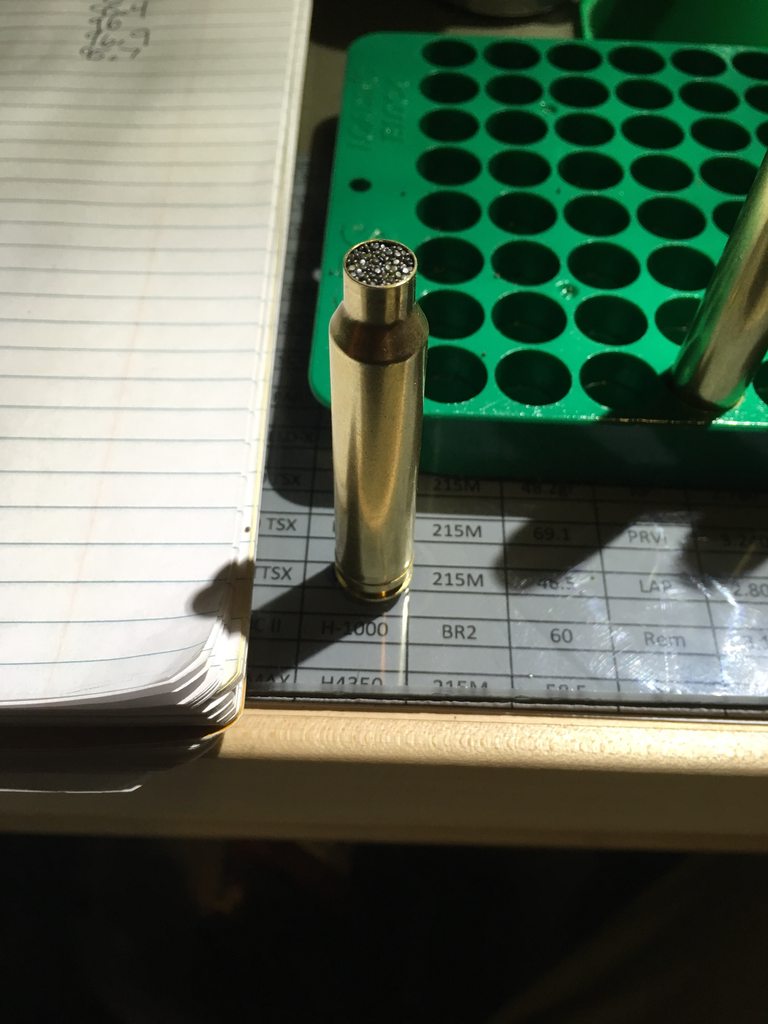
Cases were filled to just above capacity and scraped flush with the mouth.

 
Take them in your kitchen with your scale and a little dish?

Also did you use a drop tube to fill the cases? Or at least vibrate them/ tap them to settle the powder and make sure you didnt conpress it while scraping it off. Water is better. A small drop of soap can brake the water surface tention
 
Last edited:
Can't really help you with those numbers, but I notice others, like John Barsness and Nosler, measure "volume" by weighing a case filled with water with the bullet of interest seated. The seated bullet uses up case capacity, of course. They report "volume" as the weight of water - the difference between a dry case and bullet, and a "wet" case and seated bullet. Seem to work with assumption of density of water = 1 gram weight per cubic centimetre volume
 
Long drop tube... tap the case to settle the powder as much as possible. Even with top of the case. Dump into the next case and see how it fills.

In fireformed, and trimmed cases, the powder level should be near identical. A slight variation in height (high or low) is ok but over 1mm in height difference would get the case marked and tested to make sure it is not out enough to cause a problem.

In a 30cal neck, maybe that would weight 1/2 gr?????

I am just looking at relative case volume... not absolute value

Jerry
 
Long drop tube... tap the case to settle the powder as much as possible. Even with top of the case. Dump into the next case and see how it fills.

In fireformed, and trimmed cases, the powder level should be near identical. A slight variation in height (high or low) is ok but over 1mm in height difference would get the case marked and tested to make sure it is not out enough to cause a problem.

In a 30cal neck, maybe that would weight 1/2 gr?????

I am just looking at relative case volume... not absolute value

Jerry

Hey Jerry , the way I was doing it was to slowly meter it into the funnel off to the side and way at the top and one tap when I was done, the level didn't appear to change after a guy tapped it, the W760 I used sure seemed to fill up without wanting to settle more.

A couple of times I did go from one case to the other, in both instances the case I was pouring into well over filled from the previous case tested.

I may try some other brass in other chamberings to see if the differences are similar as I have all kinds of brass all the way up to Lapua.
 
Can't really help you with those numbers, but I notice others, like John Barsness and Nosler, measure "volume" by weighing a case filled with water with the bullet of interest seated. The seated bullet uses up case capacity, of course. They report "volume" as the weight of water - the difference between a dry case and bullet, and a "wet" case and seated bullet. Seem to work with assumption of density of water = 1 gram weight per cubic centimetre volume

How would this work if your cases had a notable difference in weight?

Personally can't see that being very accurate.
 
The difference from the same case. Dry vs wet tells you for that exact case. Then next case, use the dry vs wet weights for the new case.

Each time using the case your measuring to get both weights. Personally i wouldnt bother seating the bullet my self. As a full case will still allow you to conpare even if its not the actual number for a loaded round
 
As I understand from John Barsness write-up, he doesn't size the neck. Weighs case with spent primer still in. Weighs bullet. Fills with water and inserts bullet of interest to depth - excess water squeezes out and is blotted away. Weigh assembly. Deduct bullet weight. Deduct case weight. What is left is weight of water. 1 gram = 1cc. All the Nosler manual's listings are the same, under "Case Holds" at top of each page - they list "grains of water" - different for every bullet weight.
 
Hey Jerry , the way I was doing it was to slowly meter it into the funnel off to the side and way at the top and one tap when I was done, the level didn't appear to change after a guy tapped it, the W760 I used sure seemed to fill up without wanting to settle more.

A couple of times I did go from one case to the other, in both instances the case I was pouring into well over filled from the previous case tested.

I may try some other brass in other chamberings to see if the differences are similar as I have all kinds of brass all the way up to Lapua.

For those cases that seem overfilled, tap the case and the powder should settle to even or a slight hump. If the level is truly overfilled, then you have your answer.... that case has smaller case volume and would be put aside for further testing.

The goal of this method is to have a fast way to cull obvious 'outs'.

If you find that the ball powder is inconsistent, try salt... that will pack very well and there is now no doubt what the comparative case volume is.

Again, you are sorting for the outliers that show a tangible difference in case volume. Remember that all the powder is expanding in a microsecond. It doesn't see nor care if the case volume varies very small amounts.

When you head out next, consider what we had discussed, bring 2 to 3 rds for each powder step and shoot the group. I would go up in 0.3gr for a magnum case. Then retest in smaller powder charge increments around the charges that show promise.

If you can't get any load to show promise on the work up, change bullet. If it fails again, get a new barrel. If you are using a quality powder with known results, changing to another rarely improves things. A good barrel will shoot good powders... may be fussy with the bullet due to quirks in the bore/chamber but powder isn't going to change the accuracy portion of the testing.

Can affect speed but that is another issue to chase ONCE you confirm the barrel is accurate enough.

Ladder testing has never really inspired me as a way to get good load tuning data.

Jerry

 
Quickload tells you to measure H2O case capacity of a case fired in "your" rifle.

Peterson select brass 'which is sorted so every case in a 50-count box is within .001 OAL and within 1 grain of the same weight."

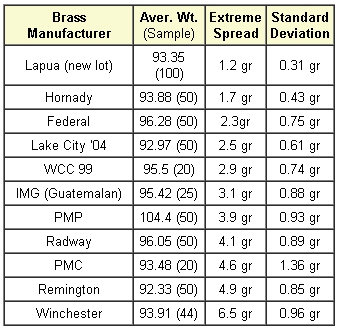
Below is to show you the difference between Lake City and Lapua case weight variations and why I buy once fired Lake City brass.


Save $$ By Using Lake City 5.56x45mm Once-Fired GI Brass
http://bulletin.accurateshooter.com/2019/10/save-by-using-lake-city-5-56x45mm-once-fired-gi-brass/

Accuracy Potential of Mil-Surp 5.56×45 Brass

So, how accurate can previously-fired GI surplus brass be in a good National Match AR-15? Well, here’s a data point from many years ago that might be of interest. A High Power shooter who wrote for the late Precision Shooting magazine took a Bill Wylde-built AR match rifle to a registered Benchrest match. His first 5-round group ever fired in a BR match was officially measured at 0.231″ at 200 hundred yards. This was fired in front of witnesses, while using a moving target backer that confirmed all five rounds were fired.

He recounted that his ammo was loaded progressively with factory 52gr match bullets and a spherical powder using mixed years of LC brass with no special preparation whatsoever. Obviously, this was “exceptional”. However, he had no difficulty obtaining consistent 0.5-0.6 MOA accuracy at 200 yards using LC brass and a generic “practice” load that was not tuned to his rifle.

PExmCCk.jpg
 
I’m fairly new at this OCD accuracy reloading deal, normally I work in volume reloading.
But measuring a volume with water seems odd. Given such a small cavity and the nature of waters surface tension, plus the ability for moisture to stay in the case multiplied by the percentage error of the operator and seems like a labour intensive way to produce questionable results (?)...
Why not weigh the empty case?
If they are all trimmed to the same length, fired from the same gun or FL sized from the same die set-up then the external measurements are the same.
If a case weighs less the cavity inside must be larger.
If it weighs more then the cavity is smaller.
If multiple cases weigh the same, the cavity must be the same.
No?
And if yes; what thresholds or groups of cases are used? (I.e.: Range of 1 grain, or .1 grain, or...).
 
I would personally not use a weight of smokeless powder (or any other type of powdery substance, ex. black powder or even flour) to try to measure this, way to much variance in how much the powder has settled. A liquid of some sort (water, oil, etc) is the only way to go.
 
Back
Top Bottom