Case head separation. How to avoid it?

Brianma65

CGN Ultra frequent flyer
Rating - 100%
197   0   0
Location
Canada
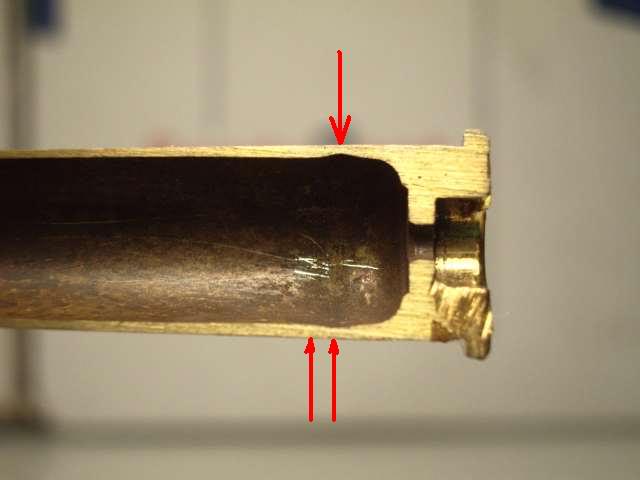
I had my 7 mm RM out yesterday and had one of my cases separate.
3 times fires Hornady brass.

I was on the max load of powder.

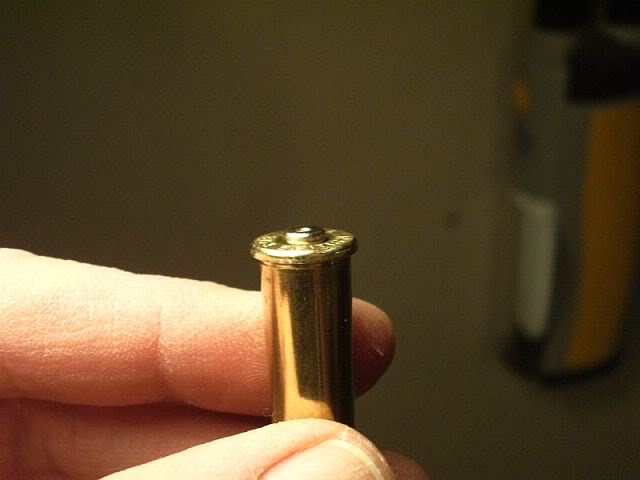
After inspection of all the brass, that I fired, I can see a slight discoloured ring ,around the base of most of the brass.
This leads me to think that the remaining brass will suffer the same fate, maybe next time out.

So,is there anyway to avoid this, by setting up my dies differently?

Thanks
 

Attachments

  • 4AD3508C-A54B-487A-A54C-B4AB79C8A2B0.jpg
    4AD3508C-A54B-487A-A54C-B4AB79C8A2B0.jpg
    24.4 KB · Views: 366
Treat the cases as if rimless. Size only enough to insure easy chambering. Forget about headspacing on the bolt.
 
look at head base for hit stamp from fireing if there some mark back off 5 grains and go up to .5 grains when you see lite hit stamp go back .5 to 1 grains and stay there problem solve have fun
 
I had my 7 mm RM out yesterday and had one of my cases separate.
3 times fires Hornady brass.

I was on the max load of powder.

After inspection of all the brass, that I fired, I can see a slight discoloured ring ,around the base of most of the brass.
This leads me to think that the remaining brass will suffer the same fate, maybe next time out.

So,is there anyway to avoid this, by setting up my dies differently?

Thanks

Almost certainly bumping the shoulder back too far. Yes, those cases which have not separated are garbage/recycling. Crush the neck and discard.

New case - fire once. Remove from chamber then try to re-chamber. If it chambers ok it should be close to fire formed perfectly for your rifle. Measure shoulder to base with proper case length gauge to the thou. Set your full length sizing die to size to exactly this length or at most 1 thou less. Resize each firing. Monitor for incipient separation with the paperclip/wire check.

Google it. Buy and read several reloading manuals. Watch youtube videos while they are still available.
 
The rest of your brass is probably junk now as well. You can check with a wire hook, I use a dental pick.

Start over with new brass. Adjust the sizing die so it touches the shellholder, then back it out a full turn. As long as the cases chamber easily (trial fit before loading) leave it there until there is a bit of resistance when closing the bolt. After a few loading the cases will start chambering harder. Screw the die in a bit at time until the handle drops properly, then lock the die down. If you happen to have Lee dies with O ring lock rings throw them away and get some
real ones.

Or do it right and get a set of Redding completion shellholders.
 
RCBS cartridge headspace gauge is a useful tool that allows setting FL die to minimal headspace. .0005" is optimal, but setting the shoulder back .001" is OK. Cartridge cases regardless of make will come apart quickly if setting back .004".
 
I’ve already ditched the rest of the brass.
And yes, I’ve got a set of Lee ,with the rubber O-ring.
Which I really don’t like:)


I have some once fired nickel brass, that’ll hold me over.
 
Almost certainly bumping the shoulder back too far. Yes, those cases which have not separated are garbage/recycling. Crush the neck and discard.

New case - fire once. Remove from chamber then try to re-chamber. If it chambers ok it should be close to fire formed perfectly for your rifle. Measure shoulder to base with proper case length gauge to the thou. Set your full length sizing die to size to exactly this length or at most 1 thou less. Resize each firing. Monitor for incipient separation with the paperclip/wire check.

Google it. Buy and read several reloading manuals. Watch youtube videos while they are still available.

XX2 Very good advice. When a die is adjusted right case seperations almost never happen. Remember to use the same shell holder as you adjusted the die with. I once ruined 50 cases for my 300 Win by changing shell hloders. They are not all equal.
 
Brianma65

The SAAMI cartridge and chamber drawing shows the following tolerances.

1. Cartridge case belt headspace manufacturing tolerances .220 -.008. Meaning ,220 to .212 from the base of the case to the forward face of the belt (cartridge headspace)

2. Chamber headspace .220 min and .227 max.

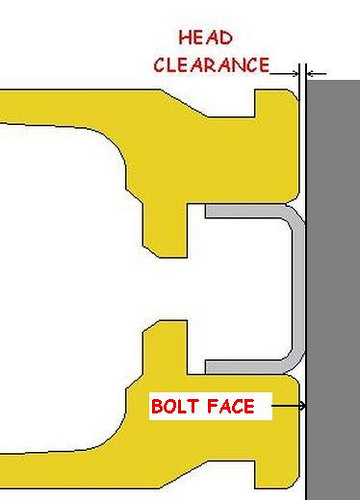
This means with a chamber at maximum headspace and a cartridge case at minimum dimensions you could have .015 head clearance. Meaning .015 "air space" between the rear of the case and the bolt face. I doubt your rifle will have .015 head clearance but finding out the head clearance with new cases will give you good information.

HK76WCp.jpg


You can find your actual head clearance with a new unfired case and a fired spent primer. This will let you know much the case will stretch the first time it is fired.

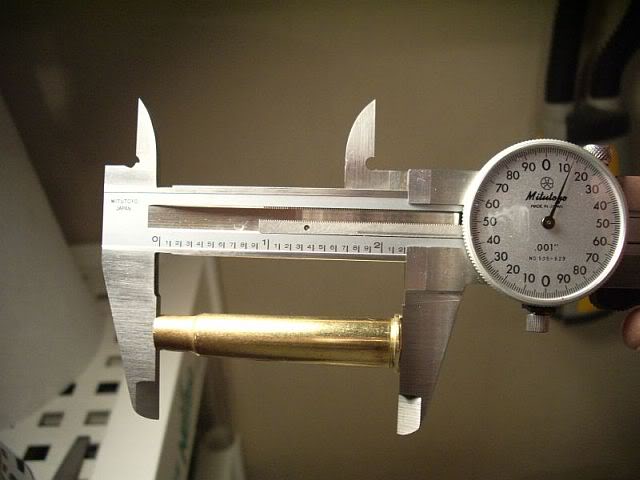
1. Measure the new cases OAL from the base of the case to the case mouth and write it down.

SgwqgaU.jpg


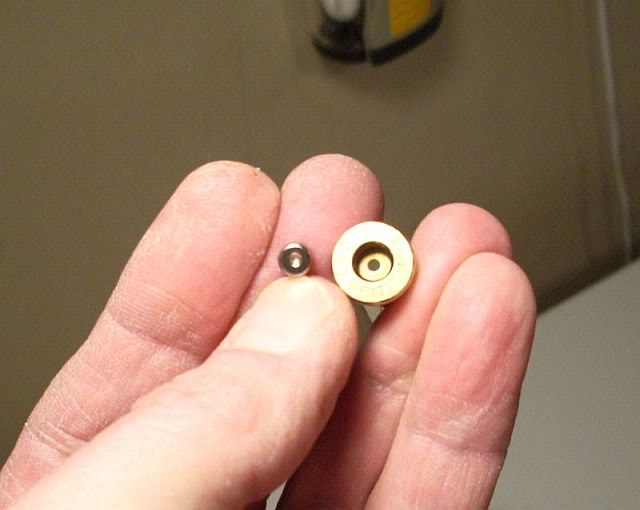
2. Now just using your fingers start the fired primer into the primer pocket.

oNIvIiX.jpg


zQxlYGp.jpg


3. Now chamber this case and let the bolt face seat the primer and then extract the case.
4. Measure the case again from the base of the primer to the case mouth and write it down.
5. Now subtract the first case measurement from the second case measurement.
6. The difference will be your head clearance or the "air space" between the rear of the case and the bolt face and how far the case will stretch when fired.

Example below, the .303 British case below stretched and thinned .009 the first time the case was fired. And when full length resized these cases separated the third time they were fired.

YoV80b4.jpg


Bottom line, you may need to fire form your cases the first time they are fired to keep them from stretching and thinning. You can do this by seating your bullets long and jamming the bullet into the rifling. This will hold the case against the bolt face when fired and prevent stretching and thinning. After this you can neck size or full length resize with minimum shoulder bump and let the cases headspace off the shoulder.

Just remember normally the case will stretch the most on its first firing. Thereafter the case will only stretch by the amount of shoulder bump, and if kept to .001 to .002 shoulder bump it will be within the cases elastic limits.

 
XX2 Very good advice. When a die is adjusted right case seperations almost never happen. Remember to use the same shell holder as you adjusted the die with. I once ruined 50 cases for my 300 Win by changing shell hloders. They are not all equal.

I have loaded some cases 10-20 times and not one separated. Heck I didn't even have leaky primers but they were getting loose.
 
XX2 Very good advice. When a die is adjusted right case seperations almost never happen. Remember to use the same shell holder as you adjusted the die with. I once ruined 50 cases for my 300 Win by changing shell hloders. They are not all equal.

Yup, for sure. If you have multiple case holders, make sure you use the exact same case holder every time. Keep it with that die. Thanks for pointing that out.
 
I have loaded some cases 10-20 times and not one separated. Heck I didn't even have leaky primers but they were getting loose.

Different cartridges require different techniques due to a variety of factors. Any belted cartridge, such as the 7mmRM and the 300WM come to mind with case stretch problems. A lot of Lee E .303 British as per bigped51's contribution above. Almost any rifle that has sloppy headspace can have this problem. It can almost always be eliminated or significantly reduced by not over bumping the shoulder as the above techniques discuss.
 
the case must been stretched a lot, you might want to have a gunsmith check the rifle's headspace. it would be a good excuse for a new barrel. if the headspace is good, then your resizing die might be off spec. try moving the die up until you just bump the shoulder of the case 1-2 thousand.
 
It’s a new Xbolt.
I was playing around with the die adjustment. Got almost 2 full turns back and the brass still fits.

If you are 2 full turns out and have a 1/16" gap or more between top of shell holder and bottom of die, then you are just partial sizing the neck and not touching the rest of the case.
Basically what a dedicated neck sizing die would do.
 
.
Pay attention to "bigedp51"'s post above


While case separations can occur with any calibre, stretched brass is very common with the .303 British. This is partly because the chamber has been cut oversized a bit to compensate for foreign debris under combat conditions, and the fact that presently made Commercial ammunition generally has thinner rims than Military stuff.

We used SMELLIE's old trick of going to the dollar store and buying a package of those wee rubber bands that women use for their hair. By slipping one on for the first firing, it holds the face of the cartridge back against the bolt. NOTE: This works for RIMMED cartridges, not rimless ones. Then, you NECK SIZE ONLY and try to keep those cases fired in that particular rifle separate from others if you have more than one of the same calibre. Chambers are like fingerprints, many are slightly different dimensions, and if you have cases that are fired in that rifle, they should go back in easily.


Dental picks are good for indicating possible case separations. But, you can easily make a small tool from a straight piece of wire, about 4 inches long. Sharpen the end, then bend it about 1/4 inch from the sharpened end, making an " L " shaped wire rod. Take a piece of 3/8 or 1/2 inch dowel, drill a hole in the end, or even an old ball point pen, epoxy the rod inside making sure it protrudes about 1/2 out from the mouth of the case. If the pointed end is a bit long to insert, shorten it slightly and resharpen it to a point.

To use, insert the short end into the fired case until it hits bottom, push it lightly on the inside of the case wall. You will easily feel any indentation where a case is going to separate.

Also, you mentioned having to back off the sizing die TWO full turns. This means that the setting was too deep, and you were pushing the shoulders back creating excess headspace. There is usually a slight gap for reloading dies between the bottom of the die and the shell holder. NOTE; shell holders can vary in thickness or height, so a shorter one allows the die to go down further.

A fast determination of depth is that reloading dies are threaded 7/8x14 threads per inch. 1000 divided by 14 equals .0714 inches. Two turns is .1428 inches or about 1/8 inch too much.
 
Last edited:
If you are 2 full turns out and have a 1/16" gap or more between top of shell holder and bottom of die, then you are just partial sizing the neck and not touching the rest of the case.
Basically what a dedicated neck sizing die would do.

I backed the die out until I had no neck tension, then kept screwing it in until I got neck tension.
Using a fired 7mm brass from my rifle.

I made a dummy rnd and it fits perfect.

Is that all I need to do?

I’ve always just followed the die instructions and never had any issues with other calibers.
Just this 7mm, but I’ve read it’s common.

Also,I seem to have a lot of free bore.
I checked this by just starting the bullit,into the neck.
Then I chambered and closed the bolt.

I’ll get measurements when I get home, but seems like a lot.
 
If you are 2 full turns out and have a 1/16" gap or more between top of shell holder and bottom of die, then you are just partial sizing the neck and not touching the rest of the case.
Basically what a dedicated neck sizing die would do.

I would definitely agree! This is excessive to say the least. Something is not right with this rifle. I would get it to a gunsmith to have the head spacing checked and I would not fire it until it has been proven to be within tolerance or has been corrected.
 
Back
Top Bottom