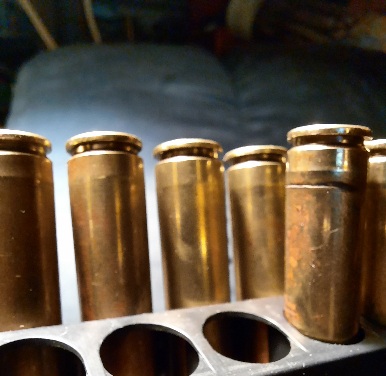
Case head separation with Win. brass 6.5x55

Swiend

CGN frequent flyer
Rating - 100%
42   0   0
Location
Pincourt, QC
Hey all, about a month ago I had the opportunity to shoot a few rounds of my reloaded Swedish Mauser rounds.
We didn't have much time so I flew through the 20 round box and packed up.
This morning I was contemplating a brass cleaning session and looked through these casings to find some brass with cracks and ring bulges. This is Winchester brass maybe reloaded twice, shot through a sportered Swede mauser. I haven't fired this rifle much in the past and I'm now wondering about headspace...what do you guys think?
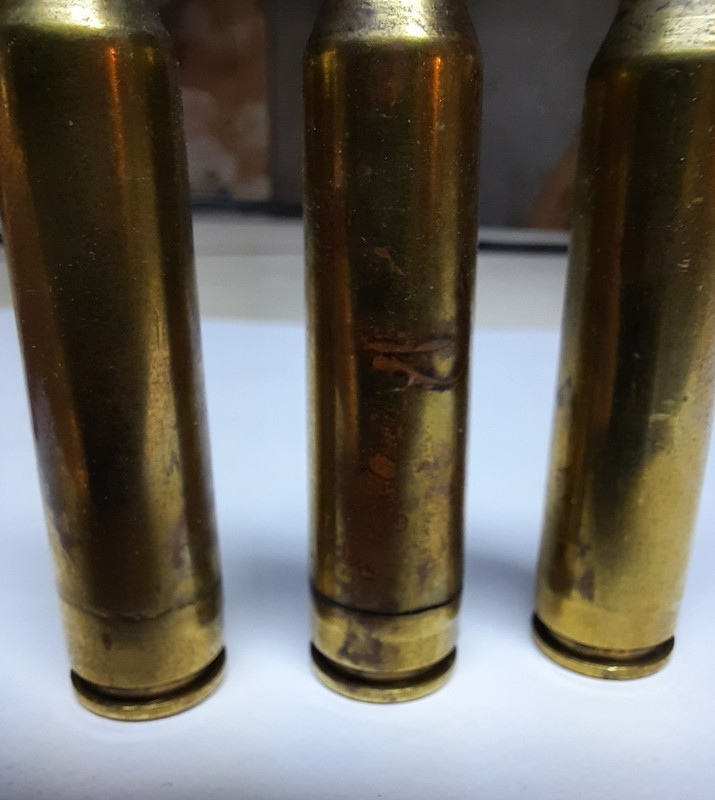
post a picture
 
First, you should make sure that when you are FL resizing your brass, that you are not
pushing the shoulder back any more than, possibly 1.5-2 thousandths of an inch.
Even a perfect chamber will do this to brass if it has been sized so as to be short. Dave.
 
Swedes were making 6.5x55 since about early 1890's. A committee of Sweden and Norway invented it - they designed it. SAAMI was created in 1920's. Winchester should be making their brass to SAAMI size. And is known that the headspace gauges in Swede Armoury are longer than what SAAMI calls out. So, you likely have a combination of USA made brass (which is likely small - compared to European stuff), and too boot, your Swede Mauser will have a longer-than-SAAMI chamber. Your reloading dies are also likely USA made and will also be sized based on SAAMI dimensions. So, like many other rifles and older cartridges - you will have to learn how to size your brass to fit your chamber - SAAMI did not do you any favours when they decided to specify different lengths for 6.5x55 than the Swedes had been using, for at least 30 years before SAAMI existed.

You might want to read this: http://dutchman.rebooty.com/headspace.html

Your sporterized Swede Mauser likely has the year it was made stamped on the front receiver ring - assuming the barrel is also more or less original, that is the era of Swede chamber sizing you would be looking at. An alternative way to establish the date of your receiver - has a 6 digit serial number and has about two letters. Those letters are the initials of the inspector at the arsenal - find someone with Crown Jewels book or similar - can use the Inspector and the serial number to ID what year that rifle was made - and could have been a M/94 or an m/96 - both were being made in same arsenal at same times - some into the 1930's. It could later have been converted into a M38 or even a CG63 before it was sporterized.
 
Last edited:
Compare N american SAMMI swede ammo to Euro CIP swede. You will find that area 6 to 7 thou smaller in SAMMI stuff. The reason is they use 3006 as a base, which while close enough is not actually to chamber spec.
 
Hmm. Very interesting! Thanks for posting that link. I have several 96 and 38 Swedes, plus reloading dies and components, but I don't think I've ever reloaded - yet. I remember loading a little carry on train case with that good Swedish surplus ammo at the old Lever Arms and hopping on the train back to SK. I tried to make the case look nice and light. :p
 
Separations like that are indicative of an excess headspace situation. The cases expanded, including the shoulders moving forward, on first firing. Subsequent sizing was probably excessive - the shoulders were pushed back too far. On the next firing, when the cases fireformed again, the stretch was too great, and the separations occurred.
Size only enough to insure easy chambering.
Swedish Mausers were not manufactured to SAAMI spec. I have tested a lot of them with SAAMI gauges - every one would accept a SAAMI NO GO.
Just size your brass to suit the rifle.
 
Even on your cases that did not crack - look inside with a good light - you will likely see a groove into the case wall - just ahead of the solid head - whatever cases of yours that did not crack on this firing, will likely let go on the next firing. Is called "incipient case head separation". You may or may not get away without that groove on the first firing - you won't on many 303 British with WWI chambers - if no groove, then that brass withstood the "stretch" that occurred - resize no more than your rifle needs - ignore set-up gizmos, etc. - need to match your brass to your chamber - likely will last for 10 or more sane re-loads before the primer pocket gets too loose.

Primer pockets that are loose after only 3 or 4 reloadings is telling you that your load is TOO HOT for that brass - regardless what a reloading manual says.
 
Traditional test was a straightened paper clip with a hook on the end to feel the groove, I prefer a made-in -India dental pick. You know the ones where you get a handful for $5 at a gunshow.
 
With unknown or generous chamber dimensions or when using Lapua or Alpha brass due their cost, I will ( in this case of the 6.5x55) run a 0.277 or 0.284 mandrel to expand the neck, then run into a properly set up sizer die to create a false shoulder that is 1 or 2 thou short of the actual chamber dimension .

This is an effort to increase longevity of the brass as the first firing may stretch that brass in excess of 0.008" depending on chamber. Many more cycles can be had doing this thus slowing the eventual case separation.
 
Thanks for all of the replies, I really appreciate it. It seems that reloading for century old milsurps isn't as straightforward as one would think. I did the cheap Indian dental pick test and felt a distinctive internal ridge, needless to say these casings are destined for the recycling bin. My next batch of reloads will be subject to a warmed over neck sizing, a dummy round might be a good idea to verify If they will chamber.
Another pic showing many of the remaining brass with the "ring of death", lol
fate stay night wallpaper
 
Thanks for all of the replies, I really appreciate it. It seems that reloading for century old milsurps isn't as straightforward as one would think. I did the cheap Indian dental pick test and felt a distinctive internal ridge, needless to say these casings are destined for the recycling bin. My next batch of reloads will be subject to a warmed over neck sizing, a dummy round might be a good idea to verify If they will chamber.
Another pic showing many of the remaining brass with the "ring of death", lol
fate stay night wallpaper

It's really easy to neck size and you don't have to worry about head separation....
 
Faced with that same long chamber in a P-17, my answer was to have rechambered to 308Norma. I have a 1944 M96/38 . I screwed up the bolt trying to make a ####-on-opening by following the instructions too closely, they were more of a suggestion. I bought a bolt with a new handle here. Using the Go gauge from Brownells and shims , I was couple of thou to the good. It's better to be lucky than good looking, but it's great when you are both.
 
Back
Top Bottom