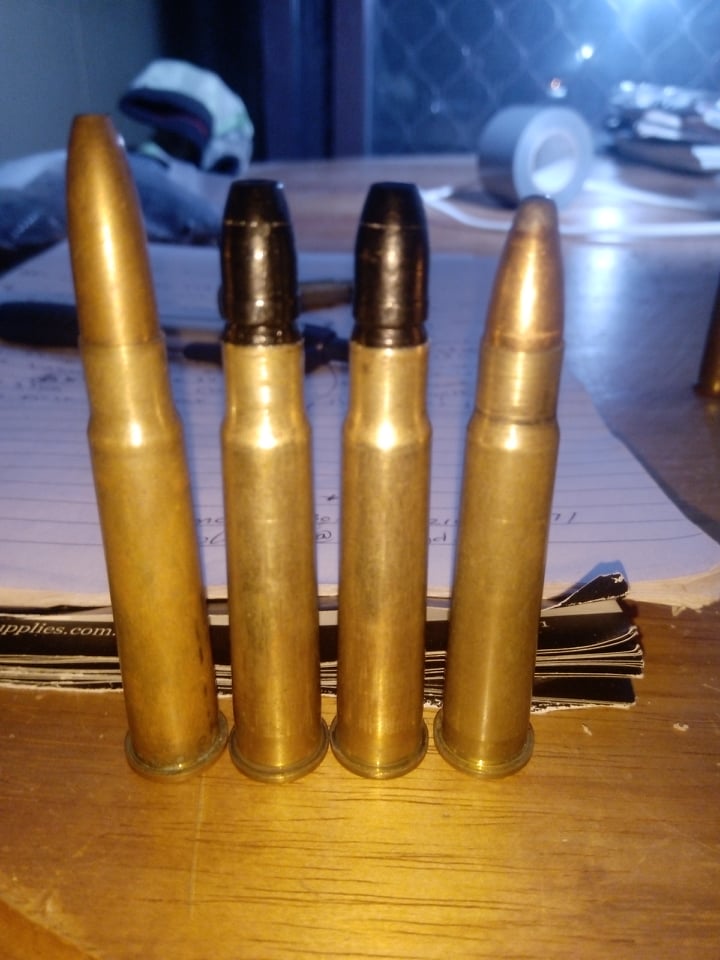
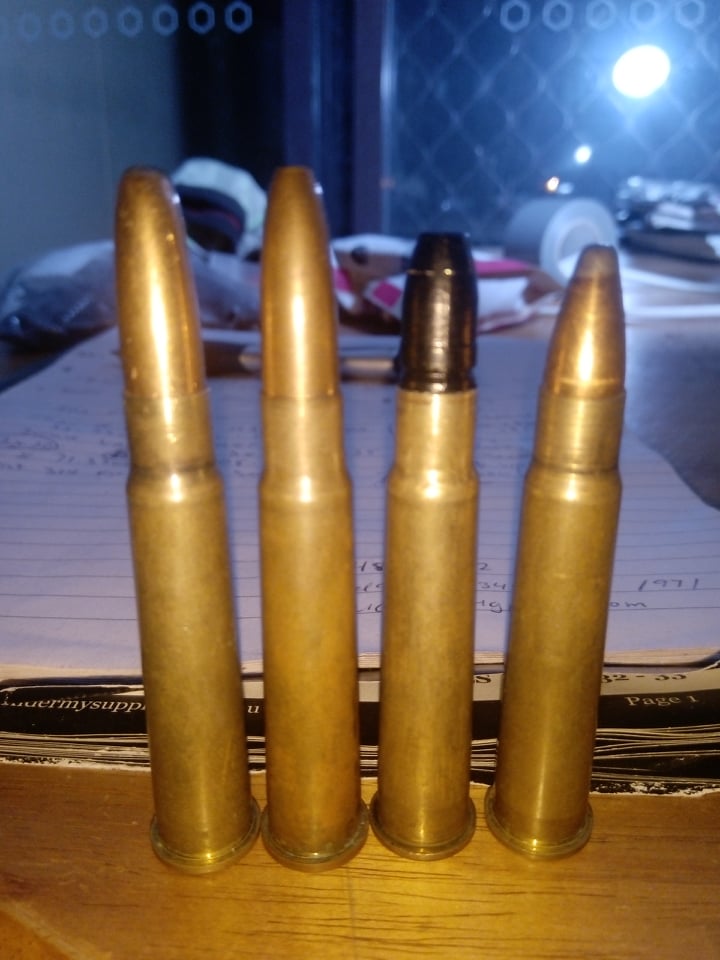
cast 303 180gr powder option

WhelanLad

CGN Ultra frequent flyer
Rating - 0%
0   0   0
Location
Australia AU
where do ya rekon start with this cast 180 gr in the 303 ruger 1, i have h4198 and varget, and 2206h , and some others but i dont think are suitable..

any tips on where to start, hard cast commercial projectile.......

or just use a downloaded varget load, an work up?
 
I have loaded thousands of rounds of mid caliber (3006,303Br,8x57, 7.62 Russian, 7.7 Jap etc) with 4198. My go to powder for cast bullet shooting. Almost all my 303 shooting is done with Lyman 311299 (205 gr). Check some reliable sources to find a safe starting point. Lyman manuals are one of the best.
 
where do ya rekon start with this cast 180 gr in the 303 ruger 1

What's your end goal? Or do you have more than one end goal?

For practice/fun, there's Ed Harris's "The Load"; whether the original 16 gr. of Hercules 2400 or the later 13 gr. of Red Dot. That should result in a MV around 1500-1600 fps, depending, depending, yadda, yadda..

Stepping up velocity a bit for hunting, 4198, 4227, 4895, RL-7 are all potential candidates.

As always, each rifle is unique in how it responds to loads to changes in powders and powder charge weights. If there was a specific best load for each bullet in all rifles, we'd call it "loading" instead of "reloading" - the experimentation with varying powder and charge weight is part of the deal.

"The Load", both the original with 2400 and the later with Red Dot (which I buy by the jug because I go through a lot of it in 12 ga. 7/8 oz loads) has worked well for me in .303 British, .30 US, and .308 Winchester. Each time I started at his specified charge weight and experimented up and down after that to find the optimal load. Usually I don't get much improvement beyond the starting point.

https://forum.castbulletassoc.org/thread/1387-the-load-is-13-grains-of-red-dot/
https://www.castboolits.gunloads.com/showthread.php?13425-Cast-Bullet-Loads-for-Military-Rifles-Article
 
What's your end goal? Or do you have more than one end goal?
goal is mostly plinking with a bit of oomph, ive got enough jacketed rounds to use for hunting with the opens, an im hoping to load cast at decent velocity to shoot targets off hand an field rests out to 200m preferably.

im at like 2400fps withthe jacket 180s now, so i spose i wanna try for 2200 with these coated projies....il load varget i suppose with a smaller charge ? but also maybe look at the 4198(2207) with maybe 28gr initially?
 
While I haven't loaded cast .303, I have loaded cast bullets in .30-06, .45-70, .38-55, .32-40 and 30-30. My go to powders to try first are IMR 4227 & 2400. Patience is important when you shoot cast lead rifle ammo!
 
While I haven't loaded cast .303, I have loaded cast bullets in .30-06, .45-70, .38-55, .32-40 and 30-30. My go to powders to try first are IMR 4227 & 2400. Patience is important when you shoot cast lead rifle ammo!

garand what velocity r u runnin the 3006 cast at mate?
 
im using this info. an goin from tere :)

Varget is an excellent powder for cast loads in .308

Modern Reloading 2nd Edition , Richard Lee page 145 has a Varget load suitable to use with your bullet. This is for a 175 Gr cast gas checked bullet and just fine to use data:

Charges go from 26 gr @ 1730 fps @ 11,400 psi to 43.0 gr @ 2530 fps @46,700 psi.

The most accurate cast load will be around 2,000 to 2,150 fps using 33 to 36 grains of Varget.

Lyman #2 alloy at the hardness of BHN 15 is suitable for this load level and a good selection for your alloy.

Gary
 
hey loaded some up an ran into an issue, with the lee 303 brit fls die, once i seat the projie, it strips off the rings of the cast!
SO what i did, time consuming. but i primed an got all ready, but seated the Drawn down 314 projie in the cases an then pulled them- filling with powder an seating the CAST, this eliminated the Stripping of the rings....
the stripping projie ended up at like 308-309.... :( so not expecting any accuracy there but time will tell @ 30gr. an loaded some without stripping with 32gr x5 to just see for leading an what the bullet looks like in the dirt for engagment and if any coatings off or what not.

should be shooting some tomorow-
will work on the accracy V velocity thing-

oh, Seated them at 2.808 / 71,3mm

cheers
 
2u5TJYl.jpg


174 ppsn, the 180 casts and 170 314 load
 
It's best to flare your cases when seating lead. Even well chamfered cases can strip off pieces of the bullet. I just use a LEE universal flaring die.
 
goal is mostly plinking with a bit of oomph, ive got enough jacketed rounds to use for hunting with the opens, an im hoping to load cast at decent velocity to shoot targets off hand an field rests out to 200m preferably.
  1. Why do you need 'oomph' for plinking? Just curious, but I have yet to see a paper target that the bullet bounced off, the plate that didn't ring when hit, or the tin can that the bullet bounced off when I'm out plinking.
  2. If you plan on target shooting at 200 meters with your centerfire rifle and cast bullets, you're going to have to up your game to graduate level cast bullet meister to achieve that. If you take a look at the CBA's annual national match results, the very best cast bullet competitors in production hunter class, with all their knowledge and experience, are placing/winning with group sizes of about 3" off the bench at 200 yards.
im at like 2400fps withthe jacket 180s now, so i spose i wanna try for 2200 with these coated projies....il load varget i suppose with a smaller charge ?

Just a suggestion, but if the intent is plinking, then maybe you should think about best accuracy and not 2200 fps? Just sayin'...

Again referencing the Cast Bullet Association national championships, the guys shooting the tightest groups across the course - in benchrest rifles built specifically for cast bullet competition - are loading their ammunition within a range of about 1400 fps to 1900 fps, with most around the 1600 fps mark.
 
hey loaded some up an ran into an issue, with the lee 303 brit fls die, once i seat the projie, it strips off the rings of the cast!

And that means numerous things. First, you've purchased bullets that were spec'd at something like .313" if I remember correctly. And you've resized your cases in dies that prep the necks to have an interference fit with jacketed bullets at .311" diameter - I'm guessing the I.D. of your case necks after sizing will be something like .309" - .310".

See what's going to happen here when you seat those .313" bullets after having done nothing but resize the cases? Especially when you almost certainly didn't put any flare in the case neck?

So you have a couple of solutions available.

First, you can buy some variation of case flaring tool to flare the case mouth. Lee has a universal case mouth expanding die, but that's pretty crude. You can flare the case mouth enough so it isn't cutting shavings off the bullet when seated, but once the bullet gets past that flare, it's being seated into a neck that is still sized to take a jacketed bullet .002" smaller. Pull a couple of bullets after you've seated them that way and see if the bullet has been sized down a bit after doing that.

Second (and in my opinion the best), you can use the Lee collet neck sizing die, which also provides all kinds of other advantages. Send Lee a few dollars and they will sell you a sizing mandrel of the size that is best for your bullet size that fits your ball seat/leade. So, if after measuring a cast, you decide that a bullet measuring .313" is the best fit for your rifle, purchase a mandrel that will size your necks to .312". And (or alternately) purchase NOE's really slick neck expander tools.

Each size button costs only a couple of bucks, so you can experiment with changes by .001". Those buttons will both expand the neck AND put a small flare at mouth to ensure there's no cutting. They don't eliminate the cold working of the case each time you resize your case like a collet die does, however. I resize with the collet die and use the NOE button to put a miniscule flare at the case mouth. It takes only a few extra seconds when doing your case prep, and if you're using a collet die for sizing, you save the time you used to spend lubing cases and then cleaning them afterwards.[/QUOTE]

 
Sometimes keeping it simple is best. My .303 loads are very, very accurate for cast and all I do is just give the mouth a little flare with the LEE die. Using a collet vs FL die doesn't seem to affect accuracy in my experience. I prefer the collet as I only shoot one of my .303 rifles and case life is certainly much longer. I'm not saying my method is guaranteed to be better but it's definitely easier than trying to get custom mandrels from a company that can't even supply enough of their regular products these days.
 
Last edited:
Back
Top Bottom