Casting with 30/70 solder

358Scout

Regular
Rating - 100%
72   0   0
Location
Saskatoon
Not that I'm going to stop using Bens magic bullets, but I'm going to try my hand at casting.

Came across 50 lbs of 30/70 solder in 1 lb bars along with a pile of rolled up roofing lead.
I already know the solder is too hard, so I'am thinking about mixing it with the roofing lead.
I'm assuming if I mix 3 lbs of the roofing lead per bar of 30/70, that should give me approximatively a 10 % tin ratio which should give ( and I'm assuming that also) a decent mixture for 45 caliber pistol bullets out of a rifle.

Has anyone had experience with this??????
 
I think that will still be a higher ratio of tin to lead than you will need.
They usually figure on 5% tin.
Tin doesn't harden the lead, it just makes it pour better. You may need some antimony to harden them.
One recipe for the alloy in Lyman's Cast bullets, is 1 part antimony, 10 parts tin to 200 parts lead.
To make much harder bullets, like lynotype alloy, the antimony can go to 10 or 15%.
 
The 30/70 bar I've have is stamped as 30Sn70Pb. It has quite a sheen and is very hard.
Its much harder than the roofing lead, which can be torn by hands alone.
An additional lb of lead, for a total of 4 lbs lead plus 1 lb 30/70 would bring it down to about 6% tin.

So, where do I get this antimony?
 
More than 2% tin in your mix is a waste of expensive tin ! 1 lb of 50/50 pb/sn ( lead / tin ) to 10 lb of ww material is all you need , Also the antimony that has been mentioned will Cast a Fatter lighter boolit than pure lead . If you want a Harder boolit . Add some Magnum hard shot to your mix and water drop your cast boolits or oven treat and Quench after about an hour @ 350-375 deg. F this is acomplished by the addition of arsenic with the shot in your melt . It is needed ( catalyst ) to cause a hardening effect on the crystaline structure of the alloy . You can reasonably expect 27-30 brinel hardness after about a week of water quenching , straight ww being around 10-12 brn . They will " soften " lose the hardness after a couple of years
 
Last edited:
The easiest way to add antimony to the mix is from Wheel weights, or best of all..Linotype, which is what I use when folks want hard bullets. Wheelweights, are a pain and can have almost anything in them, but Lino is king, this added component(Antimony) makes heat treating or quenching work. This added hardening(heat treating/quenching) has it's own benefits but also quite a down side as the hardness changes over short periods of time, that's why I don't do now...Ben
 
The 30/70 bar I've have is stamped as 30Sn70Pb. It has quite a sheen and is very hard.
Its much harder than the roofing lead, which can be torn by hands alone.
An additional lb of lead, for a total of 4 lbs lead plus 1 lb 30/70 would bring it down to about 6% tin.

So, where do I get this antimony?

Ummm. Yea....good luck with that one. If you actually find any, and they don't want a staggering price per pound, PLEASE, let me know too.
 
I'm with BEn in the short time that bullets stay hard, after quenching them out of the mould.
Denny, I thought you were a good scrounger and could easily find antimony. A good source is babbit from the bearings of old machinery. Slow turning, light pressure shafts had babbit that was not much harder than lead. But Highspeed and high pressure bearings were made from babbit that was very similar to linotype.
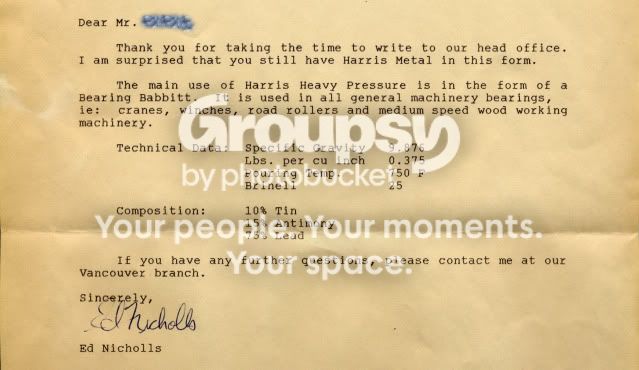
Here is a letter I got some years ago, on my request for nformation on cakes of babbit I had (have).
Note they state this metal is suitable for medium turning wood working equipment. A planer in a sawmill used to use babbit on their high speed shafts. In the olllld days, I saw a blacksmith pouring a bearing on one of these. The metal was hot but the blacksmith was leary of the alloy. He told an assistant to go to a store and get a roll of nickels! He opened the roll of five cent pieces and dumped them into the hot metal, then poured the bearing!
File0002-1.jpg
 
Back
Top Bottom