










































Converting black powder: 3F to 4F?

762mm

CGN Ultra frequent flyer
Rating - 100%
35   0   0
Hey guys,

I have a Lyman Deerstalker flinter and a 1 LB bottle of American Pioneer BP substitute in FFF. According to what I've been reading, I should be using 4F for the pan, otherwise the ignition could be very slow and\or could fail to ignite altogether. I've asked around the local gun stores, but no one seems to have 4F powder (which is a rare commodity nowadays, it would seem).

So, here's my question: can I make my own 4F out of 3F? It is my understanding that 4F is basically the same powder, just granulated to a much finer consistency... so, could one theoretically use a mortar to mash up some 3F until it is more "powdery" and 4F-like? Your thoughts please... and thanks in advance!

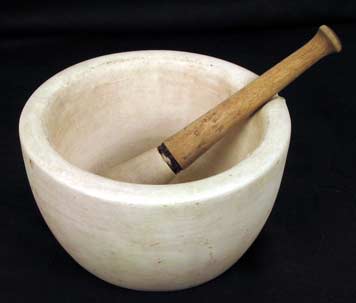
:)

mortar.jpg
 
I have done it with 3f black but Keep it to very small amounts no more than a teaspoon at a time keep the can of powder far away any form of static etc could = boom
 
I have done it with 3f black but Keep it to very small amounts no more than a teaspoon at a time keep the can of powder far away any form of static etc could = boom

Yes, I figured as much.. lol! But theoretically, is there anything that could cause a spark in a marble (or similar material) mortar? Not that I would take a chance with the bottle too close or large quantities of BP inside the mortar, but I believe that it shouldn't be possible for static electricity to travel through it, or to obtain a spark from mere friction. Unless PB friction in itself can cause a spark to occur (I'm no physicist, so I don't know)...

Anyway, thanks for the answer. I guess I'll be investing in a mortar at some point & adding it to my reloading equipment... they're probably much easier to find than 4F anyway, lol!

:D
 
buy yourself a can of goex 3fffg and use it for priming,or main charge i cant tell the difference between 4-3f when used for priming, i wouldnt use a bp substitute in a flinter either, as its a bit harder to ignite, wade
 
If you want to grind up some powder, place a bit in the bowl of a spoon. Place another spoon on top. Grind. Repeat. Won't be 4F, necessarily, but it will be finer than what you started with.
I've never used that particular subsitute, but substitutes in general do not work well in flintlocks, either in the barrel or in the pan.
 
I'm in Montreal, Quebec... so shipping could be an overkill, unfortunately. But thanks for the offer, Ben.

As far as my choice of a substitute is concerned, that was because I was still a newbie to antiques when I bought it and I really had no idea what to buy ( got the flinter in the mail from Ellwood Epps just a few hours earlier). I went to the local LeBaron and asked a guy there what would be best and the least corrosive for my Lyman flinter. He went in the back and came out with a bottle of American Pioneer 3F and said "That's the best stuff for yer gun"... and I answered "Sold!". :D

Thanks for the spoon tip, by the way... I haven't thought of that one. I might give that a try while I look around for a small mortar (for better and easier grinding results).

:stirthepot2:
 
Grind a bit and burn a small pile of each at the same time. Just enough to check burn rates.
Do it in the garage or the wife will be all over you. ;)

Not married yet.. but thanks for the tip! (because one day I might be, haha.. and I sure as hell won't let go of my favorite hobby)

:p


P.S. I wasn't aware that one could visually check the burn rate of BP. I always thought that it would just go "poof" in an instant, as opposed to smokeless that burns much slower.
 
Forget 4F and use 3F in the pan. It makes shooting flintlocks a lot simpler. I've never had any ignition problems with 3F. Just make sure you keep the priming charge below the touchhole.

Hmm.. interesting. Isn't ignition seriously impeded by using 3F? I've been reading that it can make the flinter impossible to fire... but then again, I've also read that it makes very little (if any) difference at all, kind of like you are saying.

I guess I'll have to test both theories and find out which one works best for me. I'll bring a couple of spoons to the outdoor range next time I go, just in case (to grind 3F, if it becomes necessary).

;)
 
P.S. I wasn't aware that one could visually check the burn rate of BP. I always thought that it would just go "poof" in an instant, as opposed to smokeless that burns much slower.[/QUOTE]

I doubt the human eye could see a burn rate difference between 3f-4f .
It would take some serious instruments to measure the difference especially when trying to set it off by hand.

It can't hurt to grind some 3f a little finer , but as stated , 3f will work fine.
 
I switched from 3F to 4F for my Lyman flintlock and went for an ignition reliability rate of 95% to 100% flawless every time. It is substantially faster and is exactly what the owners manual said to use. I substituted 3F as that was all I could get locally at the time( and was told that it would be just fine) but now that I have been using 4F I would never go back. I also made some finer powder for priming when I had problems at first. I used a stainless steel fine screened collander( I swiped from my wifes baking drawer) and a little hand carved wooden mortar. I put small ammounts of powder in at a time and rubbed it around over the screen with the wood slowly until it all went through. It made great flash pan priming powder. I stopped doing that though as soon as I got my hands on a couple pounds of 4F at the first rendezvous I attended. The finer powder definitely speeds up ignition.
Al
 
With my Brown Bess I primed with 1F right from the cartridge, 100% reliable. That was with a REAL flintlock, though, using proper flat springs that throw serious sparks. My friend tried 1F in his TC Hawken and it wouldn't even light. If you watch the modern coil sprung locks, compared to the older type they are much slower. One thing you might try is simply sifting your powder with a screen. Some lots of powder are quite dusty, and actually have quite a bit of 4F in them.
 
i use 4F for priming cuz i have it.
but in a humid environment i use 3F for priming especially in the field.

the 3F has a "glaze" to it and it doesn't attract humidity as much as 4F.
 
Back
Top Bottom