Copper shavings when seating bullets

backdoorsally

CGN Regular
Rating - 93.8%
15   1   0
Does anyone else get fine copper shavings when seating bullets? It’s nice new brass that has had the case mouth chamfered. But I always get fine copper shavings coming off the bullet when it is forced into the neck.
I find the shaving on the reloading press, in the ammo box, and all around the case neck

Loading for rifle not pistol
necks where expanded with an inside neck sizing mandrel
 
Last edited:
That's not good. Chamfered or not the chamfering tool still leaves a slight burr which can shave the softer copper.

More importantly it tells me that you are not setting up the powder and flare die deeply enough to very slightly bell mouth the casings before you seat the bullets. And yes, you do want to do that.

We're not talking about much of a flare for copper jackets or copper plating. Just enough that when you set the bullet on the mouth of the cases you feel the bullet sink down just a hair into a "seat" and not wobble around on the edges of the cases. That should make the shavings go away.

The other possible issue is that you're trying to crimp too strongly against the copper jacket or plating. Unless there is a cannelure groove in the jacket you only want to crimp until the flare goes straight and just the slightest amount more. Like you can barely see if you hold it just right to the light. Or can just barely feel. This is especially important if you use a three position setup where you seat to depth and crimp at the same time. You do NOT want to crimp strongly and early in that case. And just barely more than removing the flare is what you want to aim for. And "barely" is just that.
 
Chamfer with a VLD. The 22.5 degree is ten times better than the standard 45.
It is easy to see why a sharp edge might be left as the left hand holds the brass and the chamfering tool in the right there is a tendency to wobble.
 
When I load a rifle caliber on my Dillon there is an extra space on the die head to flare the case mouth.

I don't use a special mouth flare die. I install a sizing die for a larger caliber and let the expander button kiss the mouth of the rifle case. \

This flares the edge a bit and then I set the seating die to kiss the case mouth enough to take the flare off.

I load a lot of virgin cases, so this saves having to champfer the mouths.

When I do champfer, I use an 11 degree tool.
 
When I load a rifle caliber on my Dillon there is an extra space on the die head to flare the case mouth.

I don't use a special mouth flare die. I install a sizing die for a larger caliber and let the expander button kiss the mouth of the rifle case. \

This flares the edge a bit and then I set the seating die to kiss the case mouth enough to take the flare off.

I load a lot of virgin cases, so this saves having to champfer the mouths.

When I do champfer, I use an 11 degree tool.

Thats a great solution. I personally live ferry isolated, even if i wanted to buy a specific die or tool, its not as simple as driving 10 minutes and picking one up

This site rocks.
 
That used to happen to me with my Rock Chucker press and Redding micrometer seating die. In my situation, it wasn't my case preparation at fault.... it was my press alignment. My friend advised me to keep turning my shellholder until my seating die stopped scuffing/marring the sides of my projectiles. Solved the problem.
 
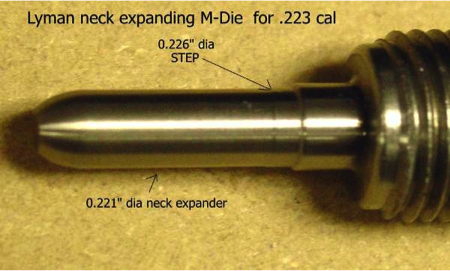
Below a .223 Lyman type "M" expander and with jacketed bullets if you bump the case mouth onto the .226 section of the expander the case mouth will end up .001 larger than bullet diameter. Starting the bullet straight into the case mouth reduces bullet runout by centering the bullet in the seater plug preventing bullet tilt.

ohIUcpd.png


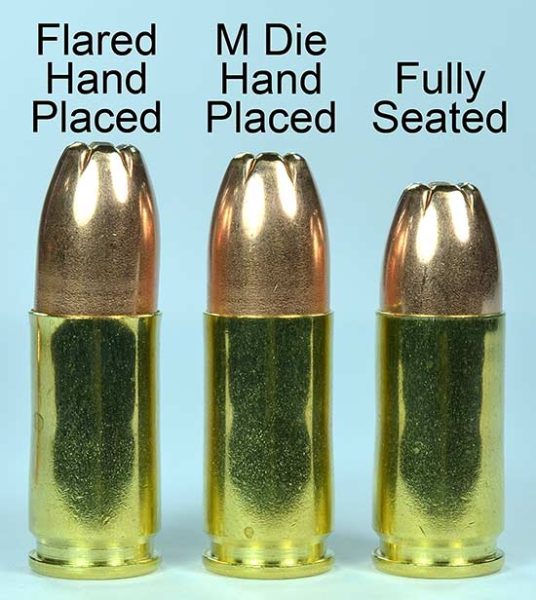
Below the same applies to pistol cases and the type "M" expander allows the bullet to be started into the case by hand.

vwgkeH3.jpg


RCBS Chamfer Tool VLD (Very Low Drag)

VLD_Deburring_Tool_Trim_Mate_1945.jpg


Last edited:

It happened to me before when I started to reload my rifle cartridge. I found out that I had too much neck tension with new brass. Using expender mandrel dies to to open up your case mouth properly and chamfering the case mouth with VLD style chamfer tool will eliminate this problem. Neck turn the new brass to uniform neck wall thickness will help to improve even better.

Zane
 
Vld chamfer tool is the ticket. I’ve yet to find an inside/outside tool that does both well though. I end up using the Lyman tool for the inside and the double ended rcbs for the outside. Admittedly, I haven’t tried a bunch of them.
 
First you do not use a mandrel ..a mandrel is made to uniform the inside of neck - push high spot out - to allow outside neck turning.
If you do not turn your neck..forget it. If you want to control neck tension use a bushing die. I use Redding competition die- bushing die with a carbide floating inside neck ball and my TIR on loaded rounds end up to .001 and below.
Do not flare the neck - this is only needed if you load lead bullet. (We are talking rifle here } and the very good advise of using a Vld chamfer tool if you use vld bullet.

My guess is that your shaving come from using a mandrel...improper use of your resizing die and not enough chamfering or none.
 
Last edited:

First you do not use a mandrel ..a mandrel is made to uniform the inside of neck - push high spot out - to allow outside neck turning.
If you do not turn your neck..forget it. If you want to control neck tension use a bushing die. I use Redding competition die- bushing die with a carbide floating inside neck ball and my TIR on loaded rounds end up to .001 and below.
Do not flare the neck - this is only needed if you load lead bullet. (We are talking rifle here } and the very good advise of using a Vld chamfer tool if you use vld bullet.

My guess is that your shaving come from using a mandrel...improper use of your resizing die and not enough chamfering or none.

I disagree with most of what your saying

I have lots of full length bushing dies, there the worst option in my opinion.

Multiple full length sizing all with the necks custom honed is far superior I feel.

But I still prefer to buy just one full length sizing die and take off the expander ball than inside neck size on the way in with a mandril rather than on the way out with an expander ball.

We could probably argue about this all day. So I will respectfully agree to disagree.

PS it doesn't matter if I use the custom honed full length dies, or the full length bushing dies, or the mandrel neck sizing method. I get small amounts of copper coming off the bullet when seating them no matter what. I bet most people do but just don't ever notice because they are not as fussy as myselfe.
 
Last edited:

I disagree with most of what your saying

I have lots of full length bushing dies, there the worst option in my opinion.

Multiple full length sizing all with the necks custom honed is far superior I feel.

But I still prefer to buy just one full length sizing die and take off the expander ball than inside neck size on the way in with a mandril rather than on the way out with an expander ball.

We could probably argue about this all day. So I will respectfully agree to disagree.

PS it doesn't matter if I use the custom honed full length dies, or the full length bushing dies, or the mandrel neck sizing method. I get small amounts of copper coming off the bullet when seating them no matter what. I bet most people do but just don't ever notice because they are not as fussy as myselfe.

My pulled bullets show no shaving at all. Obviously there is something wrong in the process or in the tools used.There is no shaving on or around my press or load after seating bullets.if you are shaving bullets - all that money you put into them goes trough the window. I think we are all fussy about our precision handloads ! Lol !
 
Last edited:

Send me some of your loaded ammo I'll find all your copper shaving for you.

Anyways,

I think multiple people have already confirmed my suspicion and answered the question.

Many have suggested the VLD chamfer tool. Seems like others have noticed the same thing and easily solved it by changing one simple inexpensive tool.

That makes more sense to me than saying that thousands of dollars of reloading equipment is all no good
 
I use half of a chainsaw file(it broke in half when I dropped it on my garage floor) to slightly bevel the edge of each case mouth.It works great??? If this is bad, someone tell me because I am very new to rifle reloading.
 
1-Annealing. If your brass has been fired many times, it gets hard and tend to spring back under specs. Hard brass will not expand gently around the soft copper jacket.
2-VLD chamfer tool.

Nerver had any shavings after that.
 
Back
Top Bottom