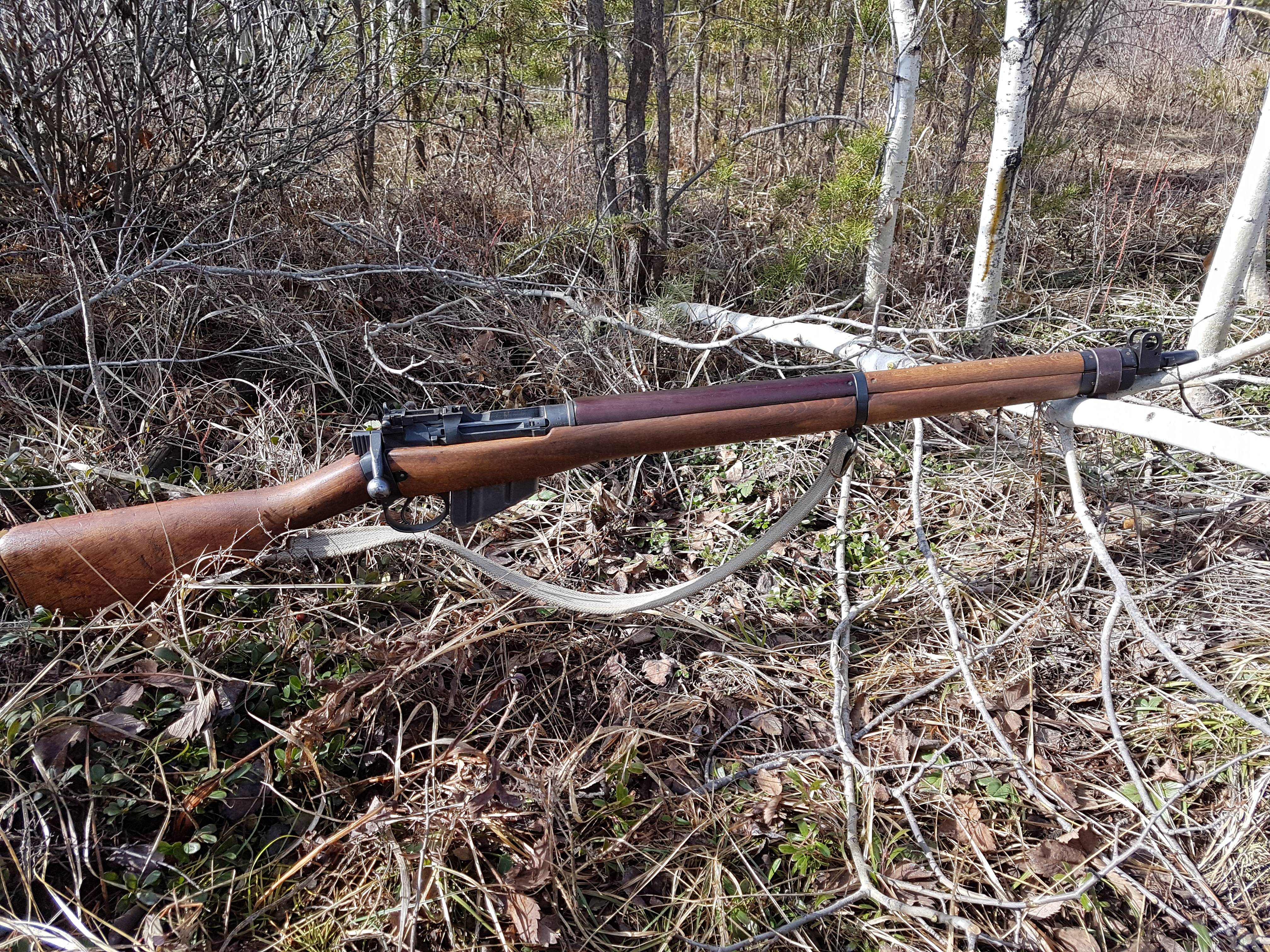
"Correcting" Mismatched milsurps? Opinions.

LeeEnfieldNo.4_mk1

CGN Ultra frequent flyer
Rating - 100%
28   0   0
Location
Alberta
Just curious to what people opinions are to "correcting" mismatched milsurps. By which i mean a milsurp that has an inncorerect part for the make or year.

For example, a Long Branch rifle that has mostly long branch parts but has one or more non-long branch parts such as barrel bands and such. would it be reasonable to replace the parts with correct parts?

A particular example is a '41 LB i have that has an incorrect front sight protector, I happen to have in my parts bin a LB marked protector to through on.

There is pretty much no way of telling if the part was put on my arsenal, or at one point it was replaced by a previous owner.

Thoughts?
 
It depends, if you want a collector firearm, I would do it. For a "shooter", I wouldn't bother. If you already have the correct part, then sure, exchange it.
 
Sure why not, if it floats your boat, I see nothing wrong with "tweaking" some parts. Since you have a properly marked part handy, might as well do it. Not sure what purists might think, but I am not one of them.
 
Its just worth less in my opinion. If you are going for the look and feel then who cares? If you want an everything matching gun you will have to pay for that cool factor

Here is mine. Can you tell what parts are English 1943?

Jzkofk4.jpg


The answer is the butt stock is a savage, the hand guards are date 1967 and the dark hand guard is unmarked. Also the bolt does not match the receiver. The middle band is also savage marked, the other two bands are unmarked

I don't care, it looks and feel right so close enough. The rifle cost me 100 and I bought about 100-120 worth of parts on it. Can't get those prices any more sadly. I restored this one right before the parts became insanely priced
 
In your case you describe exchanging a non original part with another, more correct, also non original part. You haven’t really changed anything about the gun.
I only have problems when fraudulent parts etc. are used with the intention of misrepresenting the value of the gun. In your case you aren’t really changing the value of the gun.
Eg. If you made a punch and stamped LB on your sight, that would make pinky pout.
 
"Correcting" is worse than bubba to me. Bubba is at least honest in what he has done. "Correcting" is destroying the actual history of the firearm. Those parts that were from other places were likely replaced by a Armourer and is a mark of service. Modifying the actual history to what the "correct" history is means you now have a rifle which is not correct in anyway. The rifle was only factory correct once in its life, after that point whatever was done in service is what was correct. Ultimately its your property but that's my thoughts on the subject.
 
Some guns only ever came to market mismatched/altered, as said above many changes were often made to a firearm in it's service history. More than one firearm has been ruined by well meaning corrections. Some field alterations in particular have been written off as "bubba"

Coming across an all matching or "correctly" outfitted example would actually flag a firearm as "faked" in such circumstances.
 
The military did not worry about the factory that made the parts when they serviced/repaired rifles. Ernie Pyle wrote a terrific story about field repairs. Wish I could find it.

Why would you take an honest veteran and #### it up to look like a home guard safe queen?
 
Great thread, here is my tuppence worth. This is a topic about which I have thought long and hard. I often find myself with this same dilemma.

Let me tell you about one rifle that I 'restored' and the epiphany that came with it.

I enjoy tinkering with older Lee Metfords and Enfields. I picked up a nice Enfield made long Lee that had done a tour of duty with a local hunt camp and had been used for hunting and plinking for generations. The bore had been kept clean and oiled and overall, it just needed a little help in the woodwork department.

Around the turn of the last century, if a factory did repair work, on completion, it would be inspected and stamped with a factory inspection marking and a two digit date. Some rifles read like a book where they had been back and forth getting repairs and upgrades.

On this particular rifle, I read all the markings and I found several BR inspector stamps and adjacent dates stamped into the left butt socket. This suggested to me that it had been returned to the Birmingham Repair facility (Sparkbrook) for work. I checked it out and found that the barrel bands, rear volley arm and back sight leaf had been replaced with BSA and Sparkbrook flavoured items. The sights had been updated for Mk.VII ammo and the throat in the barrel's chamber had been updated for the pointy bullet.
I rummaged around in the bins and found Enfield marked parts with acceptance stamps from the era of the rifle. I switched them out and now I had an Enfield rifle with all Enfield parts mounted. Yes, well done I thought, I put it back to how it was when it left the factory.

It then dawned on me as to what I had just done. When I first got the rifle and was reading the markings, I could tell that it had been factory repaired and where they had been working on that rifle. I could tell as to what they had done to it.
What I had just done was to remove this evidence, so now the next owner will take a look at the BR factory markings and wonder why it was there and what had been done. I had just destroyed much evidence of its history. So I put everything back to the way I found it.

RSAF Enfield actually had a parts pool to which all manufacturers would ship batches of parts. Then when there was a shortage, any factory could draw what it needed from the pool to keep production going. Being on site, Enfield was constantly dipping into it to keep their production flowing. I note that many, if not most Enfield made long Lee rifles have BSA marked trigger guards (go take a look). Probably drawn from the pool and factory fitted rather than a later replacement.

So even factory fresh rifles could be a mix match of manufacturers' parts. Long Branch and Savage shared their resources too, so a mix match can be 'correct'.

I get it about switching out parts to put everything into the same livery, I really do. My OCD often kicks in and I have a hard time resisting.
If I build something from parts or restore a cut up sporter, then no problems, whatever fits and works is good for me, it aint a collector piece. But a complete rifle that comes to me in 'as in service' configuration now stays that way. I have learnt to live with it.

You have no way of telling if your parts were switched out in service or by Farmer Brown. So in this case, I would say switch them if it makes you warm and fuzzy when you take the rifle out to play. Otherwise, leave it be. It is quite 'correct' as is.

If I do come across an all one brand of parts rifle, it makes me suspicious and I look closer at it. Having restored and cleaned many antique rifles, I can usually tell if somebody has been 'improving' something.

Read some of the threads about M1 Garrand and M1 Carbine collectors. Oh my goodness!! Some of them are quite anal about having all matching parts on their rifle. Which I find ironic as the factories assembled with mixed parts at the get go.

 
Quite a bit of good info. I was leaning more towards keeping as is, as it very well could have been put on my the military.


The original plan was to swap the part out but keep it labeled in a separate bag where it came from, that way if I had a change of heart I could swap them back.

But I understand the argument that every different part is a chapter in the rifle history.
 
back when I did up a couple enfield sporters back to full wood I tried to keep all the parts factory correct.

unless its one of the post war Mk2 or '50s longbranch chances are that something will be not matching.
 
Back
Top Bottom