Custom Revolvers

Boomer

CGN Ultra frequent flyer
Uber Super GunNutz
Rating - 100%
21   0   0
Seyfried13.jpg


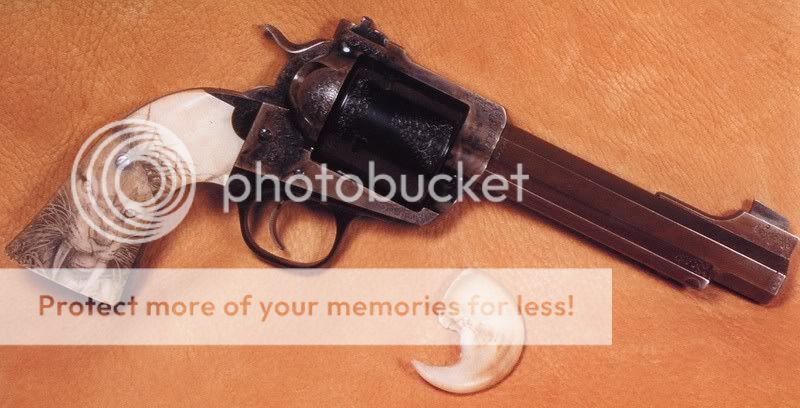
So OK, I’m not going to spring for a gun this ornate, but for those of us that carry a revolver for serious work, the custom makers produce some very interesting pieces. They can also relieve you of some of that pesky money that is needlessly weighing down your jeans. While excess coin has never been one of my problems, I did need to send my Ruger 3 screw SBH out for some tweaking, and decided that if it was going to be out anyway why not make some improvements at the same time.

In order to determine if a change would indeed be an improvement I needed to look critically at this gun and see what it’s weaknesses were. The next step would be to address the specific weakness and work out solutions to the problems.

Starting with the simple stuff I needed to replace the damaged rear sight, and a broken grip panel. Attention had to be given to the lockwork because the gun was tying up. I also wanted to get a durable coating which could stand up to prolonged holster wwar and being exposed to the elements. I would also want a lanyard ring. Simple and straight forward right? Well, it would of been except about this time I received a copy of “The Custom Revolver” by Hamilton Bowen. Bowen built the Seyfried #13 in the pic.

First problem the gunsmith encountered was that the lock work was badly worn and would need replacing. Ruger told my guy they no longer made 3 screw lockwork for the SBH, and he would have to send the gun out to a Ruger warranty shop and have it converted to the New Model. Oh no - not my gun your not going to convert - I want that 3 screw lock work - that’s why I bought that gun! I told him to order the lock work for the Ruger Old Army which still uses the original 3 screw lock work.

Before the gun was sent out I ordered a Rough Country rear sight from Bowen, to replace the factory sight. The blade flew off from recoil, so it made sense to me to get the toughest rear sight I could find. The installation instructions said that the sight was at it’s strongest when it was screwed down in the lowest position. This I did, and with the aid of some red Loctite made sure it would stay there.

Now the gunsmith would have to install a new front sight and regulate it to the loads I would use. I wanted a baughman style vertical face on that front sight with a brass insert. I discovered from the front sight on my .375 that a brass sight produces good contrast to the target regardless of color. It appears black against white and white against black. The top of the sight would have to be steel because brass would be worn too quickly from holster wear, so an insert was the answer.

With durability in mind I ordered a set of black micarta grips from Lett grips. I didn’t get the grips until the gun had been sent out, so I forwarded them in case some minor fitting was required.

By now I was well into the chapters on the Ruger Blackhawks in Bowen’s book, and decided there were some must haves. A locking screw in the base pin, while not handsome, is recoil proof. An 11 degree forcing cone, (Taylor Throat) makes the bullet’s entry into the barrel from the cylinder throat more gentle, resulting in better accuracy. A black powder chamfer is the machining of a chamfer to the front edge of the cylinder. The purpose, aside from a nice look, is reduced holster wear. I had originally planned on a recessed crown but I changed my mind and will stay with the factory crown. One part of the factory design which would have to go was the hook at the bottom of the square trigger guard. I considered making the guard round, but I like the look of the square back, so I just had that knuckle banging hook ground away.

All that was left now was to choose the type and color of coating. The gunsmith suggested I go with Duracoat as one of the most resilient coatings available, and that I should go to Lauer Weaponry's web site to pic a color. The first attempt was dismal - let's just say the color I picked was not the color I saw on Lauer web page. A color blend resulting in a dark blue shade was finally chosen.

All that is left now is the waiting - for you too because I won't post pics until it's back home. :D
 
Last edited:
Dan, you bring up a point which interests me. I see that lots of folks prefer the Bisley grip to the traditional western grip on big powered revolvers. I've never had a Bisley grip in my hand, but I would of thought that the recoil would be straight back into the web of the hand and therefore be less comfortable than one that allows the recoil to torque the gun through your grip. Am I wrong?
 
That's Seyfried's gun! I read the article on it years ago, awesome gun. If I remember correctly the grips are ancient mamoth or walrus ivory. The other side has a pic of some hunting goddess. I think it's chambered in .475. Barrel is damascus steel. Appprently he took an antelope at 270yds. or there abouts with it.
 
Boomer, when the recoil level gets high enough, having the handle roll back into your palm is not a pleasant sensation (bottom of the hammer where it goes into the frame can be driven into your hand, ow!) . The Bisley handles it (or more accurately, transfers the recoil pulse into your hand) in such a fashion as to lessen the felt recoil. More straight back into your hand. The twisting plow handle just doesn't dissipate enough recoil (remember, it's actually the drag in your hand that's absorbing some of that energy) for the genuinely big revolver calibers. FWIW - dan
 
Just a note on the Bisley grip. I find them better in recoil than the traditional single action grips. Most of Linebaugh's and Bowen's big bore revolvers use the Bisley grip. Also note that Freedom arms followed closely the curve of the original Bisley grip on their Casulls. It is a more comfortable and controllable grip shape on heavy recoilling revolvers, at least that is what most people using these things say and I agree from my own experience. I use a few .454s and have for nearly 20 years, I would really like to get a Freedom Arms .475 Linebaugh someday.
I have handled but not shot a few of John Linebaugh's revolvers as well as a few made by Hamilton Bowen. They were all very impressive five shooters with Bisley grips. The Linebaughs seem made for hard work and the Bowens more nicely finshed and fitted, though basically to the same design.
 
Last edited:

I very nearly went the Freedom Arms .475 Linebaugh route, but at the time the $3000.00+ price tag was just too tough to justify. Someday though. I priced out getting my SBH rebuilt to .475, and a guy might as well just buy the Freedom Arms gun.
 
The barrel on the Siefried gun is sleeved in damascus steel, it is not all damascus. I have the article here somewhere. He commisioned it when he was employed by Peterson publishing. He was fired by them, then went to work for Wolfe publishing. He was then fired by them. Apparently he is to honest to be a writer for most gunzines.

He is the best writer in the buissness, and has a great varity of experience and interests. He was IPSC world champion before IPSC became the shooting worlds version of a ### pride parade. He has been a white hunter in Africa, a rancher in Colorado, ...

He also does a lot of his own gunsmithing, makes some of his own bullet molds and is a big proponent of Hollywood reloading presses.

I wish he would write a book or three, including a compilation of his past writings.
 
custom gun

+2.

Correect. I also read that article many years ago. Ross went on to take his first game with this new gun in hard winter conditions in Montana somewhere.
He shot a pronghorn or something similar that was bedded in a pile of snow at some fair distance if I recall correctly.

He is in my opinion the direct gun cultural heir to Elmer Keith. I used to wait for his monthy writings in gunzine (idem for Keith).
I have had opportunity to talk and write to John Linebaugh who has been also quite instrumental in pushing the .45 Colt.

I had several Bisleys and Freedom guns and the Bisley is an excellent platform to get your dream gun.
With a bit of research you can spot some good guys that can turn excellent big bore customs in Canada. ( been there and done that..... no publicity here).

BB

buckbrush said:
The barrel on the Siefried gun is sleeved in damascus steel, it is not all damascus. I have the article here somewhere. He commisioned it when he was employed by Peterson publishing. He was fired by them, then went to work for Wolfe publishing. He was then fired by them. Apparently he is to honest to be a writer for most gunzines.

He is the best writer in the buissness, and has a great varity of experience and interests. He was IPSC world champion before IPSC became the shooting worlds version of a ### pride parade. He has been a white hunter in Africa, a rancher in Colorado, ...

He also does a lot of his own gunsmithing, makes some of his own bullet molds and is a big proponent of Hollywood reloading presses.

I wish he would write a book or three, including a compilation of his past writings.
 
I agree, we have the talent here. A guy just has to know where to look.

Like you I couldn't get enough of Seyfried's articles. I admit that I got a little frustrated with his apparent inexhaustible supply of cash, although he made up for that with some very down to earth practical advise. He wrote about owning an original .416 Rigby bolt gun that would cycle empties, an O-U .300 H&H built on a Red Label, and those wonderful .475 Linebaugh revolvers. Ross was the first guy I ever heard of shooting a 12" group at 1 mile - I think it was with a .30-378, but it might of been a .338-378.

He was friends with the best men in the industry, Elmer Keith and Jeff Cooper.

Edited to add -

Further to the Damascus barrel on the Seyfried #13 Bisley, this from Bowen's book:

"Certainly the most unique component of the metal work is the barrel. Steve Rollert of Keensburg, Colorado, a skilled knife maker, consented to forge a Damascus blank that was grafted over the barrel liner made from LaBounty stock, resulting in a barrel with an intricately figured pattern-welded exterior and a tough interior that can withstand the violent pressures of the .475 Linebaugh cartridge."
 
Last edited:

Back
Top Bottom