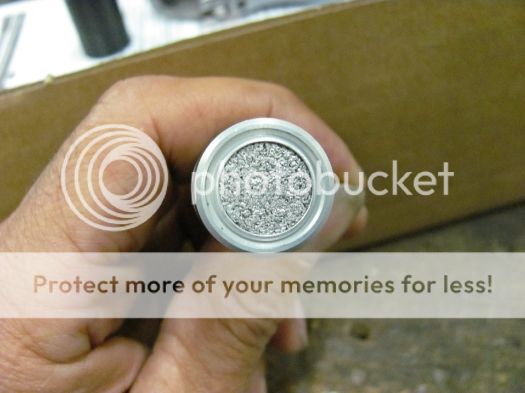






























I have read posts on other forums regarding the exclusive use of a hand pump for filling of PCP guns, and the concerns that moisture could pose the potential for problems.
It was not until I was sent an older Daystate Air Wolf, for repair of a slow leak, that I got to see firsthand what the possible downside could be to dedicated use of a hand pump for filling. Unfortunately, it was not until after I had cleaned up a lot of the parts, that it occurred to me to contact the owner for a bit more info, and it was then confirmed that the gun had been filled pretty much exclusively with a hand pump since new.
As I began dis-assembly, I thought it to be a bit strange that Daystate would use green threadlocker so liberally on so many of the parts - until I realized that it was not threadlocker at all, it was green corrosion residue from the brass parts. At that point I was wishing that I had taken pictures before I cleaned those parts up. Can't go back now.
When I opened the valve body, it was time to reach for the camera. The valve stem seat had a light green ring around it - despite being made of aluminum. It appeared that the green corrosion residue had somehow migrated to the valve seat? Unfortunately, the pics that I took didn't show what I was hoping to, because of the nature of the part. However, after the valve body was cleaned up, and the aluminum bore a little more shiny, I managed to get one decent pic.
Looking at the pic below, three of the arrows point to tiny blackened craters - the beginning of corrosion craters in the aluminum. the lower, left hand arrow points to a telltale abraded ridge where the traces of green corrosion residue was worked between the valve stem seal and the valve face.

This close-up of the valve stem sealing lip shows the slight green coloration, and the abrasion of the sealing lip face (two upper arrows). Under a jeweller's loupe, it almost appears that the seal was seating onto a course grit sandpaper. The two lower arrows point to breaks in the sealing lip, which appear to me to be the result of the stem seating down on hard bits of debris.

A special tool had to be made up to resurface, and polish the valve seat. No more craters, no more abraided ridge.

The valve stem sealing lip has been re-cut and polished as well.

The rest of the seals were all replaced, the gun re-assembled, and the reservoir charged. The gun was then set aside to monitor it for any signs of leaks. After about three weeks, with absolutely no apparent drop in reservoir pressure, the gun was ready to head home.
While this one particular case may not be a truly conclusive test for some folks, it has me thinking that it is probably to the benefit of my PCP airguns that I am just too lazy to be bothered using a hand pump on them.
It was not until I was sent an older Daystate Air Wolf, for repair of a slow leak, that I got to see firsthand what the possible downside could be to dedicated use of a hand pump for filling. Unfortunately, it was not until after I had cleaned up a lot of the parts, that it occurred to me to contact the owner for a bit more info, and it was then confirmed that the gun had been filled pretty much exclusively with a hand pump since new.
As I began dis-assembly, I thought it to be a bit strange that Daystate would use green threadlocker so liberally on so many of the parts - until I realized that it was not threadlocker at all, it was green corrosion residue from the brass parts. At that point I was wishing that I had taken pictures before I cleaned those parts up. Can't go back now.
When I opened the valve body, it was time to reach for the camera. The valve stem seat had a light green ring around it - despite being made of aluminum. It appeared that the green corrosion residue had somehow migrated to the valve seat? Unfortunately, the pics that I took didn't show what I was hoping to, because of the nature of the part. However, after the valve body was cleaned up, and the aluminum bore a little more shiny, I managed to get one decent pic.
Looking at the pic below, three of the arrows point to tiny blackened craters - the beginning of corrosion craters in the aluminum. the lower, left hand arrow points to a telltale abraded ridge where the traces of green corrosion residue was worked between the valve stem seal and the valve face.
This close-up of the valve stem sealing lip shows the slight green coloration, and the abrasion of the sealing lip face (two upper arrows). Under a jeweller's loupe, it almost appears that the seal was seating onto a course grit sandpaper. The two lower arrows point to breaks in the sealing lip, which appear to me to be the result of the stem seating down on hard bits of debris.
A special tool had to be made up to resurface, and polish the valve seat. No more craters, no more abraided ridge.
The valve stem sealing lip has been re-cut and polished as well.
The rest of the seals were all replaced, the gun re-assembled, and the reservoir charged. The gun was then set aside to monitor it for any signs of leaks. After about three weeks, with absolutely no apparent drop in reservoir pressure, the gun was ready to head home.
While this one particular case may not be a truly conclusive test for some folks, it has me thinking that it is probably to the benefit of my PCP airguns that I am just too lazy to be bothered using a hand pump on them.
Last edited: