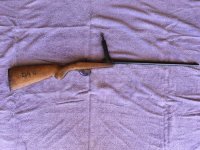
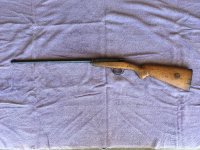
From the research I have done, the DEUTSCHE WERKE Model 1, was a basic, single shot, 22LR rifle manufactured in Erfurt Germany between 1919 and 1939. It has been referred to as a “youth gun”, or “garden gun” and has a rather unique “trap door” breach. I acquired one of these in the late seventies or early eighties (I think). I really have no idea who I got it from. It must have been given to me because I can think of no reason why I would have bought it at the time. It was kind of beaten up and quite rusty on the outside, but the bore looked pretty good. I never fired it and it just stayed in storage until just recently.
Early this year I ran across it while rummaging through some old stuff and the thought crossed my mind that perhaps I should clean it up and see if I could still hit a target with it. I enjoyed rifle range as an Air Cadet many years ago, but didn't have much interest in hunting so I have done very little shooting since. I was able to get the poor old thing cleaned up pretty good and gave it some cold bluing, which turned out reasonably well.
But before I could shoot again I had to get my PAL. That took a while, but I finally got my license and was able to join the local rod and gun club and take the gun out to the range. Almost to my surprise, I was able to hit a target at 20 yards with an acceptable grouping, considering my lack of practice and the fact that this gun is probably 100 years old, perhaps a bit older. But there was a problem. I was getting a lot of misfires.
I'm not a gunsmith, but on closer examination I could see that the firing pin was worn and not making a very good impression on the casing. I could see that the domed tip was not symmetrical and the protrusion was only about 0.025”. I was able to re-shape the tip and file the stop shoulder on the main body of the pin down to increase the protrusion to about 0.035”. I tried it again, but little or no improvement. I examined a bit closer and found that the centre of the contact point of the pin on the casing was about at the outer edge of the rim. That meant that only about half the pin diameter was in actual contact. The impression was only a shallow dimple. Also, the spring looked like it either had been replaced or modified as one of the ends was not finished and had obviously been snipped off. I had doubts if the spring tension was adequate.
Then I noticed something else. The headspace seemed to be about 0.005” too deep, as the rim was recessed into the chamber a bit. Because of the design of the “trap door” breach, there has to be some clearance between the chamber and the breach block, but the combined distance of this and the deeper headspace was about 0.008”.
I reasoned that if I were to flatten the tip of the pin, radius the edge a bit, and increase the protrusion to about 0.043” it should solve my misfire problem. I also put a 0.040” shim behind the spring to give it some more tension. I went to the range today to check it out and shoot some groups to see what I could do. 30 rounds later, not one misfire. The casing impressions were a pretty little half moons, just what I was looking for.
Now, as far as grouping is concerned, it's not great. But having said that, I'm old and out of practice. The gun has non adjustable iron sights, and the weather was not the best. It was blowing 25, gusting 38 KPH on the water. The range is about a mile from shore and in a clearing in heavy woods, but it was still gusty coming from behind and to the left.
I was shooting Norma TAC-22: .22LR, 40 grain LRN, 1083 FPS. The best five shot group I could manage at 25yards was 6.254 MOA. The approximate centre of the group was about 3 1/8” high and 1 1/4” right of the bull.
The best five shot group I could manageat 50 yards was 5.785 MOA. The approximate centre of the group was about 4 1/4” high and 1 1/4” right of the bull.
The 100 yard group was a bit embarrassing. I was shooting at a paper target 13 1/4” high and 10 1/4” wide, which I could barely see. I fired 10 rounds at it, but only 5 found the target, so I used them as a group of 11.47 MOA. The top shot was 6” high and about 1 1/8” to the right. The bottom shot was 5” low and 4 5/8” to the right.
So, in conclusion, I think I'll just try to hone my skills at 25 yards. 50 yards is pretty hard for me to see and 100 is really out of the question. It is a fun little gun to shoot, now that I seem to have the misfires cured, and as a “garden gun” it probably works just fine as designed all these years later.
Early this year I ran across it while rummaging through some old stuff and the thought crossed my mind that perhaps I should clean it up and see if I could still hit a target with it. I enjoyed rifle range as an Air Cadet many years ago, but didn't have much interest in hunting so I have done very little shooting since. I was able to get the poor old thing cleaned up pretty good and gave it some cold bluing, which turned out reasonably well.
But before I could shoot again I had to get my PAL. That took a while, but I finally got my license and was able to join the local rod and gun club and take the gun out to the range. Almost to my surprise, I was able to hit a target at 20 yards with an acceptable grouping, considering my lack of practice and the fact that this gun is probably 100 years old, perhaps a bit older. But there was a problem. I was getting a lot of misfires.
I'm not a gunsmith, but on closer examination I could see that the firing pin was worn and not making a very good impression on the casing. I could see that the domed tip was not symmetrical and the protrusion was only about 0.025”. I was able to re-shape the tip and file the stop shoulder on the main body of the pin down to increase the protrusion to about 0.035”. I tried it again, but little or no improvement. I examined a bit closer and found that the centre of the contact point of the pin on the casing was about at the outer edge of the rim. That meant that only about half the pin diameter was in actual contact. The impression was only a shallow dimple. Also, the spring looked like it either had been replaced or modified as one of the ends was not finished and had obviously been snipped off. I had doubts if the spring tension was adequate.
Then I noticed something else. The headspace seemed to be about 0.005” too deep, as the rim was recessed into the chamber a bit. Because of the design of the “trap door” breach, there has to be some clearance between the chamber and the breach block, but the combined distance of this and the deeper headspace was about 0.008”.
I reasoned that if I were to flatten the tip of the pin, radius the edge a bit, and increase the protrusion to about 0.043” it should solve my misfire problem. I also put a 0.040” shim behind the spring to give it some more tension. I went to the range today to check it out and shoot some groups to see what I could do. 30 rounds later, not one misfire. The casing impressions were a pretty little half moons, just what I was looking for.
Now, as far as grouping is concerned, it's not great. But having said that, I'm old and out of practice. The gun has non adjustable iron sights, and the weather was not the best. It was blowing 25, gusting 38 KPH on the water. The range is about a mile from shore and in a clearing in heavy woods, but it was still gusty coming from behind and to the left.
I was shooting Norma TAC-22: .22LR, 40 grain LRN, 1083 FPS. The best five shot group I could manage at 25yards was 6.254 MOA. The approximate centre of the group was about 3 1/8” high and 1 1/4” right of the bull.
The best five shot group I could manageat 50 yards was 5.785 MOA. The approximate centre of the group was about 4 1/4” high and 1 1/4” right of the bull.
The 100 yard group was a bit embarrassing. I was shooting at a paper target 13 1/4” high and 10 1/4” wide, which I could barely see. I fired 10 rounds at it, but only 5 found the target, so I used them as a group of 11.47 MOA. The top shot was 6” high and about 1 1/8” to the right. The bottom shot was 5” low and 4 5/8” to the right.
So, in conclusion, I think I'll just try to hone my skills at 25 yards. 50 yards is pretty hard for me to see and 100 is really out of the question. It is a fun little gun to shoot, now that I seem to have the misfires cured, and as a “garden gun” it probably works just fine as designed all these years later.