












































You are using an out of date browser. It may not display this or other websites correctly.
You should upgrade or use an alternative browser.
You should upgrade or use an alternative browser.
Dewat Thompson
- Thread starter Don Kael
- Start date
- Status
- Not open for further replies.


I am one of those disgusting, shocking "purists" and DEWATS bother me.
Every gun DEWATTED is one less left in active condition, one less operational historical artifact turned into one more paperweight.
Some of those Airsoft guns are really good-looking. I actually got foold by an Airsoft Luger a couple of years ago..... and I OWN thee Lugers, have had one of them for 50 years now!
SOME DAY, we MIGHT get the laws in this authoritarian semi-dictatorship of ours made a little more SANE.
These things were Restricted in 1934; that is 79 years ago. So far there have been ZERO crimes of violence with legally-owned active ones. Yes, the Union Nationale used to use them for election engineering and Lortie used one in the National Assembly and the QPP have machine-gunned dangerous Painters with them, but those all were Government guns or LEGALLY USED BY THE AUTHORITIES, so they don't count. So far, CITIZENS have never used one for a violent purpose.
Hammer THIS home loud and long and we might get some action.
Until then, let's try not to be a market for the Welders-uppers and the Chop-them-all-in-half-Dofasco-needs-the-Scrap crowd.
Every gun DEWATTED is one less left in active condition, one less operational historical artifact turned into one more paperweight.
Some of those Airsoft guns are really good-looking. I actually got foold by an Airsoft Luger a couple of years ago..... and I OWN thee Lugers, have had one of them for 50 years now!
SOME DAY, we MIGHT get the laws in this authoritarian semi-dictatorship of ours made a little more SANE.
These things were Restricted in 1934; that is 79 years ago. So far there have been ZERO crimes of violence with legally-owned active ones. Yes, the Union Nationale used to use them for election engineering and Lortie used one in the National Assembly and the QPP have machine-gunned dangerous Painters with them, but those all were Government guns or LEGALLY USED BY THE AUTHORITIES, so they don't count. So far, CITIZENS have never used one for a violent purpose.
Hammer THIS home loud and long and we might get some action.
Until then, let's try not to be a market for the Welders-uppers and the Chop-them-all-in-half-Dofasco-needs-the-Scrap crowd.

There is no harm in saving a beautiful piece of history from the smelter by having it deactivated. Given the two options, I know I would rather see it intact where people can appreciate it. Of course it isn't a first option, but every piece saved from destruction - one way or another- is a small victory.

Someday, if reasonable people take over from the sheep, maybe there will be Orders-in-Council to "Rewat" the classics... so don't throw out that welded-up chunk of metal 
(Why yes, the sky is a beautiful colour over in my world, why? )
(Why yes, the sky is a beautiful colour over in my world, why?
)There's a M1A1 at Collector's Source for the low, low price of $2500.
h t t p://www.collectorssource.com/deactivated-firearms/thompson-m1-submachine-gun-deactivated.html
I die a little every time I go to that website and look at the deactivated firearms and their prices. Thanks for making me go through that horror one more time. This is what i get for being helpful....
The horror......the horror......someone hold me please and tell me it was all a bad, bad dream and that everything is going to be alright....
h t t p://www.collectorssource.com/deactivated-firearms/thompson-m1-submachine-gun-deactivated.html
I die a little every time I go to that website and look at the deactivated firearms and their prices. Thanks for making me go through that horror one more time. This is what i get for being helpful....
The horror......the horror......someone hold me please and tell me it was all a bad, bad dream and that everything is going to be alright....

I got into an argument with a "gentleman" over his dewatt Kar98k (a RC). He laughed when I figured out she was a dewatt. Just for the fun of it, I asked him how much he wanted for it and he replied with $800. I laughed back at him and told him I had a working one for half that price at the time and walked away.

I was speaking of full-autos in general.
Yes, you are right: Lortie used a CAF Sterling.
Union Nationale used to "borrow" Stens from the armouries.
What the SQ used on those poor Painters I do not know.
The important point is that all of those were ILLEGAL or GOVERNMENT uses.
There has never been a crime of violence committed in Canada with a legally-owned full-auto.
WE say that that is because we are, essentially, law-abiding folks.
THEY say it is proof that "gun control works".
Gun Control only works on LAW-ABIDING folks. THAT is the point that they miss, always.
Yes, you are right: Lortie used a CAF Sterling.
Union Nationale used to "borrow" Stens from the armouries.
What the SQ used on those poor Painters I do not know.
The important point is that all of those were ILLEGAL or GOVERNMENT uses.
There has never been a crime of violence committed in Canada with a legally-owned full-auto.
WE say that that is because we are, essentially, law-abiding folks.
THEY say it is proof that "gun control works".
Gun Control only works on LAW-ABIDING folks. THAT is the point that they miss, always.
In the end, it was in part public perception of those incidents which ended up with us having no full-auto licences issued since 1978.
A good chunk of our history, and a good chunk of our hobby, went down the drain with that.
I do wish, also, that the "Freetard" slagging could stop. I have made it clear, time and again, that I am not a Freeman of the Land. I consider their approach to be misguided and counterproductive, not even to mention their nonsensible punctuation.
I am an HISTORIAN. I see it as my job to get things RIGHT by leaving all the propaganda out and by careful evaluation of the facts which are known. Conjecture comes a long way down the line and, for the most part, I consider conjecture to be a part of the fiction which I write. It does not belong here, so it does not show up here. It's not MY fault that some folk haven't bothered to learn the Constitution of the country they are supposed to be protecting. The facts are available and I am willing to make available a list of reputable, public sources for this factual material. Any conclusions drawn from this material must be subject to an appreciation of Canadian history and of the historical process as well as of the pertinent legal principles involved.
Further, nobody was trying to "insult the police who shot some bank robbers 40 years ago". The robbers escaped because the SQ were shooting up a motel room across the hall in which there were a couple of house painters who were trying to get home for Christmas. There you have the FACTS which I did not put in previously.... and none of it is insulting to anyone.
**************************************************
Now, where were we?
Another aspect of the demise of FAs was the creation of the CA class. Originally, I got a ruling from the Attorney General of Newfoundland and Labrador to the effect that a FA which was permanently converted to another class of firearm, as to a Semi-auto or a Manually-Operated type, would no longer be subject to the restrictions which applied to the original FA type. The prime stipulation was that the conversion had to be of a permanent nature. Thus, I was able to gain approval in principle for a semi-auto conversion unit for the MG-42, SA conversions for the MG-34 and 3 different conversions for the Sten and similar open-bolt SMGs. With this approved, in writing, from one Attorney-General, the others looked at the situation more carefully, concurred and the rush was on to convert much of the available stock of unsalable full-autos to semi-auto or manually-operated status which, incidentally, removed them from the requirement to be registered at that time.
ALL of these conversions were rendered academic at best when the Federal Government revamped the laws yet again, bringing in, Restricting and then Prohibiting the CA class, exactly as they had promised they would not.
Many conversions to CA status involve making or adding new parts to an existing design, but a few involve precisely the opposite: REMOVING parts of a FA until all you are left with is an inherently-semi-auto firearm. But to do this you have to start with a design which is, in its simplest form, semi-auto..... and there are not very many of those because AUTOMATIC fire seems to be for many designs the default condition, so you have to add parts to make one SA.
The inherently-SA type is a bit of an anomaly and only a couple of designs come to mind, of which the H&R Reising likely is the best single example.
The gun was designed by Eugene Reising and was seen at one point to be a very real advantage to an industrialised nation. Much of the work on the gun could be done by automatic machine tools and the raw materials were off-the-shelf standard sizes. Only a single machine cut in the action was at all difficult and there were only a few parts necessitating the production of dies which were at all complex. The result was a robust little gun chambered for the .45ACP cartridge, available in 3 models with a huge amount of interchangeability among them.
Standard was the Model 50, a selective-fire carbine-style gun which looked like a very bulky .22 with a short barrel, the Model 55, which was the same mechanism on a Mickey-Mouse folding stock.... and the Model 60, which was a straight semi-auto and was the SIMPLEST of the lot. The Model 60 was sold for home and industrial protection and likely would have made a fun little sporting gun. It was "voluntarily" removed from production after the BATT (forerunner of the later BATF and more-modern ATF and most-modern ATFE) leaned on H&R rather heavily. Their complaint was that the gun was "too easily" converted to a taxable FA status, despite the fact that this would require welding-in entire new assemblies of unavailable (because of being permanent parts of the Receiver) parts. Guns came from the factory with built-on compensators and generally were equipped with a 20-round double-into-single-column magazine. The 12-round magazine intended for the Model 60 turned up on the Canadian market when the last serving Reisings were surplussed by Venezuela some years ago,
The Model 50 and 55 were used to an extent by the US military in the Pacific campaign in its earlier stages and it is here that the gun showed its single flaw: it was vulnerable to sloppy maintenance procedures. The Bolt of the Reising was carefully-fitted to an individual Receiver, but the receiver was numbered and the Bolt was not. The corrosive ammunition of the period (nearly all US military ammunition was corrosive up to 1953) necessitated cleaning the gun after firing with hot water. The easy way for the troops to do this was to boil up a huge kettle of water and throw in all the parts, then pick them out and dry them off and reassemble them. This worked fine, the Reising being a completely-interchangeable gun..... except for the critical Bolt..... and here a PROBLEM raised its ugly head. If the wrong Bolt were to be assembled to a given receiver, several things could happen:
1. It could headspace and function just fine, or
2. The Bolt could be too loose, giving excess headspace and possible functioning issues, or
3. The Bolt could be too tight, in which case even chambering a cartridge could become difficult or impossible. If the round were brass-cased, it could jam up into the leade and become nearly impossible to extract; it it were steel, the situation was even worse. With a jammed-in round, breaking the Extractor was a distinct possibility and this, because of the Reising's DELAYED-Blowback system of operation, could compromise reliability to a huge degree.
This final condition, especially, gave the Reising a terrible reputation, even though there was nothing wrong with the GUN. As with the Ross Rifle, the problem was a lack of training in the MEN and, as with the Ross, the Reising paid the price. In the end, the easy-to-make and inexpensive Reising was replaced by the far more expensive and complexly-made Thompson.
There were slightly more than 111,000 Reisings built, about 1/15 the number of Thompsons.
I realise that this has strayed rather far from DEWAT Tommies, but I thought it could be pertinent. At this time, I have access to a couple of CA Reising Model 50s and can provide photos of how the conversion to CA status was done...... if anyone is interested.
A good chunk of our history, and a good chunk of our hobby, went down the drain with that.
I do wish, also, that the "Freetard" slagging could stop. I have made it clear, time and again, that I am not a Freeman of the Land. I consider their approach to be misguided and counterproductive, not even to mention their nonsensible punctuation.
I am an HISTORIAN. I see it as my job to get things RIGHT by leaving all the propaganda out and by careful evaluation of the facts which are known. Conjecture comes a long way down the line and, for the most part, I consider conjecture to be a part of the fiction which I write. It does not belong here, so it does not show up here. It's not MY fault that some folk haven't bothered to learn the Constitution of the country they are supposed to be protecting. The facts are available and I am willing to make available a list of reputable, public sources for this factual material. Any conclusions drawn from this material must be subject to an appreciation of Canadian history and of the historical process as well as of the pertinent legal principles involved.
Further, nobody was trying to "insult the police who shot some bank robbers 40 years ago". The robbers escaped because the SQ were shooting up a motel room across the hall in which there were a couple of house painters who were trying to get home for Christmas. There you have the FACTS which I did not put in previously.... and none of it is insulting to anyone.
**************************************************
Now, where were we?
Another aspect of the demise of FAs was the creation of the CA class. Originally, I got a ruling from the Attorney General of Newfoundland and Labrador to the effect that a FA which was permanently converted to another class of firearm, as to a Semi-auto or a Manually-Operated type, would no longer be subject to the restrictions which applied to the original FA type. The prime stipulation was that the conversion had to be of a permanent nature. Thus, I was able to gain approval in principle for a semi-auto conversion unit for the MG-42, SA conversions for the MG-34 and 3 different conversions for the Sten and similar open-bolt SMGs. With this approved, in writing, from one Attorney-General, the others looked at the situation more carefully, concurred and the rush was on to convert much of the available stock of unsalable full-autos to semi-auto or manually-operated status which, incidentally, removed them from the requirement to be registered at that time.
ALL of these conversions were rendered academic at best when the Federal Government revamped the laws yet again, bringing in, Restricting and then Prohibiting the CA class, exactly as they had promised they would not.
Many conversions to CA status involve making or adding new parts to an existing design, but a few involve precisely the opposite: REMOVING parts of a FA until all you are left with is an inherently-semi-auto firearm. But to do this you have to start with a design which is, in its simplest form, semi-auto..... and there are not very many of those because AUTOMATIC fire seems to be for many designs the default condition, so you have to add parts to make one SA.
The inherently-SA type is a bit of an anomaly and only a couple of designs come to mind, of which the H&R Reising likely is the best single example.
The gun was designed by Eugene Reising and was seen at one point to be a very real advantage to an industrialised nation. Much of the work on the gun could be done by automatic machine tools and the raw materials were off-the-shelf standard sizes. Only a single machine cut in the action was at all difficult and there were only a few parts necessitating the production of dies which were at all complex. The result was a robust little gun chambered for the .45ACP cartridge, available in 3 models with a huge amount of interchangeability among them.
Standard was the Model 50, a selective-fire carbine-style gun which looked like a very bulky .22 with a short barrel, the Model 55, which was the same mechanism on a Mickey-Mouse folding stock.... and the Model 60, which was a straight semi-auto and was the SIMPLEST of the lot. The Model 60 was sold for home and industrial protection and likely would have made a fun little sporting gun. It was "voluntarily" removed from production after the BATT (forerunner of the later BATF and more-modern ATF and most-modern ATFE) leaned on H&R rather heavily. Their complaint was that the gun was "too easily" converted to a taxable FA status, despite the fact that this would require welding-in entire new assemblies of unavailable (because of being permanent parts of the Receiver) parts. Guns came from the factory with built-on compensators and generally were equipped with a 20-round double-into-single-column magazine. The 12-round magazine intended for the Model 60 turned up on the Canadian market when the last serving Reisings were surplussed by Venezuela some years ago,
The Model 50 and 55 were used to an extent by the US military in the Pacific campaign in its earlier stages and it is here that the gun showed its single flaw: it was vulnerable to sloppy maintenance procedures. The Bolt of the Reising was carefully-fitted to an individual Receiver, but the receiver was numbered and the Bolt was not. The corrosive ammunition of the period (nearly all US military ammunition was corrosive up to 1953) necessitated cleaning the gun after firing with hot water. The easy way for the troops to do this was to boil up a huge kettle of water and throw in all the parts, then pick them out and dry them off and reassemble them. This worked fine, the Reising being a completely-interchangeable gun..... except for the critical Bolt..... and here a PROBLEM raised its ugly head. If the wrong Bolt were to be assembled to a given receiver, several things could happen:
1. It could headspace and function just fine, or
2. The Bolt could be too loose, giving excess headspace and possible functioning issues, or
3. The Bolt could be too tight, in which case even chambering a cartridge could become difficult or impossible. If the round were brass-cased, it could jam up into the leade and become nearly impossible to extract; it it were steel, the situation was even worse. With a jammed-in round, breaking the Extractor was a distinct possibility and this, because of the Reising's DELAYED-Blowback system of operation, could compromise reliability to a huge degree.
This final condition, especially, gave the Reising a terrible reputation, even though there was nothing wrong with the GUN. As with the Ross Rifle, the problem was a lack of training in the MEN and, as with the Ross, the Reising paid the price. In the end, the easy-to-make and inexpensive Reising was replaced by the far more expensive and complexly-made Thompson.
There were slightly more than 111,000 Reisings built, about 1/15 the number of Thompsons.
I realise that this has strayed rather far from DEWAT Tommies, but I thought it could be pertinent. At this time, I have access to a couple of CA Reising Model 50s and can provide photos of how the conversion to CA status was done...... if anyone is interested.
Last edited by a moderator:


Manufactured by Savage in January or February 1942- Ordnance Department’s ‘Flaming Bomb’ acceptance stamp, “RLB” (Col. Roy L. Bowlin was the A.I.O. Ordnance inspector “GEG” in a circle (GEG is for George E. Goll, the AO civilian inspector and former driver for General John T. Thompson)


On April 2nd 2005 I paid $1,500 for the M1928A1 Thompson shown above.
It had been deactivated from full auto by the gunsmith that I bought it from.
It is not #### and click but has great markings.
As I had no intention of shooting it...because of our Canadian laws it made sense to me.
I have a number of 12(3) CA smgs and the fact that this Thompson is a Dewat makes little practical difference to me.
David
P.S.
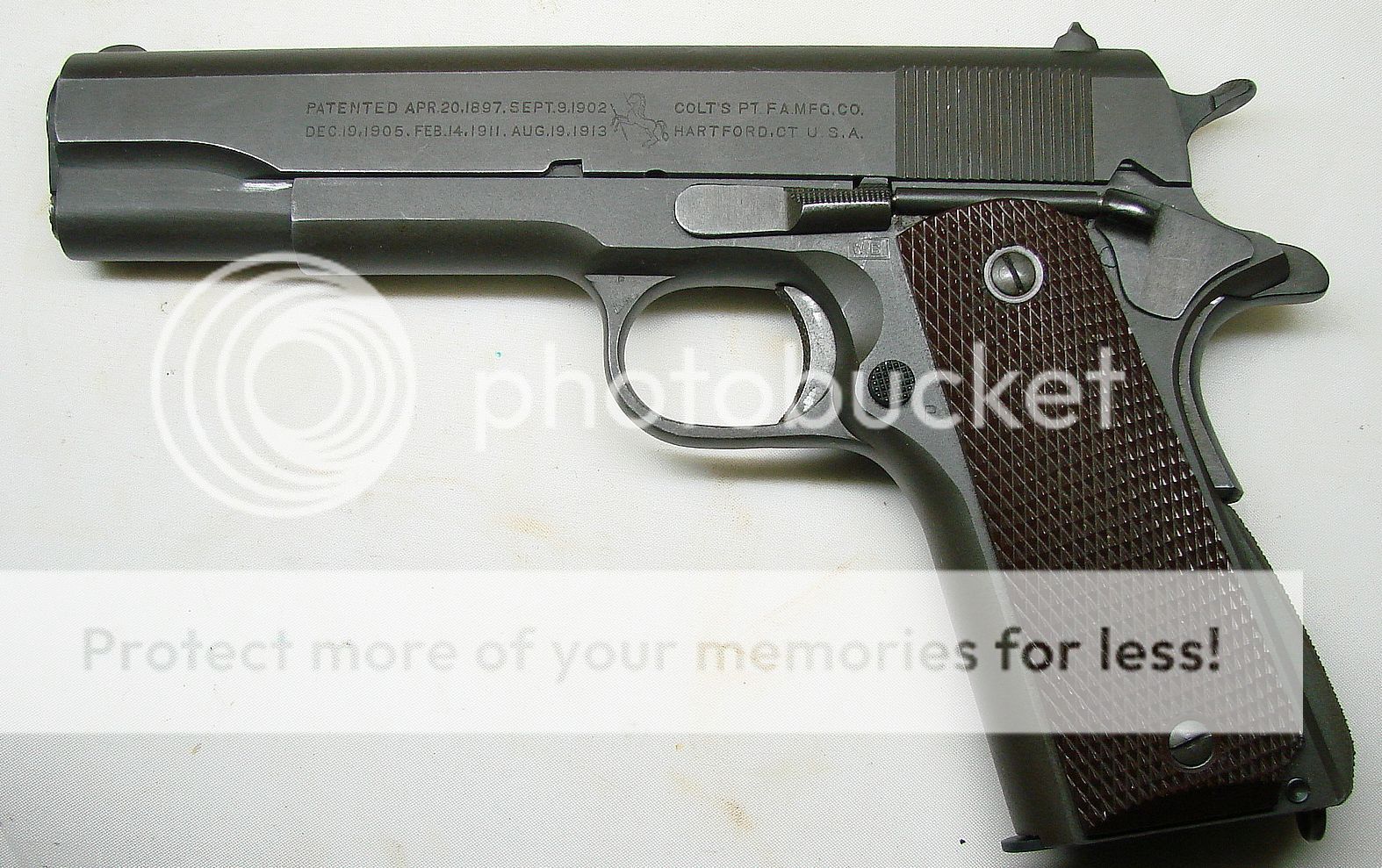
The M1911A1 Colt shown in the last photo was also 1942 manufactured in an early 1943 dated M3 shoulder holster.
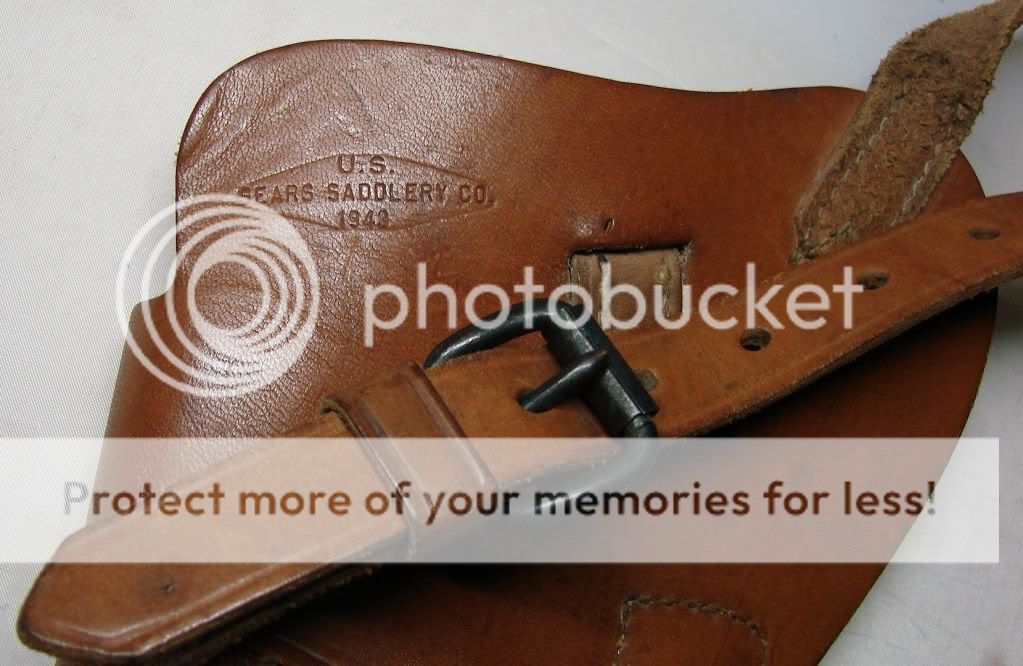
This M1911A1 Colt could have come in this M3 holster.
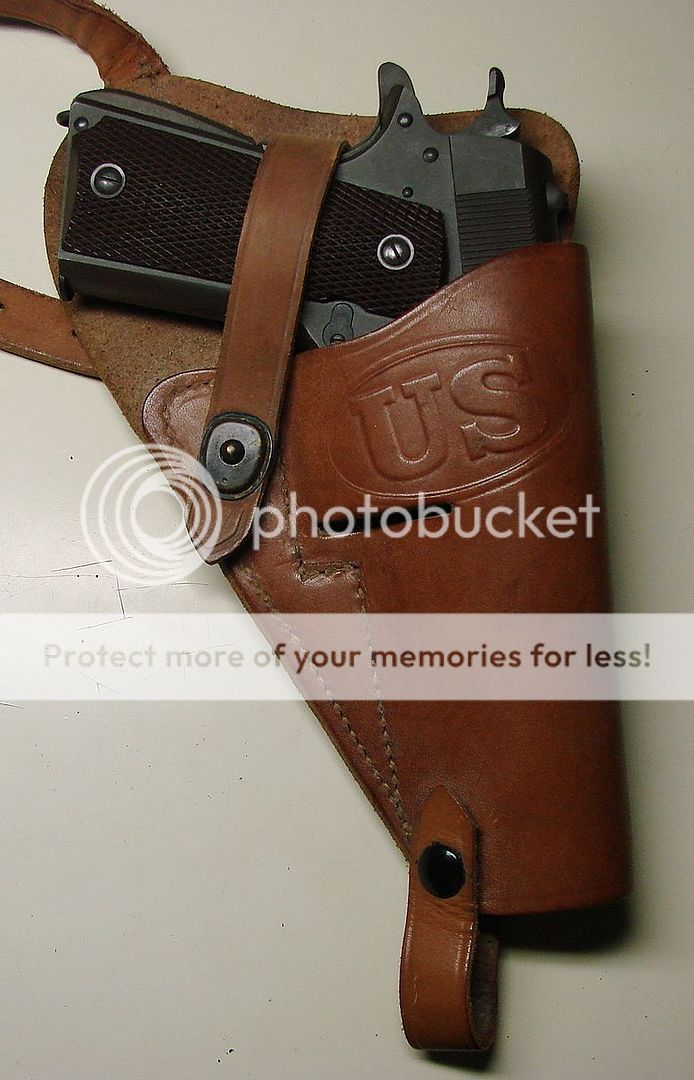
But it it did not....this is the holster that it came in
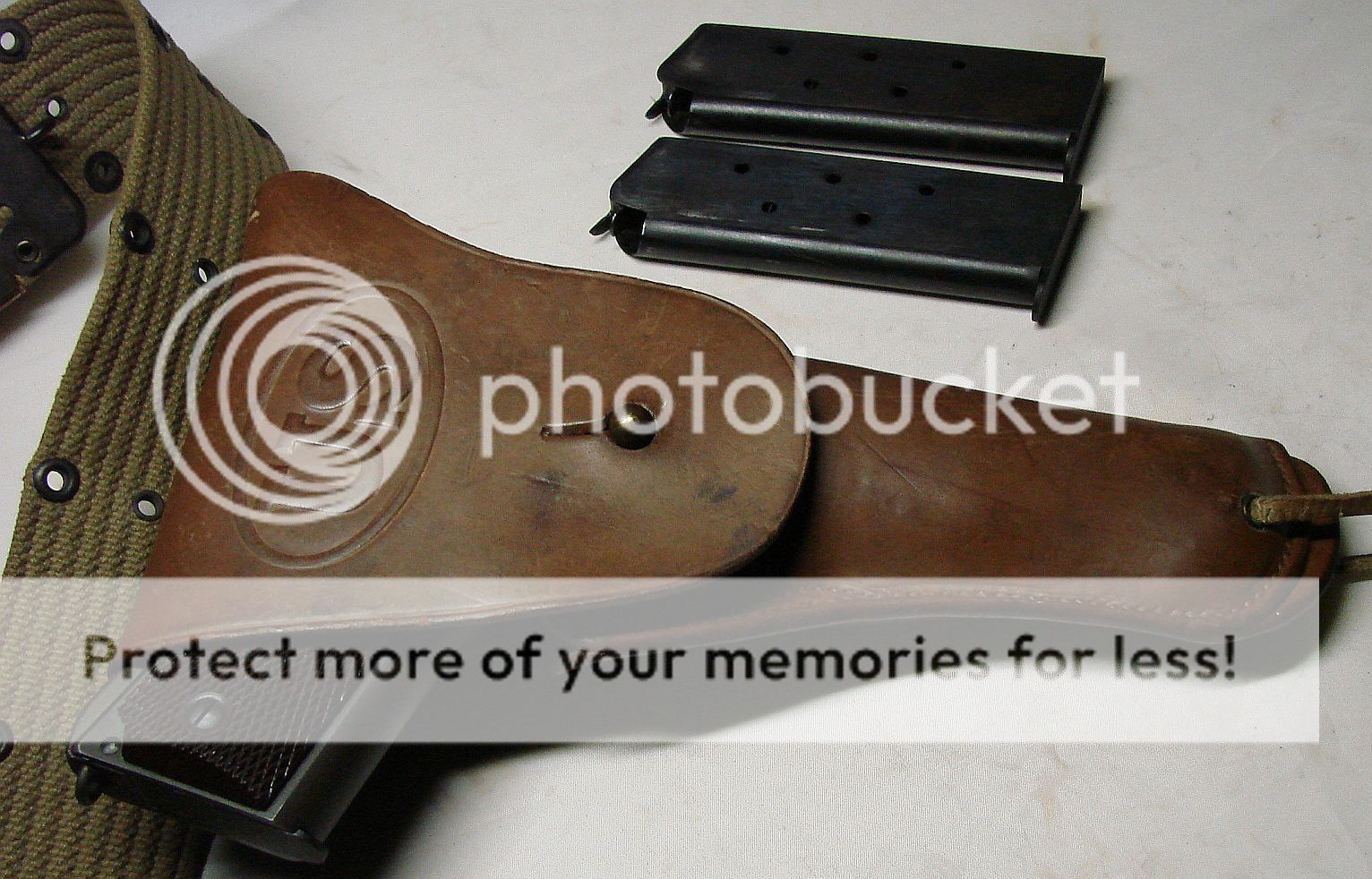
W.B. marked delivered from Colt to Springfield Armory on June 25th 1942.
Last edited:

Drm3m, you are right -it is better to save what you can of our history, rather than have it go to the smelter. It just hurts to see it have to happen. These are an important piece of history and I thank you for saving as much as you can.
Please to not take their comments personally- It just hurts them so much to have to have it done and so they forget to appreciate the fact that you have saved as much as you can.
again thank you
Janice
PS it is beautiful!
Please to not take their comments personally- It just hurts them so much to have to have it done and so they forget to appreciate the fact that you have saved as much as you can.
again thank you
Janice
PS it is beautiful!

drm3m, nice Savage 28. Most of the Canadian issued 28s during WW2 were in fact Savage manufactured. There were a few Bridgeport (Remington) made guns, but not many. There were probably a few Colts in there too, but they too, very rare, and probably started from Britain or Ireland prior to '39.
Below are the SMGs being discussed. Both are 12.3, but thank the gawds I can't take them out of the house, or who knows what poor 7-11 would be decimated. Mine is a Bridgeport manufactured in 1942. There weren't any Canadian marks, and the research I've done, tells me this may have initially gone to Yugoslavia to fight with the partisans. I think yours probably has a better finish, including the barrel blue. When I first got mine it had the L sight on the rear, but I was able to find the Lyman and rivets. The front grip is a repro made by a guy that cruises the Machine Gun Books, Thompson threads. He does very good work. The rear stock is GHB and Springfield wheel stamped. The pistol grip is unmarked and a general issue.
The Model 50 is completely without finish. It has the 12 round mag that fortunately the Canadian government allowed me to rivet/block to 5 rounds. It's got a rack number on the side, but I haven't been able to find out any info as to it's origin or who may have issued it.
Oh ya, I forgot about the threat to all society, the 50 round Bridgeport drum on the 28. It too has a really cool rivet in it to prevent any catastrophe.
I know of at least one Colt 1921 12.2 in this country. My opinion, it would be the epitome of any firearm collection.
My opinion for anyone wanting to get the Thompson bug for collecting, 12.2, 12.3, or de-wat, doesn't matter, my list goes:
Auto-Ordnence 1927
M1A1
M1
1928A1 Savage or Bridgeport
1928 Savage
Any 1921 Colt variant including the original 1927

Below are the SMGs being discussed. Both are 12.3, but thank the gawds I can't take them out of the house, or who knows what poor 7-11 would be decimated. Mine is a Bridgeport manufactured in 1942. There weren't any Canadian marks, and the research I've done, tells me this may have initially gone to Yugoslavia to fight with the partisans. I think yours probably has a better finish, including the barrel blue. When I first got mine it had the L sight on the rear, but I was able to find the Lyman and rivets. The front grip is a repro made by a guy that cruises the Machine Gun Books, Thompson threads. He does very good work. The rear stock is GHB and Springfield wheel stamped. The pistol grip is unmarked and a general issue.
The Model 50 is completely without finish. It has the 12 round mag that fortunately
the Canadian government allowed me to rivet/block to 5 rounds. It's got a rack number on the side, but I haven't been able to find out any info as to it's origin or who may have issued it.Oh ya, I forgot about the threat to all society, the 50 round Bridgeport drum on the 28. It too has a really cool rivet in it to prevent any catastrophe.
I know of at least one Colt 1921 12.2 in this country. My opinion, it would be the epitome of any firearm collection.
My opinion for anyone wanting to get the Thompson bug for collecting, 12.2, 12.3, or de-wat, doesn't matter, my list goes:
Auto-Ordnence 1927
M1A1
M1
1928A1 Savage or Bridgeport
1928 Savage
Any 1921 Colt variant including the original 1927

- Location
- WMU248 near Edmonton
OK I've had enought with cleaning up this thread and handing out warnings and infractions
It appears that your not listening.
It appears that your not listening.
- Status
- Not open for further replies.






















