













































You are using an out of date browser. It may not display this or other websites correctly.
You should upgrade or use an alternative browser.
You should upgrade or use an alternative browser.
Dumb annealing question
- Thread starter Irons78
- Start date


Terry Perkins
CGN frequent flyer
- Location
- Bruce County
If it were my brass, I would bump the shoulder, tumble clean (wet or dry), anneal, tumble clean and neck resize.
I found when neck resizing right after annealing, I would get scrapes in the neck. So, I take the time to clean the brass between annealing and neck sizing.
I found when neck resizing right after annealing, I would get scrapes in the neck. So, I take the time to clean the brass between annealing and neck sizing.


BattleRife
CGN Ultra frequent flyer
- Location
- of No Fixed Address
It's not a dumb question at all.
The answer depends on why you are annealing. If you want to get the most life out of your brass, then anneal after sizing to remove all the stresses incurred by deformation.
If you are hoping that annealing will make your brass more consistent so that it all repsonds to the sizing operation identically, then I imagine you would have to anneal before sizing. If this latter case is what you are after then I suggest taking very careful measurements before and after to see if the effort is worth it, because I've seen a lot of claims on this topic but not much evidence that it is real, or data showing how good your process has to be before it makes things more consistent. I have on the other hand seen some good data that shows sloppy annealing practices (the good ol' pan, water and torch practice) will make brass worse than when you started.
The answer depends on why you are annealing. If you want to get the most life out of your brass, then anneal after sizing to remove all the stresses incurred by deformation.
If you are hoping that annealing will make your brass more consistent so that it all repsonds to the sizing operation identically, then I imagine you would have to anneal before sizing. If this latter case is what you are after then I suggest taking very careful measurements before and after to see if the effort is worth it, because I've seen a lot of claims on this topic but not much evidence that it is real, or data showing how good your process has to be before it makes things more consistent. I have on the other hand seen some good data that shows sloppy annealing practices (the good ol' pan, water and torch practice) will make brass worse than when you started.
I have just finished reforming some Winchester Super X brass to 7X61 S&H. I reformed, trimmed to length, and chamfered case mouth before loading and firing the first time with near full-power loads.
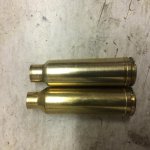
Annealed after first firing to sight in and check rifle at different distances.
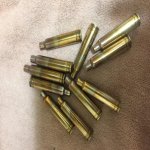
Ted
PS:Anyone know how to make these images smaller to save bandwidth?
Annealed after first firing to sight in and check rifle at different distances.
Ted
PS:Anyone know how to make these images smaller to save bandwidth?
Attachments


Last edited:
The answer depends on why you are annealing. If you want to get the most life out of your brass, then anneal after sizing to remove all the stresses incurred by deformation.
When you anneal in your reloading cycle has no impact on how long your brass will last.
If you re-size then anneal then fire, you have the two "stressful" actions next to each other. Fire - resize -anneal - fire - resize - anneal
If you anneal then re-size then fire, you still have the two "stressful" actions next to each other. Fire - anneal - resize - fire - anneal - resize
If your brass lasts 10 cycles, you still have 10 re-sizing and 10 annealing either way.
I anneal every firing before I resize. Makes the brass softer and therefore resizes more consistently in my experience. Brass is less "springy" for resize.
Same here, although technically since brass is work hardened by firing/resizing, it will be more springy after annealing.

That is from the AMP website.
Those guys have done more lab testing and more lab work than most people ever have. If not more than anyone.
More detailed info on their site.
Feel free to do whatever you like or works best for you. IMO annealing first is the best way to go no question. Based on my experience as well.
Attachments

I think we are mixing up terms here. Springiness = less spring-back.
Brass is hardened by working it. Imagine you have a case you just fired for the 10th time without annealing. The neck OD is say .342, and you want to re-size it with a bushing of .338 When you try to re-size it, the draw on the press is very hard. You then measure the brass and is .340 This is spring-back. The brass is hard and does not want to change dimensions. When you pulled the case out of the sizing die, the brass "sprang back" to close to its original OD and didn't stay at the bushings .338
A common complaint of guys when their brass needs annealing is they report that sized brass isn't holding the bullets after seating. That's because of the spring-back, the neck's are not sizing completely.
Annealing softens the brass, making it more malleable, more "springy", and more willing to change shape.
If you eliminated the spring-back entirely, you couldn't have any neck tension. When you seat a bullet, the OD of the bullet is slightly larger then the ID of the neck. If the brass had no spring-back, seating a bullet would be the same as sizing the neck with a bullet as a mandrel, and there would be no interference fit to hold the bullet.
Other then that, I agree with you completely. Anneal before sizing and anneal often.
Brass is hardened by working it. Imagine you have a case you just fired for the 10th time without annealing. The neck OD is say .342, and you want to re-size it with a bushing of .338 When you try to re-size it, the draw on the press is very hard. You then measure the brass and is .340 This is spring-back. The brass is hard and does not want to change dimensions. When you pulled the case out of the sizing die, the brass "sprang back" to close to its original OD and didn't stay at the bushings .338
A common complaint of guys when their brass needs annealing is they report that sized brass isn't holding the bullets after seating. That's because of the spring-back, the neck's are not sizing completely.
Annealing softens the brass, making it more malleable, more "springy", and more willing to change shape.
If you eliminated the spring-back entirely, you couldn't have any neck tension. When you seat a bullet, the OD of the bullet is slightly larger then the ID of the neck. If the brass had no spring-back, seating a bullet would be the same as sizing the neck with a bullet as a mandrel, and there would be no interference fit to hold the bullet.
Other then that, I agree with you completely. Anneal before sizing and anneal often.

I think we are mixing up terms here. Springiness = less spring-back.
Brass is hardened by working it. Imagine you have a case you just fired for the 10th time without annealing. The neck OD is say .342, and you want to re-size it with a bushing of .338 When you try to re-size it, the draw on the press is very hard. You then measure the brass and is .340 This is spring-back. The brass is hard and does not want to change dimensions. When you pulled the case out of the sizing die, the brass "sprang back" to close to its original OD and didn't stay at the bushings .338
A common complaint of guys when their brass needs annealing is they report that sized brass isn't holding the bullets after seating. That's because of the spring-back, the neck's are not sizing completely.
Annealing softens the brass, making it more malleable, more "springy", and more willing to change shape.
If you eliminated the spring-back entirely, you couldn't have any neck tension. When you seat a bullet, the OD of the bullet is slightly larger then the ID of the neck. If the brass had no spring-back, seating a bullet would be the same as sizing the neck with a bullet as a mandrel, and there would be no interference fit to hold the bullet.
Other then that, I agree with you completely. Anneal before sizing and anneal often.
We definitely have opposite opinions on springy.
In my world the word springy means more spring back and less soft.
We are agreeing here yes. We just have an opposite opinion on the definition of springy.
Anneal every firing. Full length size ever firing.
Brass is LESS springy after annealing. It stays where you put it.
That statement I agree with 100%.
sharp shooter
CGN frequent flyer
- Location
- Essex county (Ontario)
I anneal after every firing, mainly because I am using lapua brass or hard to find brass (222 mag, etc.) so that it lasts longer. It also helps with accuracy I find as the brass seems to have the same tension on the bullet all the time (noticed when seating).
I reload in this order:
1 - Shoot
2 - deprime
3 - anneal
4 - clean
5 - FL size (Forster/Bonanza)
6 - trim (if needed)
7 - debur/chamfer as needed.
8 - charge cases
9 - seat bullets
10 - check for run out (but since I started doing it in this order I have not noticed any)
Let me know if I should switch anything up here.
I reload in this order:
1 - Shoot
2 - deprime
3 - anneal
4 - clean
5 - FL size (Forster/Bonanza)
6 - trim (if needed)
7 - debur/chamfer as needed.
8 - charge cases
9 - seat bullets
10 - check for run out (but since I started doing it in this order I have not noticed any)
Let me know if I should switch anything up here.
I anneal after every firing, mainly because I am using lapua brass or hard to find brass (222 mag, etc.) so that it lasts longer. It also helps with accuracy I find as the brass seems to have the same tension on the bullet all the time (noticed when seating).
I reload in this order:
1 - Shoot
2 - deprime
3 - anneal
4 - clean
5 - FL size (Forster/Bonanza)
6 - trim (if needed)
7 - debur/chamfer as needed.
8 - charge cases
9 - seat bullets
10 - check for run out (but since I started doing it in this order I have not noticed any)
Let me know if I should switch anything up here.
Above is exactly how I used to do it, in the exact same sequence, when I was "flame-annealing". Now, having switched over to the Salt Bath annealing system from Ballistic Recreations, I just switch the order from fire -> deprime -> wet pin tumble clean -> anneal in salt bath then drop into water which recleans the brass while stopping the anneal process -> resize -> prime -> reload (powder/bullet/seat/crimp). Cleaning before the anneal process also reduces contamination in the anneal salts for longer life of the melted salts.
O.N.G.
sharp shooter
CGN frequent flyer
- Location
- Essex county (Ontario)
I use the salt bath as well. If the cases are dirty I will clean before annealing too.






















