Enfield bolt oddity ShtLE

woodchopper

Moderator
Moderator
Rating - 100%
78   0   0
so I was in need of a bolt for a ShtLE so I picked up one from the recent gunshow

When I got it home I was testing it and something seemed a little off, the bolt head needed to be aligned for the firing pin to protrude. So pull out the tools for a full disassembly.

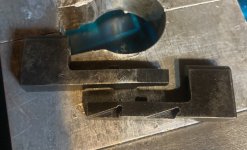
The odd thing the firing pin does not have the 2 little notches in it, it has a single lug and that lug engages into a notch on the bolt head. I found that you can disassemble the bolt without a tool and that the bolt head can be used to unscrew the firing pin.

I don't recall reading about that style of firing pin.

I will need to pull out the books again
 
You have a first variation firing pin. Most were modified to have the two notches. It was used on mk1, mk1*and mk3. The second variation is the most common, used on mk3* and 7.62 2A/2A1.

thanks that confirms what I was thinking, figured it was pre 1906 but it seems that if it was used on early MkIII then perhaps as early as 1913-14

I can see why they changed to the second variation, if the bolt head is a little mis-aligned the lug will not fall into the notch properly and the fireing pin gets hung up.
 
thanks that confirms what I was thinking, figured it was pre 1906 but it seems that if it was used on early MkIII then perhaps as early as 1913-14

I can see why they changed to the second variation, if the bolt head is a little mis-aligned the lug will not fall into the notch properly and the fireing pin gets hung up.
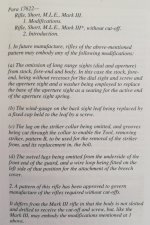
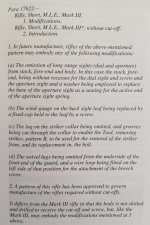
The striker collar lug was omitted in the LoC of 1916 that introduced changes to the MkIII & the introduction of the MkIII*
IMG_20210507_090536.jpg
You shouldn't be able to get the collar lug & the bolthead mis-aligned if assembled correctly
 
so I was in need of a bolt for a ShtLE so I picked up one from the recent gunshow

When I got it home I was testing it and something seemed a little off, the bolt head needed to be aligned for the firing pin to protrude. So pull out the tools for a full disassembly.

The odd thing the firing pin does not have the 2 little notches in it, it has a single lug and that lug engages into a notch on the bolt head. I found that you can disassemble the bolt without a tool and that the bolt head can be used to unscrew the firing pin.

I don't recall reading about that style of firing pin.

I will need to pull out the books again
Hi woodchopper. Your current early striker variation was designed to allow a "no tool" takedown of the bolt. That is why you have a notch cut into the back of the bolt head. Very early bolt heads had a spring loaded cap that secured the back of the striker into the back of the cocking piece. So one could reposition the cap, turn the cocking piece into the fired position making sure the bolt head notch was secured by the striker lug and use the bolt head to unscrew the striker. Unfortunately it was found that one could reassemble the bolt with one complete turn short which would produce minimal firing pin protrusion causing misfire. So the early SMLEs had a take down bolt. So did the Ross Mk I rifles. John T.
 
The very great majority of early FPs and c@cking pieces were changed at armorer level, and they are rare today, even in otherwise non-refurb mkIII rifles.

More common to still seem them in MkI rifles I think, though with a very different bolt head, of course.
 
Hi woodchopper. Your current early striker variation was designed to allow a "no tool" takedown of the bolt. That is why you have a notch cut into the back of the bolt head. Very early bolt heads had a spring loaded cap that secured the back of the striker into the back of the cocking piece. So one could reposition the cap, turn the cocking piece into the fired position making sure the bolt head notch was secured by the striker lug and use the bolt head to unscrew the striker. Unfortunately it was found that one could reassemble the bolt with one complete turn short which would produce minimal firing pin protrusion causing misfire. So the early SMLEs had a take down bolt. So did the Ross Mk I rifles. John T.
Only the MkI SMLE had the spring loaded cap (on the cocking piece not the bolthead) that enabled a no tool takedown of the bolt, this was changed to a screw even before the introduction of the MkI* SMLE in 1906, the collar lug & corresponding notch in the bolthead continued till around 1916
Firing pin protrusion can only be reduced by winding in the firing pin so far that the travel of the firing pin & cocking piece is stopped by the cocking piece hitting the rear of the bolt body & not the collar on the firing pin hitting the base of the bolthead, there is no way to increase firing pin protrusion other than removing material from the base of the bolthead or adding material to the tip of the firing pin
 
Only the MkI SMLE had the spring loaded cap (on the cocking piece not the bolthead) that enabled a no tool takedown of the bolt, this was changed to a screw even before the introduction of the MkI* SMLE in 1906, the collar lug & corresponding notch in the bolthead continued till around 1916
Firing pin protrusion can only be reduced by winding in the firing pin so far that the travel of the firing pin & cocking piece is stopped by the cocking piece hitting the rear of the bolt body & not the collar on the firing pin hitting the base of the bolthead, there is no way to increase firing pin protrusion other than removing material from the base of the bolthead or adding material to the tip of the firing pin
Yessir. You are correct. The Stiker collar determines firing pin protrusion. I guess my memory is fading. But it was determined that the authorities did not want the individual soldier capable of a total bolt dismount. John T.
 
Only the MkI SMLE had the spring loaded cap (on the cocking piece not the bolthead) that enabled a no tool takedown of the bolt, this was changed to a screw even before the introduction of the MkI* SMLE in 1906, the collar lug & corresponding notch in the bolthead continued till around 1916
Firing pin protrusion can only be reduced by winding in the firing pin so far that the travel of the firing pin & cocking piece is stopped by the cocking piece hitting the rear of the bolt body & not the collar on the firing pin hitting the base of the bolthead, there is no way to increase firing pin protrusion other than removing material from the base of the bolthead or adding material to the tip of the firing pin

You can also remove material from the front of the firing pin stop collar in a lathe as well (if you have the later dual notch version of the FP, that is). I've almost never had to do that, but if you do need to adjust FP protrusion, it's easier to skin cut the FP in the lathe with a sharp bit of carbide and keep things square, than to squarely file the back of the bolt head (just my opinion).
 
The striker collar lug was omitted in the LoC of 1916 that introduced changes to the MkIII & the introduction of the MkIII*
FWIW, the 1916 LOC changes documented changes that BSA had introduced earlier in mid-1915, and even RSAF Enfield had made many of the MkIII* modifications before the LOC was formally updated. I would consider a newer firing pin arrangement on a 1915+ rifle from BSA or Enfield to possibly still be the original pin, even if 2 notch.

Because the bolt is the same for both types of pins and heads, it's not uncommon to see an original bolt with matching font serial number with the updated firing pin, and sometimes still with a notched bolt head based on the sample of early SMLE bolts I've personally had apart, but I would not venture a guess how common it is to still have the older style FP - other than to say fairly uncommon today.
 
You can also remove material from the front of the firing pin stop collar in a lathe as well (if you have the later dual notch version of the FP, that is). I've almost never had to do that, but if you do need to adjust FP protrusion, it's easier to skin cut the FP in the lathe with a sharp bit of carbide and keep things square, than to squarely file the back of the bolt head (just my opinion).
I have done this a couple of times when I didn’t have extra firing pins. First time I did it I sat down and looked at the pin bolt relationship and thought why couldn’t I just take a bit off the front of the collar. Stopped my occasional mis fires.
 
Yes you could remove material from the collar to increase protrusion but that's a bit trickier & could weaken the leverage point where you undo the pin
The LoC of 1916 states in Part 1 which is about the MkIII " In future manufacture, rifles of the above-mentioned pattern may embody any of the following modifications" & in Part 2 of the LoC about the MkIII* it states "but, like the MkIII, may embody the modifications mentioned at 1 above"

Other than the cutoff slot which is the only actual difference between a MkIII & a MkIII* all the modifications mentioned in part 1 may or may not be applied at the time of assembly, this i assume is to allow certain parts in stock to be used up or was simply worded this way to allow the BSA MkIII* rifles assembly in 1915 to be accepted, BSA was told off & were threatened that their rifles might not be accepted, however, certain parts like the swivel boss on the trigger guard & the windage rearsight did continue on after 1916
Yes, a lot of the firing pins were changed after 1916 but the bolthead remained, my 1911 BSA MkIII which is full matching original numbers including the cocking piece & has the notched bolthead but the later pattern firing pin, this was obviously changed at a later date & not assembled as such in 1911


IMG_20210507_090536.jpg
 
When you modify the collar, you’re taking maybe 10 thou off it and adding a slight forward edge chamfer. It can’t be seen with the naked eye compared to another pin usually. I’ve done it on a fair few smle’s over the years without issue, it’s by far the easiest way to correct short protrusion if you are close and have a metal lathe with sharp carbide cutters (the pin collars are hard). Usually when I’ve done this it’s for someone wanting a new longer bolt head fitted (within saami go/nogo) for reloading reasons and the pin ends up under 40 thou of protrusion. It’s an easier fix that rummaging through all available used firing pins.

When the Brit’s maintained rifles they had limitless new parts. I do not ;)
 
I've only ever gotten those Type 4's on rifles a couple times in my life, normally I come across them as orphan parts. The Brits tried their darndest to change them all out post-war. If you se one on a rifle, it almost always has the simplified safety with helical cam bolt lock that lets you open the bolt with the safety on (which was seen as a bad thing by the MOD), and often they will also have crudely stamped and welded trigger guards. Both those other features are also rarely found on Brit rifles today, as they took efforts to find and change them all out starting late in the war and well afterward - except for LongBranch who adopted a rather nicely made stamped and welded trigger guard late in production. Those were never changed out systematically.
 
I do believe they were changed out due to finish wear and where they came from. The story I have is that they came out of the Parker warehouse in the UK. I bought a bunch of parts from the UK. I have seen one rifle with that cocking piece, a Maltby that the fellow brought out of Austria when he immigrated here. 1978 said he put it I a container and never declared it. He showed it to be about 5 years ago. Never know what you find. A couple Sparkbrook bands where also with the parts. LSA bands which I put on the LSA’s I rebuilt.
 
Back
Top Bottom