













































You are using an out of date browser. It may not display this or other websites correctly.
You should upgrade or use an alternative browser.
You should upgrade or use an alternative browser.
Enfields in "bocage"
- Thread starter cyclone
- Start date


could maybe look this dude up Harold Marshall.
A non-sniper's perspective would also be useful...


Most of the fighting in the Normandy bocage country was done by the Americans, although the Brits did have to deal with some of that terrain. The bocage favored the German defenders by presenting obstacles to maneuver and movement, denied observation and shortened engagement ranges. Small unit actions, rather than big attacks, were the norm. All standard weapons were used by the players. Machine guns were critical and could dominate approaches through narrow lanes and gaps in the bocage.
Most of the fighting in the Normandy bocage country was done by the Americans, although the Brits did have to deal with some of that terrain. The bocage favored the German defenders by presenting obstacles to maneuver and movement, denied observation and shortened engagement ranges. Small unit actions, rather than big attacks, were the norm. All standard weapons were used by the players. Machine guns were critical and could dominate approaches through narrow lanes and gaps in the bocage.
You forgot preregistered targets.

Grizz
Most of the fighting in the Normandy bocage country was done by the Americans, although the Brits did have to deal with some of that terrain. The bocage favored the German defenders by presenting obstacles to maneuver and movement, denied observation and shortened engagement ranges. Small unit actions, rather than big attacks, were the norm. All standard weapons were used by the players. Machine guns were critical and could dominate approaches through narrow lanes and gaps in the bocage.
I have a story from one of our house masters at school about fighting in the bocage. It was interesting, if only because it shows how short an active service life can be, and how the Wehrmacht rapidly modified their tactics to cope with the opportunities offered by the 'channelisation' of massed troops by the local topography.
An officer I knew who served in Normandy and Holland as an NCO said that all the Canadian casualties he saw on stretchers (in the unit) were from enemy mortar fire. Although another former NCO had his legs shot to hell in an early action by an LMG. An Hon. Col. who had served as a company comdr said that they really like to ‘get hold of’ BAR’s when they could. I have mentioned this before but site members have assured me this was a bad decision ... regrettably this decorated officer can no longer defend his comment.

The big advantages of the US Army in Europe were mechanization, mobility, firepower, air superiority and tactical air support. There were 3 battles where close terrain denied them these advantages and put them one-on-one with the Germans. These were the fighting in the Normandy bocage, the Hurtgen Forest and the Ardennes. The Hurtgen campaign was avoidable, but the bocage and the Ardennes were not. The Germans ran a mechanized offensive through the Ardennes, but ran into similar problems with lack of high speed movement routes and found themselves canalized on the limited roads and delayed/blocked at key road junctions like Bastogne and St Vith. When weather cleared in the Battle of the Bulge the US forces were able to exploit their tactical air superiority to good advantage.
Its never good to give up your advantages and fight on the enemy's terms, but sometimes there's no choice.
Its never good to give up your advantages and fight on the enemy's terms, but sometimes there's no choice.
I have a story from one of our house masters at school about fighting in the bocage. It was interesting, if only because it shows how short an active service life can be, and how the Wehrmacht rapidly modified their tactics to cope with the opportunities offered by the 'channelisation' of massed troops by the local topography.
Canalization...
Identifying canalizing terrain from a map and/or from a reconnaissance is a basic part of an officer's battle procedure. If you can't identify canalizing terrain during your map appreciation and make deductions from that information, you are incompetent.
It's not so much that the Germans were geniuses and tactical innovators for using the advantages to the defender that the bocage country provided, it's that they would have had to have been wholly incompetent not to do so.
The real story would be the failure of the US 1st Army to identify and prepare for the challenges the bocage would pose in fighting. There's no reason why that should have come as a surprise. It was known well ahead of time where US 1st Army would be landing and where they would be fighting. Near identical terrain exists in England that could have been used for training.
The big advantages of the US Army in Europe were mechanization, mobility, firepower, air superiority and tactical air support. There were 3 battles where close terrain denied them these advantages and put them one-on-one with the Germans. These were the fighting in the Normandy bocage,
Those advantages weren't denied by the terrain in the bocage, they were denied by weather and a lack of training. Once the 1st Army got it's #### together and devised effective tactics and equipment to fight in the bocage, the advantages of mobility and firepower were restored. Air superiority and tactical air support weren't denied because of the terrain, they were denied because of the horrendous weather throughout June and July. Not much anyone could do about that.
.
Anyone aware of good accounts of the Enfield's use in fighting in the French bocage?...
Why that terrain in particular?
As purple says, the bocage country was to the west of the Canadian and British advance. It fell to the US 1st Army to fight through it. That's why you don't see hedgerow plows on Canadian or British armour.
But why just the bocage? All it is is complex close terrain. Plenty of battles that took place in far more complex and far closer terrain... Ortona for starters. For that matter, from the perspective of the infantry rifleman, the distances you'd be shooting at in the bocage weren't remarkably short. Contrary to the fantasy of the lone rifleman engaging targets hundreds of meters away, the overwhelming majority of small arms use happens at less than 100 yards. Nothing particularly unusual about the bocage in that respect.
An officer I knew who served in Normandy and Holland as an NCO said that all the Canadian casualties he saw on stretchers (in the unit) were from enemy mortar fire. Although another former NCO had his legs shot to hell in an early action by an LMG. An Hon. Col. who had served as a company comdr said that they really like to ‘get hold of’ BAR’s when they could. I have mentioned this before but site members have assured me this was a bad decision ... regrettably this decorated officer can no longer defend his comment.
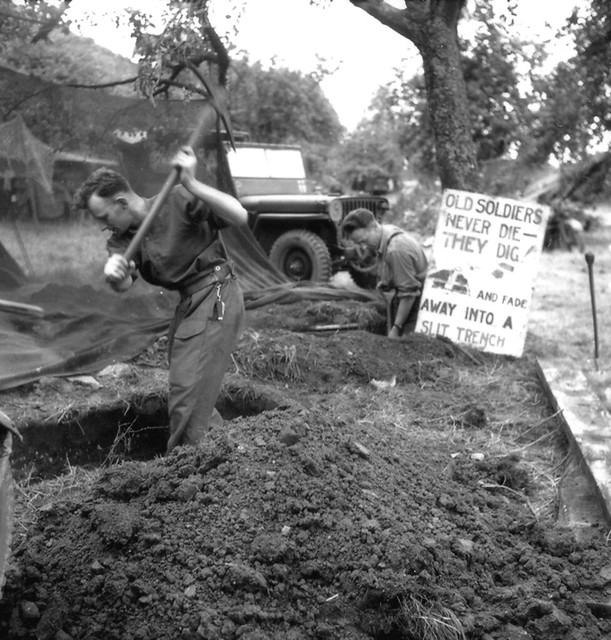
The vast vast majority of casualties on both sides were caused by indirect fire, whether mortars or artillery. There's a friggin good reason you see a long GS shovel stuffed behind the small pack in almost every photo of Canadian infantry... you can dig in a lot quicker and a lot deeper with a GS shovel than with the 37 patt entrenching tool. Given the choice I'm sure most would have rather given up their rifles than their shovels. As sure as god made little green apples, the very next thing that will happen after over running a German position is an artillery barrage and a counter attack. Best to be dug in when that happens.
As far as BARs, who knows. Perhaps it was his particular preference, or perhaps his Coy had unusual bad luck with Brens, or perhaps they appreciated extras. But... I've never heard a WW2 or Korea vet have anything but unstinting praise for the Bren. Even the Americans didn't particularly like the BAR. If he survived as a Coy comd in combat, he must have known what he was doing, so I'd be more interested in the *why* he preferred BARs, which runs counter to pretty much everything anyone has to say about the Bren vs BAR. I've shot both, though not in combat of course, and no question I prefer the Bren.
Last edited:
I found this book a good read:
https://www.amazon.ca/gp/product/2840484552/ref=ox_sc_mini_detail?ie=UTF8&psc=1&smid=A12UFBL1JPT2UF
Thanks for that.
Ordered.

Donny Fenn1
CGN Ultra frequent flyer
- Location
- East Kootenays
The vast vast majority of casualties on both sides were caused by indirect fire, whether mortars or artillery. There's a friggin good reason you see a long GS shovel stuffed behind the small pack in almost every photo of Canadian infantry... you can dig in a lot quicker and a lot deeper with a GS shovel than with the 37 patt entrenching tool. Given the choice I'm sure most would have rather given up their rifles than their shovels. As sure as god made little green apples, the very next thing that will happen after over running a German position is an artillery barrage and a counter attack. Best to be dug in when that happens.
As far as BARs, who knows. Perhaps it was his particular preference, or perhaps his Coy had unusual bad luck with Brens, or perhaps they appreciated extras. But... I've never heard a WW2 or Korea vet have anything but unstinting praise for the Bren. Even the Americans didn't particularly like the BAR. If he survived as a Coy comd in combat, he must have known what he was doing, so I'd be more interested in the *why* he preferred BARs, which runs counter to pretty much everything anyone has to say about the Bren vs BAR. I've shot both, though not in combat of course, and no question I prefer the Bren.
No skin in the game here, my granddad liked the BREN and somewhere I read some ne'er-do-well say BAR stood for Bloody Awful Rifle.��

No skin in the game here, my granddad liked the BREN and somewhere I read some ne'er-do-well say BAR stood for Bloody Awful Rifle.��
I believe that "Bloody Awful Rifle" term was first used by Canadians seconded to the First Special Service Force.......
Apparently, the Canadians disliked (putting it mildly
) it when compared to the BREN gun Commonwealth forces were using. Sure, the BAR was lighter by a couple of pounds, but it had a smaller magazine, it was harder to change magazines, and didn't have a quick change barrel.I recall the Spike TV show Deadliest Warrior had an episode with the French Foreign Legion vs the Gurkhas, and two of the weapons compared were the BAR (FFL) and BREN (Gurkhas). The show decided that the BAR was a better weapon than the BREN - mostly because the BREN has offset sights that supposedly moved when the gun was fired - unlike the BAR's sights. (I called BS on that).






















