Finally done! Three more Enfields retrofitted

louthepou

Snow-White Le Mod<br>Moderator
Moderator
Rating - 100%
792   0   0
Location
Aylmer, QC
Finally...

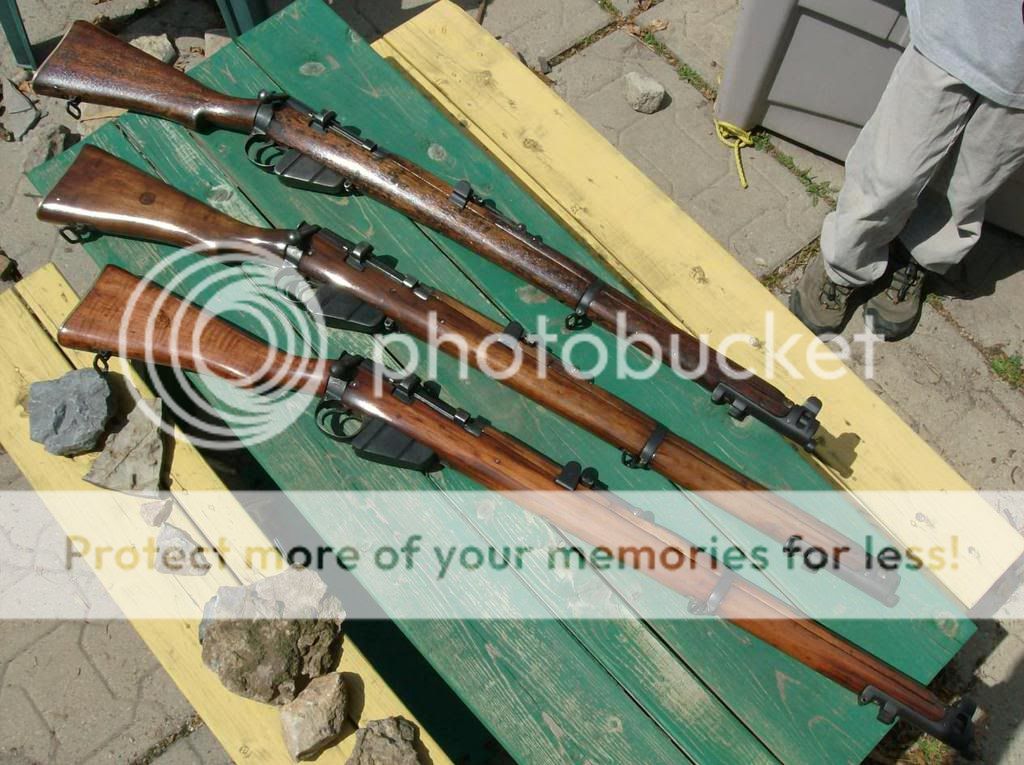
Here are the three No1 MK3 that I've been playing with these past few weeks. They all started as sporterized - appologies for not remembering which forum member sold me which rifle! :confused:

The walnut one (darkest) gave me a bit of trouble fitting the butt stock, so it took that one an unplanned extra 1.5 hrs... but it fits well now so I'm happy. For the two others, I didn't realize the handguards were not making perfect contact on the top of the forends here and there before today; I shall do better next time.

I did take the time to bed the barrels in the forearms, I do believe I did a reasonable job at this. Contrary to my previous retrofitted Enfields, I painted the middle bands, rear sight guard and nose caps.

The bores in these three are not pristine, there's wear for sure; but rifling is still present in all of them. For the middle one though, the rifling is worn at the chamber end of the barrel, while better for the front 2/3rds... wonder why.

Looking forward shooting them to see how good (or bad!) accuracy will be. All in all, a fun time doing three simultaneously, but for the next few months I will likely slow down my pace!

Cheers,

Lou
HPIM0957.jpg

HPIM0959.jpg
 
Cool!

My guess is that the one with the worn rifling probably shot a lot of Cordite in it's day.

I think I read somewhere that the heat of the Cordite has a tendency to wear down the rifling nearest the chamber faster than further out (especially in machine guns.)

Good job on the resurrections!

BTW That is one proud looking lad! That rifle is my favourite out of the three too.

Funny how it looks like it is taller than him (for now!)
 
Last edited:
nice job- beautifully done!

I've got 2 jungle carbines myself (1945 issue) in amazing shape, bores bright and clean, rifling sharp the works. I have two gripes maybe you could suggest proper fixes on. one has "loose" upper handguard (near the action), the other a fairly deep scratch on the stock ( like it fell over or something). I don't want to go too far because of how nice the rest is so...
 
I've got 2 jungle carbines myself (1945 issue) in amazing shape, bores bright and clean, rifling sharp the works. I have two gripes maybe you could suggest proper fixes on. one has "loose" upper handguard (near the action), the other a fairly deep scratch on the stock ( like it fell over or something). I don't want to go too far because of how nice the rest is so...

I would try how a new upper handguard fits, and try steaming out the crack to see if the recess will swell out the point it can be gently sanded flush with the rest of the stock.
 
fixes...

colour on the one thats loose is unsually dark, would be difficult to match...who am I kidding, thats what stain is for. The other one is a scrape really, not a crack. Do you still think steam? How do you steam it without affecting everything around it? could I fill it with "plastic wood fill" or is that unthinkably primative?
 
Why did you paint anything?

the drill purpose metal bits I received were so ugly it was painful to look at; rust, other surface defects and barely any paint left on them. The previous ones I got (previous projects) showed wear, some paint missing, that I was ok with; but this batch was hopeless... imho... the other option would have been to leave them bare metal.

Lou
 
haven't got a time machine...

End result looks great, you've put in way more effort than a lot would, particularily if the bores are so so. Despite all my black toys, I really appreciate the grain of the wood and feel of the workings of these guns. Takes you back, doesn't it? Well I'm only mid thirties but you know what I mean.
 
colour on the one thats loose is unsually dark, would be difficult to match...who am I kidding, thats what stain is for. The other one is a scrape really, not a crack. Do you still think steam? How do you steam it without affecting everything around it? could I fill it with "plastic wood fill" or is that unthinkably primative?

It is easier when all the lacquer is removed, but I have a hand held steamer that I use.

I lay a clean shop towel (dampened with warm water) over the affected area and start blasting with the steamer at the affected area. I give it a little blast and then let it sit for a few seconds. I then lift off the towel and watch to see if there is any swelling starting to happen. I will keep repeating carefully until I figure it is good enough or it seems to stop having an effect.

You can also use an iron for this by laying the damp cloth down and hitting steam on your iron for a few seconds over the area.

You want to go carefully, keeping in mind this is 60+ year old wood that has probably been dry for a long time. Even if you only do a little a day it should pay off.

I have a Lee Enfield Beech forestock that has a very deep gouge in it. I am going to try dripping boiling water into it with an eyedropper to see if I can raise the wood. It is tricky because the stock has a serial number that matches the receiver.

If I screw it up I will have to replace the whole thing.:(

Anyways, that is my method and it has worked for me. Other more experienced guys may have better suggestions.

Cheers!
 
Thanks for the comments, folks, I appreciate.

Happydude, I put four coats of BLO on. difference between three and four coats, in this case, is significant. Now, I'm not using the purest linseed oil - although I finally found some locally, and I'll do my No4 Mk1, No4 Mk2 and No4 M1* Longbranch with that stuff. This time though I used typical off the shelf danish oil, Circa 1850 danish oil; it does have additives to make it dry faster. Downside is that it doesn't go in as deep, and it's less like the real treatment these rifles would have receives way back when.

Sticky-fingered-Lou
 
Beeswax

LouThePou, did you ever try cutting your first linseed oil 50/50 with pure turpentine? it helps get into the dried wood easier on the first coats..
After two good passes applied with 0000 steel wool then rubbed down in the pores, you can begin applying a stronger mixture of BLO, turpentine and a little beeswax.
I usually melt the beeswax flakes in a small bowl by heating them very carefully then adding them to the turpentine. This is mixed with the BLO and stirred so the beeswax stays definitely in solution.
Allow at least 24 hours between the coats, rubbed strongly to help the BLO polymerize. The more applications, the thinner the coats.
The last coat is usually applied very thin, rubbed with bare hands and can be pure BLO.

PP.:)
 
Back
Top Bottom