You are using an out of date browser. It may not display this or other websites correctly.
You should upgrade or use an alternative browser.
You should upgrade or use an alternative browser.
FLIR MS 224 monocular - Can it be used to detect water leaks in a house?
- Thread starter geologist
- Start date

Probably yes, if the leak is major. If it leaks enough to moisten the drywall then there would be a difference in emmissivity between the dry and wet part. Also usually the floor or carpet would be wet, maybe not enough to feel it, but the infrared would detect this
I am assuming you have one at work? There is cheaper units designed for house inspections.
I am assuming you have one at work? There is cheaper units designed for house inspections.
Probably yes, if the leak is major. If it leaks enough to moisten the drywall then there would be a difference in emmissivity between the dry and wet part. Also usually the floor or carpet would be wet, maybe not enough to feel it, but the infrared would detect this
I am assuming you have one at work? There is cheaper units designed for house inspections.
I was planning to buy one in the new year but am shopping houses now.
I have a moisture gauge but would like something to scan a house for leaks as the house was built in 1997 with that grey plastic water pipe that can leak at the joints.
There is better options if your looking for building applications. Depending on your budget, the E Serie from FLIR is pretty good. I have used a couple of them with great results. If you are thinking in going into the building inspection business they are good entry level units.
If this is the only inspection you wanna do, I would suggest finding a building inspector that offers this service, it would probably cost $200 instead of $1200-$1500. And there is slightly more to it than point and shoot. Lots of variable and interpretation.
Another option for home use only, and I emphasis HOME USES ONLY, Canadian Tire has one that comes on sale once in a while for a couple hundred $$$. The resolution is horrible but you should be able to find leaks. They sell it as a mechanic inspection tool.
Hope this helps.
If this is the only inspection you wanna do, I would suggest finding a building inspector that offers this service, it would probably cost $200 instead of $1200-$1500. And there is slightly more to it than point and shoot. Lots of variable and interpretation.
Another option for home use only, and I emphasis HOME USES ONLY, Canadian Tire has one that comes on sale once in a while for a couple hundred $$$. The resolution is horrible but you should be able to find leaks. They sell it as a mechanic inspection tool.
Hope this helps.

does the house have a water meter? my water meter has a small pointer that spins on the smallest amount of water use. supposed to be able to detect leaking toilets etc. would be more reliable than a thermo cam.
I was planning to buy one in the new year but am shopping houses now.
I have a moisture gauge but would like something to scan a house for leaks as the house was built in 1997 with that grey plastic water pipe that can leak at the joints.

Can a FLIR MS 224 IR 240x180 pixel monocular be used to detect water leaks from plastic water pipe in a drywalled house?
I have a Flir b50 and can detect the smallest amount of moisture behind drywall.

Hi Geologist, we might be able to help out a bit with this... our sister site (ShopFLIR.com) specializes in FLIR thermal imagers.
After talking to one of the trained (Level 1) Thermographers here in our office we've got some suggestions for what you could do/what unit you may want to use.
First of all, you're going to need a unit that features a 0.08 degree C Sensitivity. Specifically you may want to look at the E6: http://www.shopflir.ca/p19120/flir_e6_infrared_camera.php
Having the right camera though, does not necessarily guarantee the results you may need. If there is a leak you may have issues detecting it unless it's directly penetrating the drywall on the surface. A good way to find this would be to crank the heat up in a room you suspect might be affected. Crank up the heat about 10 degrees and check every 10 minutes to see if you can detect a temperature difference on the surface of the wall. If there is moisture in the drywall, the affected areas will take longer to heat up.
If you'd like to chat more Thermal Imager options, or what techniques you may be able to use to find issues please feel free to call us at 1.877.766.5412. Otherwise I'd be happy to answer any questions.
Best of luck with this issue, we hope you can get some solid answers!
After talking to one of the trained (Level 1) Thermographers here in our office we've got some suggestions for what you could do/what unit you may want to use.
First of all, you're going to need a unit that features a 0.08 degree C Sensitivity. Specifically you may want to look at the E6: http://www.shopflir.ca/p19120/flir_e6_infrared_camera.php
Having the right camera though, does not necessarily guarantee the results you may need. If there is a leak you may have issues detecting it unless it's directly penetrating the drywall on the surface. A good way to find this would be to crank the heat up in a room you suspect might be affected. Crank up the heat about 10 degrees and check every 10 minutes to see if you can detect a temperature difference on the surface of the wall. If there is moisture in the drywall, the affected areas will take longer to heat up.
If you'd like to chat more Thermal Imager options, or what techniques you may be able to use to find issues please feel free to call us at 1.877.766.5412. Otherwise I'd be happy to answer any questions.
Best of luck with this issue, we hope you can get some solid answers!

I was planning to buy one in the new year but am shopping houses now.
I have a moisture gauge but would like something to scan a house for leaks as the house was built in 1997 with that grey plastic water pipe that can leak at the joints.
ohhh its not just the joints that leak... any place where that pipe was kinked by the installer will break and leak over time, think pressure washer behind drywall..
Hi Gaetoune.
The reason we'd recommend the E6 with a 0.08 degree C sensitivity is because it's hard to guarantee that a lower accuracy model would be able to detect the small levels of variance between the drywall and the moisture. So, if the drywall isn't completely soaked but is lightly dampened by moisture, it's more likely that a camera with finer sensitivity would be able to pick up the variance in temperature.
This isn't a necessity, it's possible that a camera like the E4 or E5 would be able to detect the issue with their sensitivity. Our goal however, is to present the best tool for the application, without recommending something that could be completely overpowered (and pricey).
I hope this helps, we're happy to discuss the specifics further if you have other questions.
The reason we'd recommend the E6 with a 0.08 degree C sensitivity is because it's hard to guarantee that a lower accuracy model would be able to detect the small levels of variance between the drywall and the moisture. So, if the drywall isn't completely soaked but is lightly dampened by moisture, it's more likely that a camera with finer sensitivity would be able to pick up the variance in temperature.
This isn't a necessity, it's possible that a camera like the E4 or E5 would be able to detect the issue with their sensitivity. Our goal however, is to present the best tool for the application, without recommending something that could be completely overpowered (and pricey).
I hope this helps, we're happy to discuss the specifics further if you have other questions.
Obviously if there is a minor seepage of the pipe and no saturation of the drywall chances are even with the more sensitive camera you would not pick anything anyway. Using an active approach using localized heat or the thermal loading of the sun during a warm day would probably yield satisfactory results.
Again, if there is a leak with such pipes I am pretty sure it should be evident, especially on the floors area right below the suspected leak. Doing a complete house inspection for leaks on all the pipe using an active technique would be extremely time consuming and definately not cheap.
So I believe investigating for somewhat major leaks you would not need the more accurate camera, but any camera, assuming you would uses localize heat.
Again, if there is a leak with such pipes I am pretty sure it should be evident, especially on the floors area right below the suspected leak. Doing a complete house inspection for leaks on all the pipe using an active technique would be extremely time consuming and definately not cheap.
So I believe investigating for somewhat major leaks you would not need the more accurate camera, but any camera, assuming you would uses localize heat.
Obviously if there is a minor seepage of the pipe and no saturation of the drywall chances are even with the more sensitive camera you would not pick anything anyway. Using an active approach using localized heat or the thermal loading of the sun during a warm day would probably yield satisfactory results.
Again, if there is a leak with such pipes I am pretty sure it should be evident, especially on the floors area right below the suspected leak. Doing a complete house inspection for leaks on all the pipe using an active technique would be extremely time consuming and definately not cheap.
So I believe investigating for somewhat major leaks you would not need the more accurate camera, but any camera, assuming you would uses localize heat.
What kind of camera do you have?
We uses older model P660. And some Fluke for rapid survey.
Doing mostly water ingress in composite structure. Air conditioning Pipe leaks. We also do surveys on building once in a while.
sweet, Little off topic but have you ever looked at your guns with it?
Yes I did once during a winter shoot. Interresting the barrel temp changes across the whole length.
I am planning to do it again during a hot summer days.
Have you?
No, It just occurred to me that I should haha. Next range trip the camera is coming with me.

TV-PressPass
CGN Ultra frequent flyer
- Location
- Mountains, Alberta
I bought the MS 224. I own the night!
Now I need to figure out a way to mount it onto my MICH helmet.
Thanks for the advice guys/gals!
Easy brah. Just use a PVS-14 J-arm.
Or you can rig something up like I did...
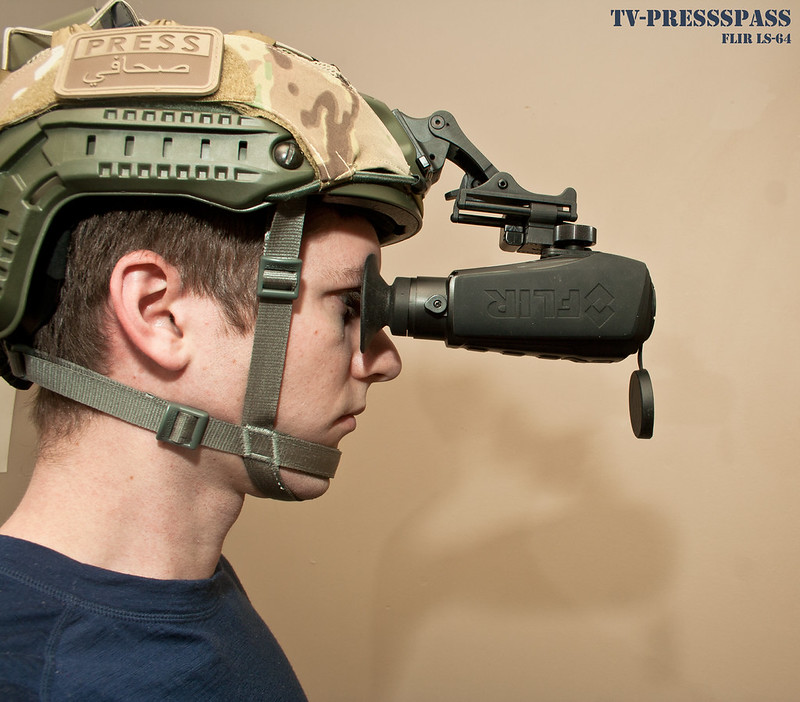
Easy brah. Just use a PVS-14 J-arm.
Or you can rig something up like I did...
Cool PP!
Where can I buy that arm plus a 1 hole shroud in Canada?
I see lots of shrouds on Amazon but none will deliver to Canada.