Garand vs Johnson

Clancy

Regular
Rating - 0%
0   0   0
Gentlemen,
Again, a question for the new guys. Here is a small file on the test between the Johnson and the M1 Garand Rifle. My question to you is do you think that the Johnson Rifle was given a fair test by US Ordnance and SA? Have fun with this one. BTW I know that the date is wrong it should read 1940.
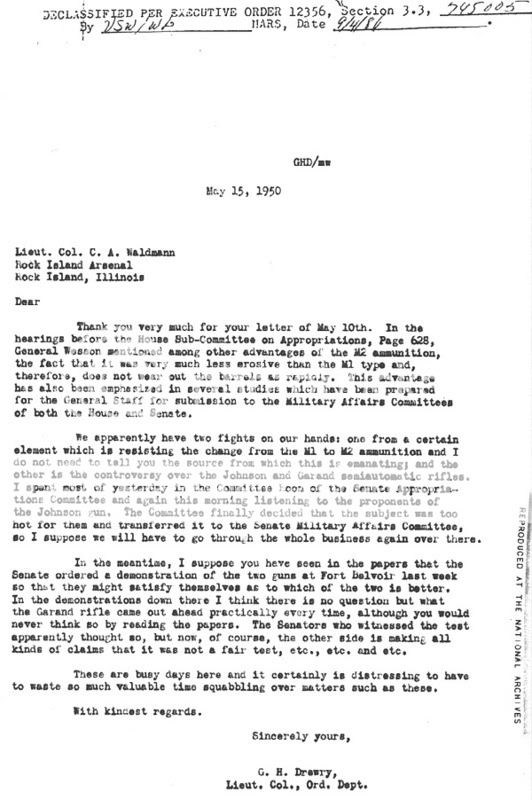

51540aa.jpg


Remindernowa-2.jpg


Thanks again for taking the time and effort to read this data. I hope you learn some data on the M1 Garand.
Clancy

ps could use some hits
NRA Life Endowment
NRA Training Counselor
NRA Instructor
FSS 90% / BW X Speed Div by 1000 = PF
 
I have some old "American Rifleman" mags from 1939-40. MM johnson seems to have been favoured by the NRA as evidenced by the favourable PR he received in a series of articles on the Johnson vs M1 question.
 
I don't understand how anyone who handled both rifles could want to carry the Johnson. It was too long, too awkward, and too heavy. My understanding was that the Johnson was issued to the Marines as M-1's were running low, and undoubtedly because the Marines were the only ones tough enough to pack the Johnson around. If you want long and heavy, the BAR wasn’t as awkward even though it filled a different role.

Still, the issue now as then, is more about money, politics, and power and has less to do with what might be best for the guy on the sharp edge.
 
My question to you is do you think that the Johnson Rifle was given a fair test by US Ordnance and SA?

No, too much Government Red Tape, Favortism and Melvin Johnson's Temper all were determining factors.

The Johnson was years ahead of it's time for features, strength, corrosion, performed extremely well in the Pacific Tests and all Tests, had a bigger mag that was topable, the rifle barrel was a takedown as well as the stock being removable for collapsing to 1/3 the size for paratroops.
Same for the Johnson LMG that was used in Italy.
 
I have to agree with "Coyote Ugly" on the too much Government Red Tape, Favortism and Melvin Johnson's Temper all were determining factors.
Both guns proved themselves to be capable firearms. The tendency to entrust the supply of the Armies weapons to a National Armory seemed to take precedent over relying on private suppliers. The era (WW2) changed that concept to a degree in that more commercial companies were being utilized to supplement the supply of firearms and equipment. Pure political pressure pushed the US government to suspend firearms manufacturing at the National Armory, and thus rely on private companies to do the work for them. The level of quality of military firearms has since degraded, as is witnessed by the fiasco of the M-16 in Vietnam.
The initial question...Yes, the Johnson was given a fair trial. It was destined to be relegated to secondary status due to the reliance on the National Armory at the time. Was the Johnson better then the Garand. From our modern standpoint, observation and current personal use we, for the most part, would definitely say NO, the Garand was and is a better gun. At the time I would assume the Ordnance Department most likely viewed both of them as near equals.
Cheers
 
"...that the Johnson was issued to the Marines as M-1's were running low..." U.S. Marine Raiders carried a few, but not because M1's were running low. The USMC didn't adopt the M1 until October of 1942, as I recall. They just didn't have 'em.
"...Was the Johnson better then(sic) the Garand..." The U.S. Ordnance Dept diecided it wasn't any better and that as the M1 was in full production, they weren't about to change rifles on the eve of a major war. Johnson's political friends(in and out of the NRA) pushed his rifle, just to get it tested.
"...Same for the Johnson LMG that was used in Italy...." For the most part, only by the 1st SSF. Mind you, they tended to carry more MGs than any regular PBI unit.
 
The Best book out there if you want to know all about the Johnson.

h ttp://www.brucecanfield.com/johnson-rifles.html

Considering the Garand (Prototypes) were tested with a Johnson Magazine, that points the finger that the enbloc system was less than ideal, for many reasons.

It really makes you wonder though, had the Johnson won out over the Garand.
 
Last edited:
The Best book out there if you want to know all about the Johnson.

h ttp://www.brucecanfield.com/johnson-rifles.html

Considering the Garand (Prototypes) were tested with a Johnson Magazine, that points the finger that the enbloc system was less than ideal, for many reasons.

It really makes you wonder though, had the Johnson won out over the Garand.


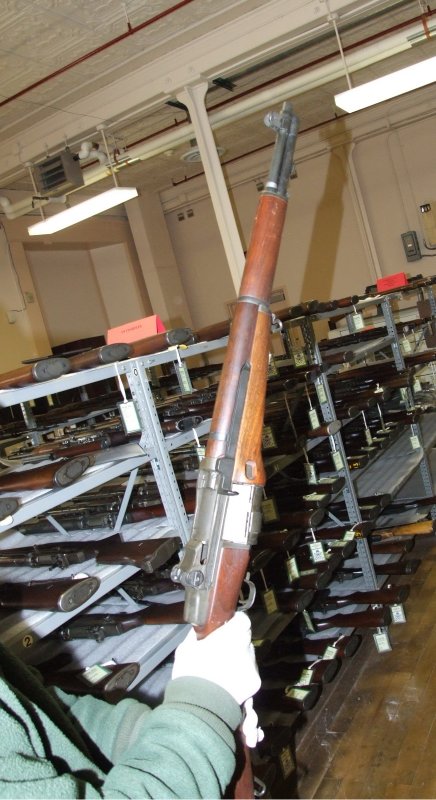
Heres one of those test subjects from my trip to Springfield

73368330.jpg
 
The level of quality of military firearms has since degraded, as is witnessed by the fiasco of the M-16 in Vietnam.

You can't blame the quality of the M-16 in terms of design or function for early problems with the deployment of the M-16 in Vietnam. You need to blame the US Army and the powers that be that changed the ammunition that was designed specifically for the M-16 at the last minute, substituting a much more dirty burning ball powder. This mistake was compounded by the fact that soldiers were not issued cleaning kits for their rifle and were told by their commanders that the M-16 required NO CLEANING!

The M-16 was a good design that was a vast improvement over earlier weapons and offered better ease of use and much improved individual firepower in a lighter and more compact package. History has proven this fact out, as it remains the principal small arm of the US Military and dozens of other nations around the world, including our own, and remains the longest serving US service rifle in their history. The only US small arm that served longer was the Browning designed 1911/1911A1 .45 ACP pistol.

As for the Garand/Johnson debate. I find the Garand better balanced and little more ergonomic to use in most respects. However, there is no denying that the Johnson was more technologically advanced for its time and had there been offical support and money put behind to mature the design and refine it, there might have been some version of the Johnson serving right up until the 1960s instead of a refined M-1 in the form of the M-14.
 
Anybody here tried to field strip a Johnson? Good times. Garands are easy. What do you do with that fancy toppable magazine when you've dented the thin cover going to ground and it's now junk? The Garand is a better rifle hands down. I'm in the same boat. Owned a Johnson and M1, still have the M1.
 
Anybody here tried to field strip a Johnson? Good times. Garands are easy. What do you do with that fancy toppable magazine when you've dented the thin cover going to ground and it's now junk? The Garand is a better rifle hands down. I'm in the same boat. Owned a Johnson and M1, still have the M1.

For level of difficulty, the Garand and Johnson are the same. You do it once and it's old hat. It's all based on your Mechanical Aptitude, some people don't have any, you're a Hero or a Zero! Some guys I know are "All Thumbs", if you know what I mean!

Too bad you can't do a barrel change on a Garand in about 10 to 20 seconds like you can on a Johnson.
 
Last edited:
For level of difficulty, the Garand and Johnson are the same. You do it once and it's old hat. It's all based on your Mechanical Aptitude. Some guys I know are All Thumbs.

Too bad you can't do a barrel change on a Garand in about 10 to 20 seconds like you can on a Johnson

I dunno, I found the Johnson to be more finicky and labour intensive. There's also the problems with all the little bits like extractors to lose.

As far as the barrel, if that was a necessary feature, I'm sure a lot of battle rifles would have it, but they don't. With a long barrel hanging out there unsupported, I guess it could be necessary.
They are neat rifles, but given to the general ranks, I'm not convinced it would have been all that great. Mind you, I wasn't there. I never took the opportunity to roll around in the mud with mine, I could see dirt, sand and crap becoming a problem getting jammmed between the barrel lugs (I dunno what they were called) and the vented guard in the receiver. Plus, like I mentioned before, one 2mm dent int the mag housing, and you're out of luck. Is there any mention of any problems arising in Canfield's book- or anywhere else for that matter?
 
I dunno, I found the Johnson to be more finicky and labour intensive. There's also the problems with all the little bits like extractors to lose.

As far as the barrel, if that was a necessary feature, I'm sure a lot of battle rifles would have it, but they don't. With a long barrel hanging out there unsupported, I guess it could be necessary.
They are neat rifles, but given to the general ranks, I'm not convinced it would have been all that great. Mind you, I wasn't there. I never took the opportunity to roll around in the mud with mine, I could see dirt, sand and crap becoming a problem getting jammmed between the barrel lugs (I dunno what they were called) and the vented guard in the receiver. Plus, like I mentioned before, one 2mm dent int the mag housing, and you're out of luck. Is there any mention of any problems arising in Canfield's book- or anywhere else for that matter?

Dent in the mag housing or not, look at how many revisions the Garand went through before they got it right. I lost count...

As for the removeable barrel on the Johnson, it was the first full size battle rifle ever parachuted into combat. Remarkable and Impressive that the rifle could be reduced to 1/3 the size.
 
Totally agree the Johnson is hard to field strip.
The reason the Dutch bought the M1941 is that it was about the only gun available. At the same time they were trying to get Hotchkiss MGs converted in the US to use 7.62 Russ ammo and were buying Iver Johnson revolvers. They also contracted Johnson to make M1895 Mannlichers.
 
Back
Top Bottom