





























Grizzly Bear Stories

olek_Z_bc

CGN Ultra frequent flyer
Rating - 100%
48   0   0
Well seeing how i'll be going grizz hunting i thought i'd google some info on the critters and their behavior, etc. etc.

Found a few stories so i thought I'd share the ones that stick in my mind the most.

Enjoy.


How to Outrun a Grizzly...
What to do when you're face-to-face with North America's most dangerous predator.
By Christopher Batin

“That bear is stalking us,” said my friend Larry Suiter as we glassed for Sitka blacktail deer on Alaska’s Sitkalidak Island.

Larry was intently scanning the shrub-laced valley we had walked earlier that morning. An 8-foot Kodiak brown bear was walking the same route we had taken. The bear had its nose to our trail like a beagle on a rabbit track, though we had taken no deer and our hip boots, clothing and packs were clean of deer scent and food. When I watched it pass within 30 yards of two blacktail does without stopping, I knew we had a problem.

“Let’s get to higher ground,” said Larry. We huffed to the next level of alpine tundra, where we had a clear view. I suggested a higher knoll, which would give us a better field of fire and put a massive ravine between us and the bear. Larry looked down just as we reached the top.

The bear, on a dead run, cleared the ridge. It would have bowled us over had we not moved to the higher position. It disappeared into the thicketed ravine, but soon reemerged in the open, on our side, 50 yards from us. We were already in defensive mode. Larry was sitting with his .338 shouldered. I took a step toward the bear, threatening it with all sorts of consequences if it came one step closer.

The bear held its head low, swaying it from side to side, trying to get our scent. It moved forward a few feet and hesitated before slowly backing up. It crouched like a cat, ready to pounce. Seeing we were not deterred, the bear eased sideways into the ravine and disappeared. That put us on alert.

“He’s trying to sneak around and get above us,” Larry said.

Perched on a rocky point overlooking the ravine, I watched the bear weave through the thickets, trying to circle around us. I scurried to an outcrop above it. It stopped, sat down and looked directly at me. The standoff lasted 20 minutes. I waved Larry over to me and we scurried up an opposite hillside out of sight of the bear. We never saw it again.

We later learned that a group of bowhunters had been in the area a week before. The bear might have associated humans with deer remains. Whatever his motivation, he presented a potentially dangerous scenario that fortunately we avoided.

When a bear is defensive, predatory or habituated to human activity, it might not run off. In 2003, an Alaska brown bear famously attacked and killed Timothy Treadwell and Amie Huguenard at their camp in Katmai National Park. Treadwell had lived among the bears for 13 summers. Nevertheless, a bear was found feeding on the couple’s remains, a gruesome reminder of the unpredictability of these creatures in the wild. “Horror stories like this make people reach for their guns and fire without thinking,” says Tom Smith, a research wildlife ecologist who specializes in interactions between brown bears and humans. “Sterling Miller, an Alaska bear researcher, published a paper that showed there was a spike in defense- of-life-and-property killings following each well-publicized bear attack. Such incidents put people on edge and they respond to bears by shooting first and asking questions later.”

An inquisitive or even an attacking bear can be effectively deterred without injury to the bear. Only as a last resort, when contact is imminent or your survival is threatened, should you consider using lethal force. Ultimately, it’s your obligation to properly interpret each bear’s behavior and react in a responsible manner.

Weapons of Deterrence
Confronting a bear with nothing but one’s own hands can be terrifying. But for Steve Ranney, it’s simply another day in the woods.

On one occasion, Ranney was hauling equipment from a goat camp high in Alaska’s coastal mountains and not carrying his firearm. Right at treeline, a pair of young brown bears were working down the gully above him, playing and running in his direction. Cornered, Ranney climbed a spruce tree.

The bears were perhaps 2 or 3 years old, large enough to hurt him if they became irritated or decided to include him in their romp. One of the bears soon tired of playing with its sibling and took a nap at the base of the tree Ranney had climbed. Ranney waited an hour for the bear to move. He was cold, his legs were tired and he still had gear to haul. Rather than risk climbing down, he tossed spruce cones at the bear’s head and shoulders. The bear woke up and ambled off. Ranney was lucky, but he was smart not to flee when he first came upon the bears.

“Encountering a bear without a means of deterring it horrifies people and causes them to run, which is a mistake,” Smith says.

Always carry at least two deterrents in bear country. One should be bear pepper spray, the other a flare pistol, air horn or firearm. Carry one deterrent in your hand; the other should be available immediately, like a handgun in a holster or a shotgun slung over your shoulder.

Bear pepper spray might not be as macho as a firearm, but it provides the confidence to stand your ground and has a proven track record in Alaska. Pepper spray is effective because the sudden, loud hissing sound of the spray and the sight of the billowing cloud of red-orange mist frighten bears.

Smith maintains a database of more than 500 bear-human conflicts in Alaska. Bear pepper spray was used in 65 cases and deterred 61 curious or aggressive bears, for a 94 percent success rate. Of 258 incidents in which firearms were carried or used for bear defense, they were effective in 175 of them, for a 65 percent success rate.

While the .458, .375 and similar big-bore firearms are recommended to slow or stop an attacking bear, a U.S. Forest Service study shows that people have a problem handling the severe recoil of these larger calibers. Smith’s records demonstrate that victims carrying large-caliber firearms often have no time to get off a shot at an attacking bear.

Smith suggests a shotgun and rifled slugs when lethal force is required. “You want stopping power and accuracy. Although buckshot gives you a wider pattern, it divides that energy too much.” Also, unlike some specialized rifle ammunition, shotgun slugs are easily replaceable if you run out of them or your luggage is lost.

“Don’t mix rounds when walking afield,” says Smith. “Always chamber slugs. Only in camp, when you might need to deter a curious bear walking an outside perimeter, should you be loaded with shot. Load one shotshell directly into the chamber. If you suddenly need to use slugs, your remaining shots are lethal loads.”

However, a firearm is no guarantee that you’ll escape an attacking bear unscathed. “Many people carry firearms of insufficient caliber, while others are ambushed so quickly they have no time to fire an accurate shot,” says Smith. “All too often, when attacked suddenly, even the most accurate and experienced shooters miss their mark. While the same elements of fright apply to people carrying pepper spray, the spray’s widespread multiple effect can’t be overlooked.”

Stand Your Ground
Alaska fishing guides often joke that sneakers are the best bear protection— “I don’t have to outrun the bear, just my clients.” But in reality, you’re better off leaving the running shoes at home.

“When eye to eye with a charging Alaska brown bear, most people’s first instinct is to run,” Smith says. “But running usually entices a bear to pursue.”

Stand your ground. Show strength, but don’t challenge the bear unless you absolutely must. Smith’s statistics show that of the 42 times a person chose to run when confronted by an aggressive bear, only 5 percent of the time did the person manage to distance himself from the bear. Only twice did the bear leave without pursuit. In 83 percent of the cases the bear chased the fleeing person, and in some cases, attacked and mauled him.

Running tells a bear that you are weak and would be easily overtaken. “Backing up says, ‘I’m passive and subordinate to you’ and bears understand and exploit such language,” Smith says. “Standing your ground is your first line of defense. It tells the bear, ‘I might be small, and I might suffer in the event of an attack, but you, too, will suffer.’”

Hazing Perimeter
A hazing perimeter is an imaginary boundary. Choose a tree or other landmark to denote the border of your circle of safety. Once a bear crosses the predetermined line, begin your hazing in escalating order. First, make your presence known quietly. More times than not, this will push the bear off. Next, make noise. And last, fire your pepper spray or a round from a firearm. Sometimes the bear will cross the hazing perimeter slowly. If it charges, you’ll have only a split second to respond.

Each person has his own tolerance level with approaching bears.

“There’s no one-size-fits-all approach,” Smith says. “Individual comfort zones are indicative of a person’s prior experience in bear country, and this distance varies widely.” My zone to begin hazing with pepper spray is 10 yards, while for others, 25 yards may be the limit.

It can be intimidating to see a large bear coming at you. When this happens to me, I repeat the following to myself: “I am invincible. I am greater than the bear. I can deter the bear and, if absolutely necessary, defeat the bear. I have the weapons that will turn it and, as a last resort, kill it if it tries to kill me. I will turn the bear or kill it if it touches me.”

Push Comes to Shove
There is no glory in shooting a defensive or surprised bear. The bear is responding to protect food or its young. Yet bears do attack. When contact is imminent, defend yourself.

When a bear is within your hazing perimeter, other methods of deterrent have failed and contact is imminent, focus intently on that first shot. Aim for the bear’s center of mass and fire.

Then again, you may not have time to shoot. Bears can reach speeds of 35 miles per hour, and an aggressive bear can knock you over before you have a chance to shoulder a firearm. If this happens, roll onto your stomach and play dead. If the bear continues to attack, if the attack is prolonged or if the bear begins to pull out chunks of your flesh, make every effort to maim, deter or kill the bear, as it is predatory.

If you are able to get off a shot before impact, stay focused and keep shooting. A bear can recover quickly from a direct hit and glancing shots are dangerous. Follow-up shots also keep the bear’s nervous system “off line” for a few moments. It’s important to break down the bear so it can’t continue its attack. Ideally, a slug should break down the front legs and shoulder bones.

Shots to the vitals guarantee eventual death and create a good blood trail to the carcass. If your first shot has hit the bear, keep firing until it is either dead or out of sight. If the bear is running directly away from you, place a bead on its tail and fire. Don’t worry about making a sporting shot; dispatching the bear is the most important thing. Allowing a wounded bear to escape is irresponsible and dangerous to others. Immediately report the kill to the authorities. Local law may require you to salvage the meat, hide, skull and claws.

Bears are wonderful creatures, and it’s up to us to learn how to interact with them responsibly. Take time to learn bear behavior. The appropriate response during an encounter will help deter unnecessary killings.
Article URL: http://www.outdoorlife.com/outdoor/hunting/biggame/article/0,19912,1155373,00.html

one more story to come
 
Last Stand
Armed with only a knife, a desperate hunter takes on a grizzly.
By Larry Mueller and Marguerite Reiss

Gene Moe snapped his head around at the ferociously loud and deep bawling roar of a close and angry bear. At first glimpse, he knew he was in for the fight of his life. This was no trotting charge of a bluffing bear. Both front paws reached forward together in each leap of a galloping bear going in for the kill. Gene made one instinctive step toward his rifle, just 5 feet away, and then recognized the futility of dropping an inferior weapon to grab a superior one he’d never have time to shoot. The knife he had been using to skin a Sitka blacktail deer was still in his hand, so he thrust it forward to meet the raging bear’s wide-open mouth, hoping to shove it down her throat. He was keenly aware that he could lose a hand, or more, but no better defense presented itself.

Gene might not have been in this life-threatening predicament had his partner of the day been able to follow their plan. Two years earlier, the same partner and Gene had just skinned out the hindquarters of a deer when a Kodiak bear appeared and plopped down 100 yards away, probably called by the dinner-bell shot. “Hey, we’ve got company,” Gene said. “Get the two quarters onto my backboard, and let’s get out of here.” They were a meager 50 yards away when the bear arrived to carry off the rest of the deer.

This year, they were camped on Afognak Island northwest of the village of Kodiak, but Gene, 69, and his son, Karl, 44, and their two partners, Tom Frohlick, 44, and Steve Fitzpatrick, 48, both employees of Gene’s concrete contracting business, motored their skiff across the straits and down about 10 miles to the lower end of Raspberry Island to hunt Sitka blacktails. Gene’s plan was to position Steve on a ridge, move out about 200 yards, and circle to move a deer toward him. If by late in the day Steve hadn’t gotten a deer, and Gene got a chance for a buck, he would take it. The rules called for the partner to be alert for the shot and then listen for the owl hoot. It would then be the partner’s job to join Gene and watch his back during the field-dressing. About that time Steve dropped his cap’s earflaps.

“Can you hear with those flaps down?” Gene asked.

“Oh yeah,” Steve answered, but later he heard neither shot nor hoot. And the bear bearing down on Gene wanted and needed more than a gut pile. This was November 1, 1999. The berry crop had been poor, a severe previous winter had killed an estimated third of the deer, and Asian ships with 20-mile nets were making clear-cuts in the ocean’s fishery. Few Pacific salmon came upstream at Raspberry Island to spawn, die and provide the fat-building nutrition essential for bears to hibernate.

The Battle Begins
Raspberry has an open grassy top, but at lower elevations moss hangs from big timber in the world’s northernmost rain forest. That year, snows had driven the deer down to the forest. Gene did watch a beautiful buck for 20 minutes, but it spooked before his partner could get a shot. About 2 o’clock, he saw another buck and decided to take it while there was still enough daylight to get it back to Afognak. Steve didn’t show up, so he began skinning it out alone. All the meat was off the carcass and laid out on plastic, and the heart and liver were in his hands when he heard the bloodcurdling roar. His only chance of survival depended on what he could do quickly with the 3¾-inch blade on his Model 110 Buck folding knife. And that chance was rapidly diminishing. Foam does bubble forth profusely from the mouths of excited bears, and this hungry sow was so excited that Gene now saw more foam than head. He could only aim his blade at the center and hope.

The knife slid alongside her head, and the bear bit Gene’s right arm above the elbow, taking out a big chunk of flesh. He could feel her trying to tear off the arm completely. He quickly reached over her head with his left hand to jab a finger in her eye, but came to an ear first and rammed his finger in as hard and far as it would go, then twisted. This experience proved to be so new and so intolerable that she relaxed her grip on his arm and tried to pull away, but Gene’s left arm was over her neck. Thinking he might put her on the ground in a more helpless position, he attempted to bulldog her as he had young bulls during his youth on the farm in Minnesota. Big mistake. She flipped her neck and threw him 8 feet.

Having watched bears doing lots of berry picking and digging, Gene knew she’d swing at him with her right paw. Like humans, the majority of bears are right-handed. This one stood up on her hind legs, arms outstretched in scarecrow fashion, and began circling, picking her moment to end this confrontation. A grizzly can decapitate a cow with one swipe; a Kodiak brown is even bigger, and Gene knew his head would come off a lot easier than a cow’s. He was also certain that she was standing on her hind legs to place that right paw at the best level to accomplish this. He tried to move closer to his rifle while focusing his eyes on nothing but that right paw. He saw it coming the instant it started. And at that same instant, he jerked his head back the way a boxer dodges a right hook. She missed, but came close enough that one claw split his ear and almost tore off the earlobe.

Since that failed, she dropped to all fours, hit his legs and knocked him on his back. She’d be on top of him next, bouncing or biting to crush his ribs or skull, so he jerked both heavily booted feet together and kicked upward with all his strength as she came flying in. The collision knocked her off to the side, and Gene leaped to his feet.

She began circling him again, and like a prizefighter up against a taller man with a longer reach, Gene knew that he had to get inside that right paw to survive. She was beating him to death. She came at him fast on all fours, and this time Gene was stepping off with his left foot, right foot still on the ground, as the paw started to swing. The paw missed and swung around his back, so she bit a large chunk out of his right leg above the knee instead. The pain was severe, but now Gene was inside the right front paw and against the bear’s shoulder with his left arm over her neck. His right arm had no feeling, and flesh from above the elbow hung down to his fingers. He reached over the neck and stabbed four times as hard as he could. Then, changing tactics, he moved closer to the jaw to slice the neck so he could push his knife and fist into the cut to stab deeper.

Standing Tall
The sow tried to stop Gene by raising him off the ground with her right paw. He hung on and kept cutting the hole deeper, but he couldn’t hold her when she dropped him to push away with both front feet. Nevertheless, before her head pulled out from under his left arm, he managed one more hard stab into the deep slash near her jaw. Blood squirted all over them both. Immediately, this Kodiak brown wanted a breather between rounds and circled out beyond the little arena of beaten-down snow.

Noticing that some of the fight was going out of her, Gene yelled, “Bear, the Lord’s on my side, so come on!”

She did. And as she ran, Gene could see blood still gushing from the cut nearest the jaw. He also noticed that her head was cocked oddly sideways, suggesting that the last stab had probably gone deep enough to injure a vertebra. Terribly battered with loose skin and flesh hanging from his arm, claw gashes in his shoulders, and painfully dragging his right leg, 6-foot 3-inch Gene tried to stand tall and move toward her looking as menacing as possible. He would not allow her the added confidence of thinking the fight had gone out of him.

Whatever she thought, it did not stop her from charging—though not with the speed demonstrated earlier. All Gene had left now was a little prayer and the advice of a dog-musher friend who said a blow to the nose from a light club he carried would stop nearly any animal. Gene drew back his left fist, and as the bear leaped at him, he threw the hardest punch of his life. He missed the nose, but struck her cocked head just under the eye. The impact of the punch combined with the momentum of the 750-pound brown was so powerful that his arm and hand went white and he had no feeling left in the knuckles. The sow’s head twitched, and she bared two front teeth that were still covered with Gene’s “meat,” as he tells it, before suddenly dropping with her paws under her body. Her cocked head straightened with the blow, and her nose pulled downward during her fall, ramming it into the moss. She lay motionless.

Crawling for Help
Gene had seen so many animals go down that he knew it’s a brain or spine shot when one drops with its feet under it. Hit other organs, it will go down with its feet or legs out from under its body. He believed this one was dead from damage he had inflicted to the spine with his knife and fist. But he wasn’t taking any chances; he stepped back to get his rifle. Before he could shoot, however, he had to first free his hand of the knife—but found he couldn’t relax his grip. Eventually, he was able to pull his fingers from the knife with his teeth, but then the loose skin and flesh from his arm fell over the scope of his rifle. Finally, he managed to raise the rifle high enough to get the flesh off to the side, and then lower it to shoot the bear twice in the chest.

A little fur flew both times, but the bear never twitched. Clearly, Gene’s lethal punch had finished breaking the vertebra of his 750-pound opponent. Gene’s ordeal, however, was far from over. He was two miles from the boat, feeling dizzy from loss of blood and still bleeding badly. He pulled the hanging flesh back up on his right arm and wrapped a plastic bag around it as best he could. His hunting pants—purchased in 1948, made of quarter-inch thick wool and worn only for the annual hunts—had probably reduced the potential damage when the bear bit a chunk out of his right leg. At least for now, he could still move on his feet. He had not seen the cubs, which later evidence showed the sow had, but as a precaution, he picked up his rifle as he left. He could easily meet other bears on Raspberry Island.

He doesn’t know how far he got before exhaustion forced him to lie down in the snow. When he felt it was time to move on, however, he couldn’t sit up. Finally, he struggled onto his stomach and pushed himself off the ground with his left arm and leg. At this point, he recognized what carrying extra weight was doing to the limits of his strength. Meeting another bear now seemed less of a gamble than whether he’d reach the beach at all. He abandoned his rifle.

At least twice he had to again lie down in the snow to rest. During one of those rests he remembers trying to die. “Lord, take me home,” he begged, but it wasn’t his time. So Gene struggled on, sometimes walking, sometimes crawling.

At one point, it appeared as if he was about to lose in the gamble of discarding his rifle—and his death wish would soon be fulfilled. He was hearing sounds from an animal too big to be anything but another bear. Yet being eaten alive did not exactly seem like a reasonable answer to prayer, so Gene remained motionless long after the noises ceased. If it had been a bear, wind direction had played in his favor.

Reaching Safety
Struggling through alder thickets was the most difficult challenge of the entire two-mile trek. The tree limbs would snag the plastic bag and yank it off his right arm. He’d stop, pull the hanging flesh back up and rewrap it, only to have it happen over and over again.

Finally, Gene spotted an opening in the woods and knew he was right on target. Within 200 yards of the beach, he could go no farther. He wearily halted, yelling for help, hoping somebody was near the boat. He was fortunate. Tom and Steve were already there and responded immediately, warming him with another coat and a full-length flotation vest. Steve had not heard the last two shots, either.

It was the custom among these hunters that the first to get back to the boat around 4 p.m. would fire his rifle as a signal that it was time to come in. The others would return answering shots, and everybody would be out of the woods before dark. They fired the routine shot and Karl answered, but then Tom and Steve began calling excitedly, trying to hurry him in so they could get Gene to medical help more quickly. Karl could not understand their words and concluded that a shot followed by loud, excited voices meant that a bear was somewhere between him and them. Instead of hurrying him in, the calls slowed Karl into greater caution, but he speeded up when he got close enough to understand. He was thoroughly shocked by his father’s appearance. The three quickly got Gene into the skiff and headed for the nearest habitation: the Silver Salmon Lodge owned by Peter and Barabel Guttchen.

Too Old to Heal?
Peter saw the skiff motoring into the bay with men waving wildly. As he walked down to ask what was wrong, he was astonished to see a man chewed and torn beyond belief step out of the boat and walk up the beach toward the lodge. A new front room was being built on the beach side of the lodge, so Gene also walked around to a door in the rear, refusing to be carried. He lay on the living room floor while Tom carefully rearranged the flesh on his right arm and bound it with an Ace bandage provided by Barabel. Karl wrapped his dad’s right leg with strips torn from her apron.

The Guttchens had the only radiotelephone in the vicinity, and immediately called the Coast Guard at Kodiak. By luck, they were going on maneuvers and had a helicopter already 10 feet off the ground. They quickly arrived at the lodge. By that time, the bandaging was finished and Gene was in a sleeping bag. Gene was flown to the then three-year-old, 23-bed hospital at the little fishing village of Kodiak, where, without a break, Dr. Barry Goldsmith spent 12 hours caring for him, 7 of them stitching the wounds. Four years later, the feeling had not returned in two of the knuckles in the left hand.

The day after the attack, Gene’s hunting partners returned to Raspberry Island to find the rifle and knife and skin the bear. Alaska law requires that any bear taken in self-defense without a tag must be turned over to Fish and Game. Gene later bought back the hide at the annual auction. The partners found the blood trail very easy to follow—sometimes drops, sometimes a spray, some smears on branches, some on trees he had leaned against, and three pools where he lay down. Behind a log with a large smear of blood, they found the rifle. Finally, as they followed the trail back to the attack site, two young bears were standing over the few remains of Gene’s deer. They were probably the dead bear’s 2½-year-old cubs, which she was trying to drive off so she could have more offspring that winter during hibernation.

Back in the hospital, Gene overheard two nurses discussing how he was too old to heal properly. The next day, however, the doctor was asking what medic put his arm back together so expertly. “Tom Frohlick,” Gene answered, “a cement finisher who works with us.” (Annually, to make his employees more aware, careful and competent in an emergency, Gene has them take an 8-hour class in first aid. Gene himself certainly benefited from his employees’ training.) Two other reasons he could outfight a bear? He never smoked and he worked hard all his life. The doctor would later say that Gene has the muscle tone of a 33-year-old man.

Gene offers one more tip to those who hunt in bear country. Something he has noticed many times, but never told anyone until now, is how raven behavior ties in with deer hunting in bear territory. “When a raven flies over and sees you,” Gene says, “he’ll give a squawk or two. If you keep watching him, you’ll probably hear him squawk again and notice that he’s flying over another ravine. I figure if he squawks when he sees me, he’s squawking when he sees something else. When the wind has been in my face, I’ve sneaked over to see what’s there, and sure enough, I’d find a deer in that ravine. But you have to be careful. It could be a bear with a kill or cubs to defend. About half of the time, when I’d start to get close, I’d see a bear coming from the other direction. I don’t know for sure if bears are smart enough to catch on to raven behavior, but I take the possibility seriously. I’ve certainly had enough experience with rifle shots calling bears to dinner.”

Excerpted from Bear Attacks of the Century: True Stories of Courage and Survival, by Larry Mueller and Marguerite Reiss. (Lyons Press; lyonspress.com)
Article URL: http://www.outdoorlife.com/outdoor/adventure/article/0,19912,1117013,00.html

This story is one i won't forget for a while.
 
I have a short Grizzly bear story. Was on a solo expedition to get to my fourth corner of Canada - Beaver Creek YK. Had previous years been to Alert NWT, Cape Spear Lighthouse NF, and Pelee Island ON. On the return leg after getting to my destination, I took a side trip into Kluane National Park.

The idea was to hike in one side of a big glacial outwash, up a side hill and around the upper edge of a valley, down and out to the road. Maybe three days. On the second morning, while descending into a coulee and about to cross a patch of berries, a brown head rises about 75' away. Round shape, not too big, teddy bear ears, pointy snout. "Grizzly! OK, where's momma?"

As I rattled my noisemaker like a drunk at Mardi Gras, I loosened my waist strap and smartly backstepped up to the promentory edge. I was able to snap a few pictures when I spotted it in the valley several hundred feet below. I judged it was the size of a medium sized black bear.

I asked myself, if that bear is afraid of me, what else in this valley is it afraid of? I told myself, it is a lot harder to get out of trouble than to get into trouble. I decided to cancel the trip and get out of there. The ranger station was pleased to take my sighting details. They even had some sections of pelt to help identify the colour.
 
I was involved in a defense kill similar to that video. My buddy fired 4 rounds of 44 mag into a grizzly that was charging him. I had a shotgun loaded with slugs. The slug crushed his left shoulder, shattered his left forelimb and left a blood splatter 2 feet long, and yet he didn't drop right after the hit. The bear dropped about 10 ft away from my buddy feet. They are tough animals that have to be treated with respect. And you have to stay calm under the pressure, cause otherwise it's :puke: and then lights out.

I hated killing that bear, but I am glad my buddy is still around.
 
in situations liek the video and the story above , you need to decide whats more important saving yuor life or letting the agressor have a quick meal.
 
Some visuals that don't lead to subscription ads like the link above...:rolleyes:

vr062605.jpg


BEARS.jpg


:D
 
An atheist was taking a walk through the woods.
What majestic trees!
What powerful rivers!
What beautiful animals!" he said to himself.
As he continued walking alongside the river he heard a rustling in the
bushes.
Turning to look, he saw a 7 foot grizzly charging towards him. He ran
as fast as he could up the path. Looking over his shoulder he saw that
the bear was closing in on him. His heart was pumping frantically and
he tried to run even faster. He tripped and fell on the ground. He
rolled over to pick himself up but saw the bear raising his paw to
take a swipe at him.
At that instant the atheist cried out: "Oh my God!..."
Time stopped.
The bear froze.
The forest was silent.
It was then that bright light shone upon the man and a voice came out
of the sky saying: "You deny my existence for all of these years,
teach others I don't exist and even credit creation to a cosmic
accident. Do you expect me to help you out of this predicament? Am I
to count you as a believer?"
The atheist looked directly into the light, "It would be hypocritical
of me to suddenly ask you to treat me as a Christian now, but perhaps,
could you make the BEAR a Christian?"
Very well," said the voice.
The light went out.

And the sounds of the forest resumed.
And then the bear lowered his paw, bowed his head and spoke:

"Lord, bless this food which I am about to receive and for which I am
truly thankful."
 
Correct me if I am wrong, but I have heard this.

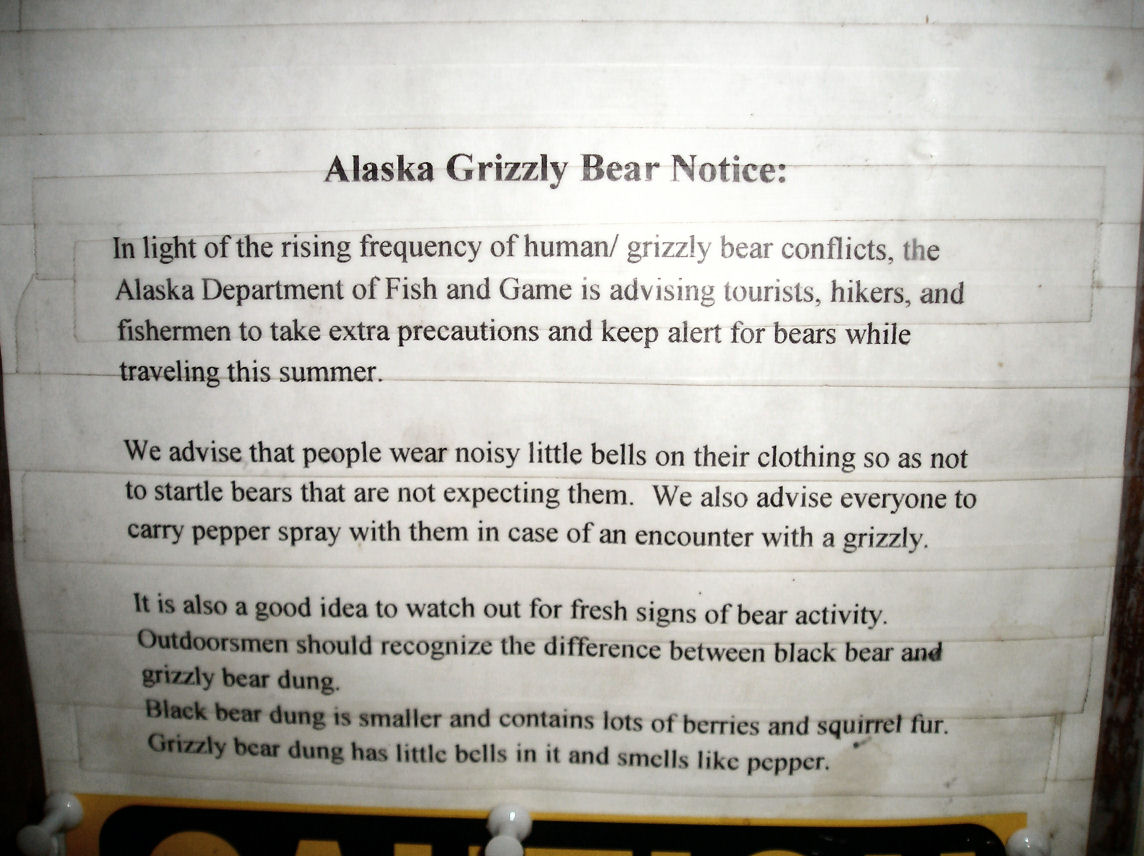
Some bears in certain areas up north have actually taken to following/stalking the bells that people wear.

Has anyone else heard this?
 
That video gave me butterflies.

I would never want to or will hunt bears. Had a friends dad at his cabin had to drop a bear with 3 shots and it still wasnt dead, took another 2 of a reload to finish it off.

After ive heard stories like that , it scares the #### out me specially since in canada we cant carry handguns.

That video is freaking unreal. Good post!
 
BlastingChipmunk said:
Correct me if I am wrong, but I have heard this.

Some bears in certain areas up north have actually taken to following/stalking the bells that people wear.

Has anyone else heard this?

On the advice of the Russian field geologists experienced in working in the Russian arctic, we got rid of our bear bells while working there as they attract the bears.
 
geologist said:
On the advice of the Russian field geologists experienced in working in the Russian arctic, we got rid of our bear bells while working there as they attract the bears.

Bears are curious, some more than others. And all it takes is one that is curious enough to come see why the dinner bell is ringin.....
 
crazy_davey said:
Bears are curious, some more than others. And all it takes is one that is curious enough to come see why the dinner bell is ringin.....

x2

When peopel start talking about how they are "bear prepared" by having bells, I immediatley dismiss them as idiots.:)
 
Back
Top Bottom