Not only have I shared targets with you here from silhouette distance testing (40 m, 60 m, 77 m, and 100 m) that show this happening with some ammo converging at pigs at 60 m and some ammo converging at turkeys at 77 m from the same gun, I have given you a step-by-step method to test this for yourself many times, since you seem incapable of believing anyone but yourself. Your selective memory is almost as bad as your sieve memory. You can literally test this yourself. Anyone can. It isn't difficult. Like I've told you many times, go shoot at 10-yard increments and see for yourself. Your dismissal of both theoretical and practical evidence which has been presented to you is hilarious. You have benchrest guns with tuners. Go shoot in 10-yard increments with the tuner installed as normal and with it removed and compare your results. The tuner moves the convergence distance. That's its whole purpose. I never replied in your other thread because I was tired of your nonsense, as I am growing again. You are either ignoring reality or are incapable of fully understanding the topic being discussed. Both cases make it a waste of time to continue discussing it with you. You think you are correct no matter what you are presented with, so you ignore what you are presented with, including directions on how to test it for yourself. That makes time and effort spent on you a waste of time and effort. Hence, no reply over there at the time. Nothing gets through closed doors, so there's little point in trying to get anything through them. You've shown time and time again that when you think there's no explanation for something, no explanation must exist. Somehow, you already know everything, so if you don't know something, that something must be wrong otherwise you'd already know it. It's silly. I don't know everything. You don't know everything. Bryan Litz doesn't know everything. We all know things the other may not. The whole point of sites like this is to gather all of our knowledge and see what makes the most sense, what should be kept and what should be discarded. Ignoring information that might prove helpful does not make sense. So I don't know why you do so. Sometimes I try to help you learn something new. Sometimes I tire of your shenanigans. Most especially when I've explained the same idea 17 different ways so that literally anyone should be able to understand at least one of the explanations and included ways you can test the idea for yourself and you still run around with your fingers in your ears screaming la la la la la la la.
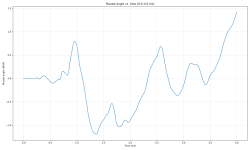
The theory relies on physics and barrel behaviour and how launch angles change due to them. We're not talking about these things magically changing when you change target distance. We're talking about given barrel/ammo behaviour dictating an ideal target distance specifically because the barrel does NOT change what it does from shot to shot. As shown in another thread, the barrel vibrates in the same fashion for every shot, much like a tuning fork vibrates in the same fashion with every strike:

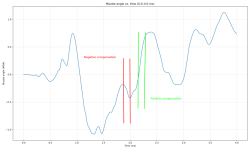
This shows how the barrel's vibration cycle is adding to or subtracting from your set launch angle over time during the firing cycle. The bullet's muzzle velocity and where along that curve it exits determines its ultimate launch angle and where it ultimately hits on target. A given ammo will have a window of average exit time determined by all the variance involved concerning all of its components. As shown in these real-world measurements, that exit time is not fixed, but will vary from shot to shot:

Shots with the same muzzle velocity can have differing exit times. This is one of the sources of variance on target. Differing exit times mean differing launch angles. Differing launch angles with the same muzzle velocity mean differing points of impact on target. This graph shows that there is a general trend of faster shots exiting earlier than slower shots with a difference on the order of about 1/375 of a millisecond per 1-foot-per-second difference in velocity. Every single shot does not follow the trend exactly because of variance in components giving each shot slightly different acceleration characteristics, but on average, that is the trend they follow. In the 20-shot example shown there is a 0.1 ms exit time window for those shots. If you look at the first graph you will see that the barrel is moving up/down quite a bit within a 0.1 ms window. In the case of
that particular experiment, he found that shots were exiting near the 2.15 ms mark. In the case of this barrel movement graph, a 0.1 ms window centred around the 2.15 ms mark would seem to put the majority of shots exiting on that long upslope. That is going to give it a natural convergence point at a given distance for a given ammo based on its muzzle velocity range and the rate of swing for that upslope. And you'd have to do an incremental distance test to figure out where that convergence is happening. This may or may not get along very well with the target distance at which you happen to be shooting. Adding something like a Harrell tuner can change that barrel trace in a manner such as this:
View attachment 1053111
Now some of the characteristics of the line have been changed due to the added muzzle mass of the tuner. The most notable thing being the angle of the upslope after 2 ms not being as sharp. Instead of taking less than 0.25 ms for the upswing to cross the 0.5 MOA mark it would now take about 0.5 ms to reach the same point in its swing. That is going to change the distance at which convergence takes place for that ammo because the muzzle is rising at a slower pace, resulting in a different amount of launch angle change during the exit time window for that ammo. The faster the rate up upswing, the further away the convergence happens for a given ammo. Benchrest shooters that shoot at 50 yards take a barrel design that will give a natural convergence distance beyond their usual 50-yard targets, in other words, a barrel that is swinging too fast for their target distance. And then they take a suitable tuner to slow it down into just the right upswing pace region to move that convergence distance to coincide with their 50-yard target distance. That's how they minimize elevation variance on target. Match upswing rate and target distance. You can't just put any tuner on any barrel. You need to start with a barrel that's too fast. And you need to slow it down just enough to put it into the right region. You're not going to shoot/approach perfect 2500 scores at 50 yards with a barrel/ammo combination that converges at 85 yards. You're going to have too much vertical dispersion at 50 yards to get perfect scores if convergence naturally takes place at 85 yards.