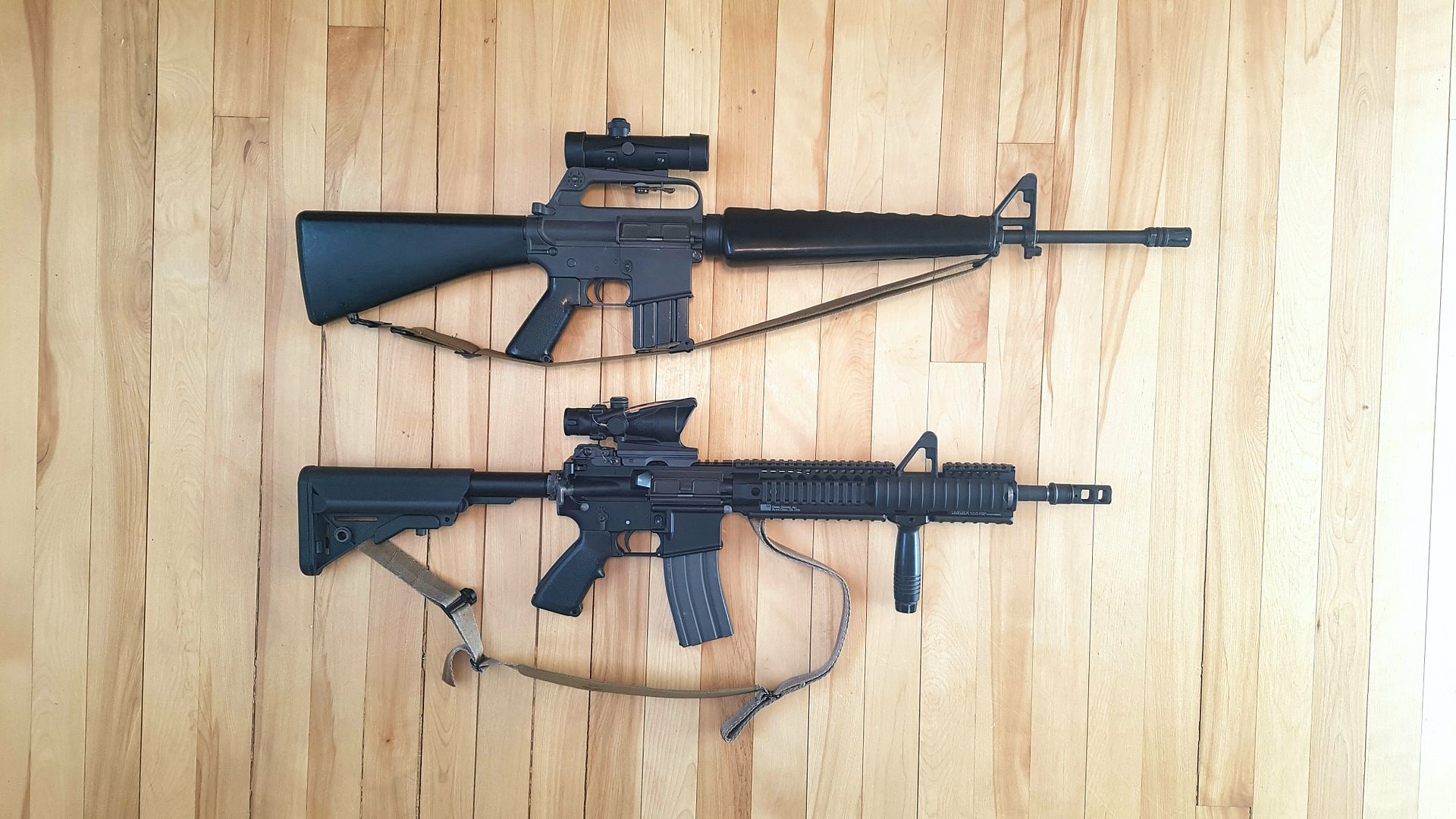
Has the AR-15 put on weight over the years?

PSE

CGN Ultra frequent flyer
Rating - 100%
18   0   0
Went to the Gun show down here in the Phoneix area and of course the premier gun of the show was the AR-15. There were hundreds of examples from many different manufacturers (many I've never even heard of) and of course there was every conceivable style in many different barrel lengths.

Of course I picked up and hefted a lot of them and then came across one of the originals with triangular fore end and was really surprised at how light it really was back then. Most of the more recent ones are noticeably heavier especially on the front end where it feels quite obvious. It seems the industry is drifting away from one of the huge advantages of the platform which was light weight. This seems especially apparent in the rise of the popularity of the monolithic upper receiver.

I know you can build from parts whatever you want and that's fine but most of the factory offerings seem rather front end heavy to me. Add to that optics, mounts, a weapon light, maybe a laser and you really have a rather front heavy piece of kit. Yeah I know I can work out more at the gym (I'll say it first)

A lot of that weight is presumably in the heavier barrel profile, probably because of a market demand for ever more accurate rifles. 3 MOA was once the military standard but that hardly satisfies the civilian shooter anymore. My 308 battle rifles don't seem that heavy in comparison anymore;)

Any thoughts on this observation?
 
Oh I absolutely agree, I've got an old 20" Colt SP1 that is far lighter than the 14.5" carbine I pieced together.

I should weight them sometime :confused:

20180120_125311_zpsql8duynb.jpg
 
The other issue is that gas piston versions are all the rage. This adds significantly to the weight especially at the front end where you notice it the most.
 
As has been said, there has been a trend towards heavier barrels, forward rail-mounted accessories (electro-optics, laser designators, lights), and Piston Operstion that has resulted in a gradual, historic weight gain. Nowhere is the shift more evident than in a direct comparison between the original XM177E2 and an operstionally-configured C8 Flat-Top Heavy-Barrel carbine. I happen to have several representative AR carbines which illustrate the historic trend towards heavier service rifles:

XM177E2 (Troy 50th Anniversary Commemorative):

30jiw6t.jpg


C8 Carbine (clone of my 2002 Service Carbine):

t9y35u.jpg


HK Match Rifle (Piston Operation & Heavy Barrel):

8wjc01.jpg


C8 Flat-Top Top Heavy Barrel with Operational Accessories (clone of my 2008 service carbine):

2r3innn.jpg
 
Once you handle and shoot an original M16A1 style AR you will truly understand balance and lightweight Sir
It's the only one I own.
All my personal preferences and outstanding design characteristics for the AR rifle start disapearing rapidly the further forward and away from that original design they get IMO
The A2 barrel profile is the best example of a useless "improvement" to the rifle in a long line of them for one example. It's not a popular opinion in these days of tactile tactical tactics, The modern AR accessories people slap on them today make them the visual and practical equivelant of those goofy ass fantasy knives that 30 year old virgins collect lol......but I'm sure I am not the only one.
This is from a perspective of a person who just takes his AR to a gun club only to shoot steel/paper mind you.
 
Last edited:
Civilians with all of the "tacti-cool" accessories affixed to their carbines Ă nd rifles are usually just trying to emulate the military firearms seen on TV and in the movies. Badarse gun = Badarse Operator, right? This "Walter Mitty" behaviour is particularly evident in Canada, where we lack the night hunting and home defence "castle laws" to legitimize the actual use of light/lasers, night vision devices, suppressors, etc. But even in the US, I am willing to bet that most "tactical" accessories are there mostly for the Look Cool Factor rather than any practical application. Absolutely nothing wrong with that, so long as people don't go around actually believing that a flashlight on their carbine makes them a ninja.....

On the other hand, everything you see pictured on my C8FTHB served a legitimate operational purpose for fighting in Afghanistan. Did I feel under-gunned in 2002 when I deployed with a basic, bone-stock C8? No, because that's all we had at the time. That said, I wouldn't have voluntarily given up any of the gunfighting "tech" advantages in 2008 as they gave us an edge over the enemy. This was particularly true at night where our infra-red laser Illuminators and target designators allowed us to precisely identify and target the enemy, but also by day where our magnified optics facilitated otherwise difficult target discrimination. There is nothing "fantasy" about that setup, other than the fact that it is now a re-creation of what I actually carried in Afghanistan. The laser designator is not a genuine infra-red PEQ2A, but the Trijicon scope, Larue mount, and M3X Tactical Illuminator are the actual items that were on my weapon overseas and survived the IED strike that took my legs and otherwise destroyed my service carbine.

As noted, it is all about perspective. This was mine...


2i90ys5.jpg
 
Most are. Majority of the problem is the chunky barrels... and the gazillion accessories. If you wanted to do a dedicated lightweight build you can. With a pencil profile barrel and have a very light carbine pending you don't bolt stuff on. Be smart about your optic/iron options and you can have some sweet rigs that balance great and weigh very little.


P.s. Bartok5 that is some ###y carbines you have there.
 
My XM177 E2 weighs in unloaded as pictured, at 6 lbs, 11.6 Oz. The accessorized C8FTHB weighs 11 lbs, 8.4 Oz. A difference of almost 5 pounds in barrel, optic, illuminator and visible laser....
 
The heavy barrel profile helps mitigate heat build up in sustained fire. I've never been in a sustained firefight so I can't comment on how much it helps in the real world, but I think we can all agree a hot barrel will not shoot as straight as a cool one. Not a big deal at close range, but at longer distances it could be the difference between scaring the crap out of the bad guy, or putting one in his melon. As for the weight, if your Mech Infantry a few extra pounds won't matter, and lugging a C2 as a Paratrooper didn't cause me any problems...and I wasn't known for my upper body strength. Perhaps in a hot climate it would make a difference, but I think on the whole a few extra pounds are worth it if it helps reduce the effect of a hot barrel on accuracy.
 
Great posts here guys.

Personally, I love lightweight ARs. But there is a valid application for every weight class of AR, from DMR all the way to light recon.

From the perspective of firearms manufacturers: Their job is to sell firearms and make money doing it. If they could make more money offering lightweight options, they would be doing it. In terms of marketable design, there is only so much you can offer in terms of lightweight versions.

I think there is probably a much smaller market for lightweight ARs than many people would think. Relatively few civilian users carry their ARs any significant distance, even in the US where you can hunt with them. Also, relatively few actually run-and-gun with them (compared to the number of tailgate shooters and armchair commandos). Those that do are probably satisfied with or would even prefer doing their own custom / semi-custom lightweight builds.

Currently, I see the best lightweight offerings marketed as 3-Gun specific models from various manufacturers. However, even there you see a tendency towards longer and heavier profile barrels. This makes sense given the design of most 3-Gun stages, though. I don't even know who currently sells pencil-barrel models.
 
The heavy barrel profile helps mitigate heat build up in sustained fire. ...

but I think on the whole a few extra pounds are worth it if it helps reduce the effect of a hot barrel on accuracy.

I agree the best "weight investment" for accuracy is in the barrel. As long as everything else works reliably. But it wouldn't even be a matter of pounds, I think. More like ounces.

And it only matters if your "shooting events" (number of shots fired before allowing the barrel to cool) are measured in numbers of magazines rather than numbers of rounds.
 
... The laser designator is not a genuine infra-red PEQ2A, but the Trijicon scope, Larue mount, and M3X Tactical Illuminator are the actual items that were on my weapon overseas and survived the IED strike that took my legs and otherwise destroyed my service carbine.

As noted, it is all about perspective. This was mine...

Bartok, I don't want to be "that guy", but I don't know what else is appropriate: We are all grateful for your service, and sorry for the unfair outcome.
 
The other issue is that gas piston versions are all the rage. This adds significantly to the weight especially at the front end where you notice it the most.

Pistons are not "all the rage" they were for a short period of time.

My XM177 E2 weighs in unloaded as pictured, at 6 lbs, 11.6 Oz. The accessorized C8FTHB weighs 11 lbs, 8.4 Oz. A difference of almost 5 pounds in barrel, optic, illuminator and visible laser....

I'm sure you would agree that the added weight from optics, laser designators, and lights are necessary evils for improving the performance of the rifle over the bone stock iron sight AR's of years ago. The Heavy barrel is a waste of time unless you do a lot of full auto work.
 
Don't forget the fore end grips and sound suppressor and pull tabs on the mags and bipod and night vision scope etc etc etc.

Starts to make a car axle look light in comparison.
 
I'm sure you would agree that the added weight from optics, laser designators, and lights are necessary evils for improving the performance of the rifle over the bone stock iron sight AR's of years ago. The Heavy barrel is a waste of time unless you do a lot of full auto work.

As I said above, the accessories carried on combat operations were essential force-multipliers in our favour. As such their use was not "optional". One could even argue that they were essential items of Force Protection Equipment, given that they provided the user with a definite edge over our enemy combatants.

Heavy barrels were not useful so much for their performance during protracted firefights, although there were certainly such circumstances on occasion. For the most part however, the value of the heavy barrel was in its stiffness, which resulted in enhanced accuracy despite not being free-floated. My preference would have been for a heavily fluted, heavy-profile barrel which would provide the stiffness/accuracy benefits of the heavy barrel without all of the weight. That said, fluted barrels can experience issues of their own if not properly heat-treated and stress-relieved.


htwfhf.jpg
 
Don't forget the fore end grips and sound suppressor and pull tabs on the mags and bipod and night vision scope etc etc etc.

Starts to make a car axle look light in comparison.

Forend grips are unecessary. Suppressors are a huge benefit/force multiplier as is NV/NOD's which should be on your head not the rifle.. A bipod is removable and should be utilized on DMR rifles. There's no free lunch but a suppressor and NOD's(and or IR designator) are worth their weight.

As I said above, the accessories carried on combat operations were essential force-multipliers in our favour. As such their use was not "optional". One could even argue that they were essential items of Force Protection Equipment, given that they provided the user with a definite edge over our enemy combatants.

Heavy barrels were not useful so much for their performance during protracted firefights, although there were certainly such circumstances on occasion. For the most part however, the value of the heavy barrel was in its stiffness, which resulted in enhanced accuracy despite not being free-floated. My preference would have been for a heavily fluted, heavy-profile barrel which would provide the stiffness/accuracy benefits of the heavy barrel without all of the weight. That said, fluted barrels can experience issues of their own if not properly heat-treated and stress-relieved.


htwfhf.jpg

I hear what you're saying, but the heavy barrel does little for accuracy. the rigidity of an HB can be achieved by using a shorter barrel as well. Of course you lose velocity which reduces effective range when you go that route. Don't forget the service ammo in use isn't match grade and I'm sure most situations didn't allow a lot of time for proper form either.

Anyone notice that CC's newest rifles the MRR series has neither the silly Simon sleeve nor heavy contour barrels... That would be a clue
 
Back
Top Bottom