Help me understand powder choice - pressure and velocity

diegocn

CGN Regular
Rating - 100%
90   0   0
I'm loading for 7.62x39 caliber, currently using IMR 4198 with good results. But when I look at load data from Hodgdon for other powders, there are other powders that (supposedly) produce more velocity for less pressure. Take the Hodgdon load data for 7.62x39 with 125Gr projectile below for example:


At max load:
* IMR 4198 produces 2250 fps at 42,500 CUP pressure.
* H4198 produces 2378 fps (more than IMR4198) at 40,400 CUP pressure (less than IMR4198).
* H4895 produces 2249 fps (roughly the same as IMR4198) at 33,600 CUP pressure (considerably less than IMR4198).

Would I be right to conclude that both H4198 and H4895 are better powder for this caliber, because they run more velocity (more KE) for less pressure (longer brass life)? Or am I worrying about something I shouldn't be?
 
Question have you shot these powders and load combinations???? If not go do it. And see in reality what your rifle likes!!! All the data in the would isn't worth a hill of beans unless you apply it to a real world shooting situation.
My guess is you will see an obvious best powder and load combination as it pertains to accuracy. After that the pressure means squat (as long as you are working the the safe zone for your rifle.) Watch for pressure signs as you shoot. Work up your loads from start in .3 grain increments. As for case life it is what it is....once you derive the best accuracy you are satisfied with. Count how many times fired and watch for things like split necks, enlarged primer pockects, case irregularities etc...

PS....I like the Lyman 49th edition as they highlight the most accurate powder and load from their testing. Gives me a good idea what should perform well for me.
 
I'm loading for 7.62x39 caliber, currently using IMR 4198 with good results. But when I look at load data from Hodgdon for other powders, there are other powders that (supposedly) produce more velocity for less pressure. Take the Hodgdon load data for 7.62x39 with 125Gr projectile below for example:

At max load:
* IMR 4198 produces 2250 fps at 42,500 CUP pressure.
* H4198 produces 2378 fps (more than IMR4198) at 40,400 CUP pressure (less than IMR4198).
* H4895 produces 2249 fps (roughly the same as IMR4198) at 33,600 CUP pressure (considerably less than IMR4198).

Would I be right to conclude that both H4198 and H4895 are better powder for this caliber, because they run more velocity (more KE) for less pressure (longer brass life)? Or am I worrying about something I shouldn't be?

The powders that produce a higher Muzzle Velocity (MV) than H4198 at the same or similar pressure also use more powder. That is because they have a "Slower Powder Burn Rate", i.e. they release their energy differently than the slightly faster H4198. The higher MV is undeniable, but what's most important is if they are accurate in your gun.
 
They are not mentioning what firearm they are shooting their loads in.
They do mention that it is a 24" barrel.
Are you using the same length barrel?
They may not even be shooting the loads out of a rifle but a test barrel in a fixture.

You are only looking at velocity. There are other things to consider such as if it will cycle your firearm properly and accuracy.
There are other factors that some may feel are important such as how a powder meters through a powder measure or trickler.
Brass life is another factor that may come into play.
I have a friend who was shooting a max load in a 300RUM and the primer pockets would be trashed in 2 shootings.
We switched powders and with almost the same velocity his brass lasts 3 times longer.
Its ability to maintain a consistent velocity in cold and hot weather is another factor as well as excessive muzzle flash etc.

You must also be aware of port pressure in semi auto firearms.
This is very important in some gas operated rifles such as the M14 pattern rifle and the M1 Garand.
Experts in those rifles say that you should use no powder faster than IMR 3031 and no slower than IMR 4064 with bullets up to 175 gr max.
There are others who have carefully loaded different powders outside that range that claim they have never damaged a rifle.
Others say differently.

The only way to tell how it will react in your rifle is to test different loads with different powders and find out for yourself what you like.
 
The 4895 shows less pressure because the case is too small and they can't get enough powder in the case.

For practical purposes, the other powders run similar pressures and velocities.

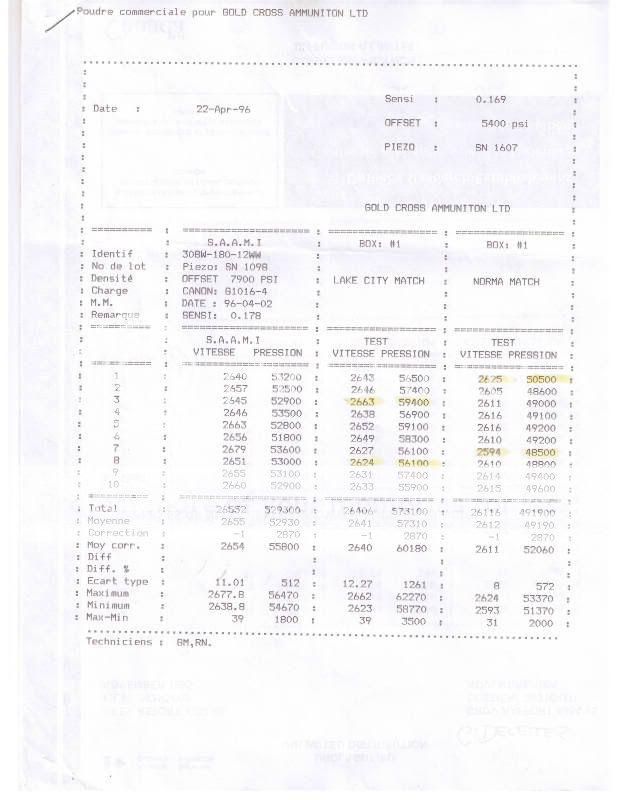
It is common to see powders listed as MAX, but the pressure shown is less than the Max of other powders. This is because when testing ammo, 20 rounds are fired. Max is a combination of the average pressure and the highest pressure of the hottest round.

The specification might say max is average pressure of 62,000 psi and max single round of 65,000 psi.

If you are choosing powders, the best powder would be the one with the highest pressure, because that indicates the less variation in pressures. A powder showing a max load with a pressure well below max indicates erratic pressures, and one of the rounds hit the single round limit.
 
The 4895 shows less pressure because the case is too small and they can't get enough powder in the case.

For practical purposes, the other powders run similar pressures and velocities.

It is common to see powders listed as MAX, but the pressure shown is less than the Max of other powders. This is because when testing ammo, 20 rounds are fired. Max is a combination of the average pressure and the highest pressure of the hottest round.

The specification might say max is average pressure of 62,000 psi and max single round of 65,000 psi.

If you are choosing powders, the best powder would be the one with the highest pressure, because that indicates the less variation in pressures. A powder showing a max load with a pressure well below max indicates erratic pressures, and one of the rounds hit the single round limit.

Exactly.

Consistency is key to developing accurate loads.
 
Wow you guys rock! This is the exact kind of response I was looking for. Usually when ask for powder choice you get the type of response like 'I tried powder A and I like it' without much reasoning behind. Also the info on how manufacturer test their powder is cool.

For the record, I do get very good result with IMR4198 in my bolt gun. I wanted to try some other powder, but at $40~50/lb it gets expensive if I start buying all of them. So I try to figure out which one is the best to try next, and hence the post.

I think the other take home point is to invest in a good reloading manual. Base on all the responses it seems a good manual offers much more than what I can find on Hodgdon site.

One more question, if I'm allowed to pick only one other powder to tinker with for 7.62x39 in my CZ527, which one of the following would you recommend and why?
- H4198
- H4985
- AA1680
- H335
 
The 4895 shows less pressure because the case is too small and they can't get enough powder in the case.

For practical purposes, the other powders run similar pressures and velocities.

It is common to see powders listed as MAX, but the pressure shown is less than the Max of other powders. This is because when testing ammo, 20 rounds are fired. Max is a combination of the average pressure and the highest pressure of the hottest round.

The specification might say max is average pressure of 62,000 psi and max single round of 65,000 psi.

If you are choosing powders, the best powder would be the one with the highest pressure, because that indicates the less variation in pressures. A powder showing a max load with a pressure well below max indicates erratic pressures, and one of the rounds hit the single round limit.

THIS IS INTERESTING!
It makes sense now that it has been explained, but I dont recall ever having read that in any manual.
And I do RTFM. :)
 
THIS IS INTERESTING!
It makes sense now that it has been explained, but I dont recall ever having read that in any manual.
And I do RTFM. :)

Next time I write something for a manual I might try to explain this. if you look at a sheet of test results, it becomes self-evident.

testdatasheet.jpg
 
Back
Top Bottom