High extreme spread with h335

rifleman1377

CGN Regular
Rating - 100%
27   0   0
I been getting high extreme spread with h335, I tried using my chargemaster to cut that down but it did not have any impact.

Here are my data. I hope you guys can shed some light on this.

Rifle: sa20
Bullet: 55gr campro
Primer:Remington SR
Powder: H335
Charge:24.8gr
Trim Length: 1.740"
OAL"2.240
Crimped

SD: 36.28 FPS
Max Spread: 116
Average FPS:3070

Velocity (FPS)
3038
3077
3105
3098
3070
2989
3104
3049
3083
3091

All readings where taken with a Shooting Chrony F1
 
I was recently given about 800 Remington 9 1/2 LR primers and tried them with a work up in .30-30. Velocities were all over the place with no linear increase in velocity with charge weight. One starting load round had higher mv than a max load round. Velocities taken with a magnetospeed. Switched to federal match primers (cause I had them) and re-did the work up with completely linear velocity increases with charge weight. Perhaps try a different primer. I usually end up right at 25.0 grs H335 under a 55gr fmj and 3050ish velocity in 18.5" gas guns with good accuracy, often under 1.5 moa.
 
Not to hijack the thread.. but legi0n would you mind sharing some of your findings on the Campro bullets? Looking at purchasing some and haven't been able to find any info on their quality and consistency.
 
after weighting two thousand Campro bullets I can say they're not the most consistent either.

This. I got less finnicky over time about neck tension and turning when I found I got better results by sorting bullets by weight.

I open a bag/box weigh each on my gempro 250 and start making stacks of each weight. All bullets then get loaded from heaviest to lightest. It was tedious, but at the same time OCD therapy. Relaxing and satisfying at the same time. The results were great and I was doing this to my .223 and .308 hornady match bullets first. Try it once for science and see how much variance your bullets have.

My best results to date have been: in order of importance.

1. powder charge consistency
2. Powder charge node finding. (ladder test)
3. bullet sorting by weight
4. neck sizing fireformed brass
5. Neck turning
 
This. I got less finnicky over time about neck tension and turning when I found I got better results by sorting bullets by weight.

I open a bag/box weigh each on my gempro 250 and start making stacks of each weight. All bullets then get loaded from heaviest to lightest. It was tedious, but at the same time OCD therapy. Relaxing and satisfying at the same time. The results were great and I was doing this to my .223 and .308 hornady match bullets first. Try it once for science and see how much variance your bullets have.

My best results to date have been: in order of importance.

1. powder charge consistency
2. Powder charge node finding. (ladder test)
3. bullet sorting by weight
4. neck sizing fireformed brass
5. Neck turning

This is exactly where I am at now as well with each stage of the above giving incrementally smaller but readily identifiable increases in overall accuracy.

As to the H335, I never could get it to work very consistently, even with Hornady match grade bullets out of a very good shooting bolt gun. Also note that it is recommended to use SR MAGNUM primers with 335 which I did. Those 55gr FMJ bullets were the worst and I tried various brands including Hornady. Don't know if they make their own or resell but the Hornady were better overall than the Campro but still far less in weight consistency than the match grade 52 and 68gr BTHP. If you want spray and pray, 2 or 3 MOA accuracy, the 55gr FMJ and H335 will give it to you. If you want good to excellent accuracy, under 0.5MOA out of a good bolt gun, 68gr Hornady or 69gr Sierra SMK with H4895 or Varget will give you a chance at it.
 
I would usually suggest a Magnum primer and good crimp. The Remington is a hot primer, so I doubt it is a hotness issue.

I suggest you try a CCI or Winchester Magnum primer and 25.0 and 25.3 gr and see if there is a change.

Also, the Chrony has a very high clock speed. It can note time differences caused by aiming the bullet through the traps at different angles. Best results are obtained by aiming at something on the far side.
 
You didn't mention the brand of your brass or the number of times it has been fired. Different brands of brass normally have different capacities resulting in different pressures and velocities. Mixed brass will not usually give as consistent results as all one brand, preferably from the same lot. Cleaning media from tumbling caked inside the case can also cause erratic velocities and pressures. Another cause can be thickened necks on much used cases, that's why the precision shooters neck turn. And as mentioned, ball powders usually call for hot primers. Good luck.
 
I been getting high extreme spread with h335, I tried using my chargemaster to cut that down but it did not have any impact.

Here are my data. I hope you guys can shed some light on this.

Rifle: sa20
Bullet: 55gr campro
Primer:Remington SR
Powder: H335
Charge:24.8gr
Trim Length: 1.740"
OAL"2.240
Crimped

SD: 36.28 FPS
Max Spread: 116
Average FPS:3070

Velocity (FPS)
3038
3077
3105
3098
3070
2989
3104
3049
3083
3091

All readings where taken with a Shooting Chrony F1

Barrel length please?
 
try a LEE factory crimp die, it cut the ES on my 223 in half. Sort brass by brand and lot #, sort bullets for consistency. Sounds like it's a bit of an economy load, so don't get too worried about perfection
 
My blasting ammo load for three AR15 rifles is 25 grains of H335 and with a long throated rifle the chamber pressure is much lower than normal and had a spread similar to yours.

The throat in my Savage .223 is longer than my AR15 rifles and could be loaded warmer than load data for .223 rifles with the shorter .0125 throats.

And if you look in the Lyman manual the max load is 27 grains of H335 for a AR15 rifle with a .0500 length throat.

Meaning I would do as Ganderite suggested and increase the load until the extreme spread lowers. In Quickload and a load of 55 grains of H335 the chamber pressure is below 50,000 psi and you may not be getting a good burn.

I would usually suggest a Magnum primer and good crimp. The Remington is a hot primer, so I doubt it is a hotness issue.

I suggest you try a CCI or Winchester Magnum primer and 25.0 and 25.3 gr and see if there is a change.

Also, the Chrony has a very high clock speed. It can note time differences caused by aiming the bullet through the traps at different angles. Best results are obtained by aiming at something on the far side.

Bottom line, todays .223 rifles have throats long enough to fit the .223 cartridge plus the company lawyer in them. And its the older .223 rifles with 1 in 12 and 1 in 14 twist rates and shorter throats that most .223 load data come from. (look at the firearm used for the load data)
 
Thanks for the info.

I think I am going to fart around for the next year with my 55gr loads. This is just for fun really, I want to get the most out of my reloads. With 69 gr smk and 24.0 gr of varget I already have a good match load.

I use this ammo for 50m shooting, just to practice shooting non supported in the 3 positions.

My take away from this post

Use magnum primers
Increase powder charge to 25 gr

Just as a heads up for those who do not already know. DO NOT USE Remington 6 1/2 primers in ar15 or 223 rem. They have really thin cups and will erode the firing pin. I found this out as I was cleaning the rifle so do becareful
 
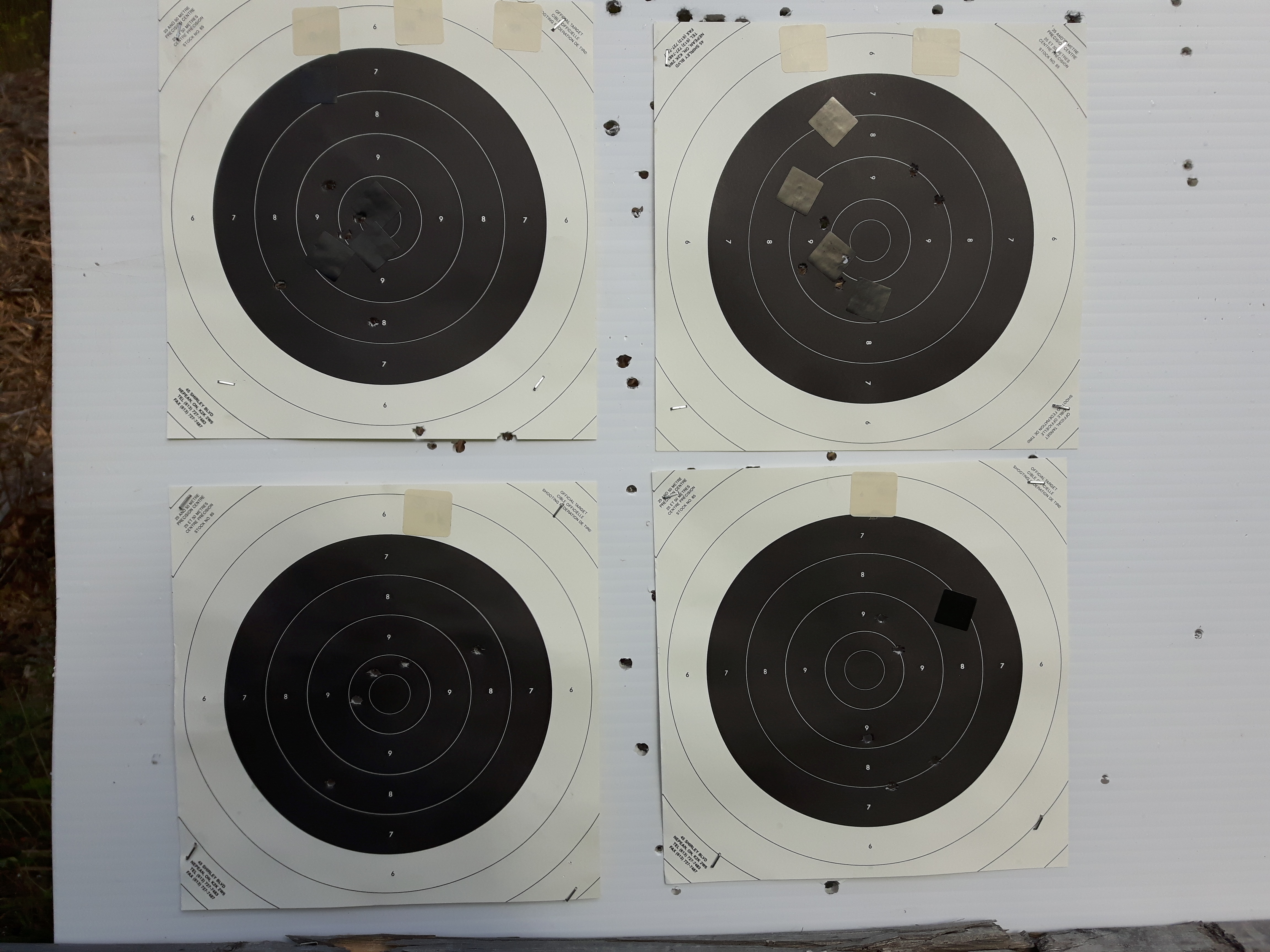
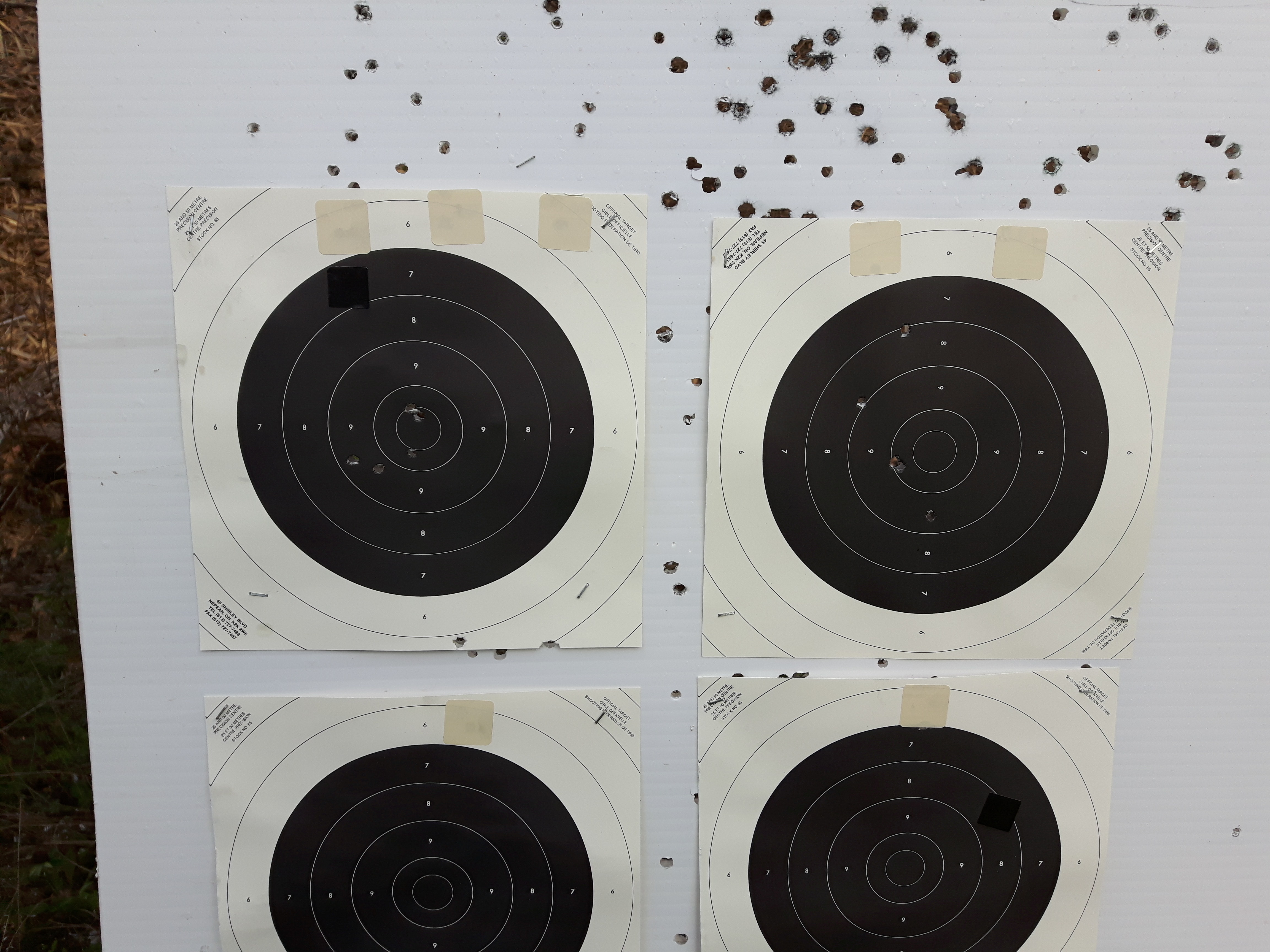
Here are the groups if anyone is curious. Ignore the bottom hole on the top left target, it was from sighting in the beginning I just did not patch it for some reason.

fgkkApT.jpg

xyABr5J.jpg
 
Thanks for the info............Just as a heads up for those who do not already know. DO NOT USE Remington 6 1/2 primers in ar15 or 223 rem......
^^^^^ EXACTLY ^^^^^

From the Midway USA website:

Remington Small Rifle Primers #6-1/2
Warning: Remington does not recommend this primer for use in the 17 Remington, 222 Remington, 223 Remington, 204 Ruger, 17 Remington Fireball. Use the 7-1/2 Small Rifle Bench Rest primer in these cartridges. This 6-1/2 Small Rifle primer is primarily designed for use in the 22 Hornet.

And from Cabelas US website:

Warning: Remington does not recommend use of the 6-1/2 Small Rifle primer for use in the 17 Remington, 222 Remington, 223 Remington, 204 Ruger, 17 Remington Fireball. Use the 7-1/2 Small Rifle Bench Rest primer in these cartridges. The 6-1/2 Small Rifle primer is primarily designed for use in the 22 Hornet.

All the same, many retailers sell the 6-1/2 primers for 5.56/.223 reloading because they don't have a clue.....
 
Last edited:
first thing to consider, a chrony has an acccuracy of +/- 1% this means if all bullets fly at exactly 3000 fps, the chrony can say anything between 2970 to 3030

it the sensors are directly under the sun, then it goes real crap. I put a table over mine. and I dont use it to judge amo concistency. I let the targets do it. its only to get a starting point for ballistic tables.

I found H322 works better than H335 with 55gr bullets and also runs cleaner. campro are nice cheap plinking bullets, but for longer range targets, keep your smk load;)
 
From my person experience the F1 is actually pretty good with the defuser. I have data from a sunny day and the SD where almost identical.

May try out the h322 in the future.
 
Back
Top Bottom