












































You are using an out of date browser. It may not display this or other websites correctly.
You should upgrade or use an alternative browser.
You should upgrade or use an alternative browser.
Holland and Holland A Short Story
- Thread starter Big Bad
- Start date


Interesting video, and a good story, thanks for posting it. Understandably the video covers more recent Hollands and the magnificent Royal, but happily it also briefly covers the firm's origins. Even a big London name had to have started somewhere. Typically, a firm started small around the output of one gunmaker, a few workers, and perhaps an apprentice or two, gradually building a reputation for putting up fine guns. Of course, the barrels, locks and assorted furniture would come from elsewhere, usually Birmingham and the black country ironworks, and the actioning, fitting and finishing done in the London premises or by skilled outworkers.
As mentioned in the video, Harris John Holland set up in business as a tobacconist. This was in 1835 at 9 King Street, Holborn, London. Also mentioned in the video is that he was a keen rifle shot and an enthusiast of live-pigeon shooting. During the 1840s, he became involved in dealing in guns, and by 1850 he was a full-time gunmaker. The business moved to 98 New Bond Street in 1858, and his nephew, Henry William Holland, was taken on as an apprentice in 1860 for the usual seven-year term. He became a partner in the business at the end of his apprenticeship in 1867. Harris retired in 1875, and in 1876, the firm's name changed to Holland & Holland.
Harris Holland started making breech-loaders in 1857 when he made six of them. In 1858 he made 14, and in 1859 he doubled his output to 28 breech-loading guns. Production increased very gradually after that, averaging some 30-40 breech-loading sporting guns a year. In 1865 he sold a whopping 66 breech-loaders (!), and by comparison, only 19 percussion-cap guns. All of the breech-loaders up to this point were pinfires, as Harris Holland made his first centre-fire gun in 1866. If these numbers seem low, they were comparable to the other top makers of the day, such as Boss & Co., Purdey, etc., and smaller firms could be making far fewer. This is why any early breech-loader is exciting, to me at least.
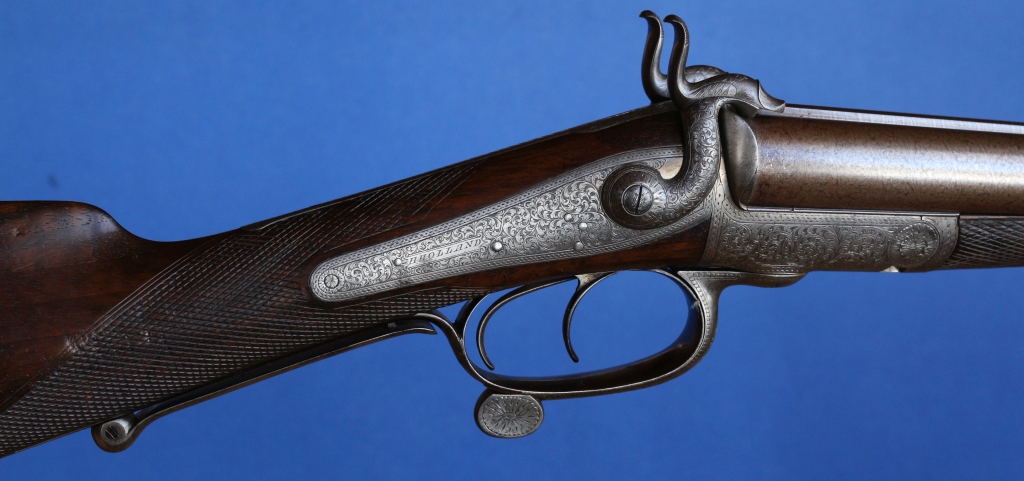
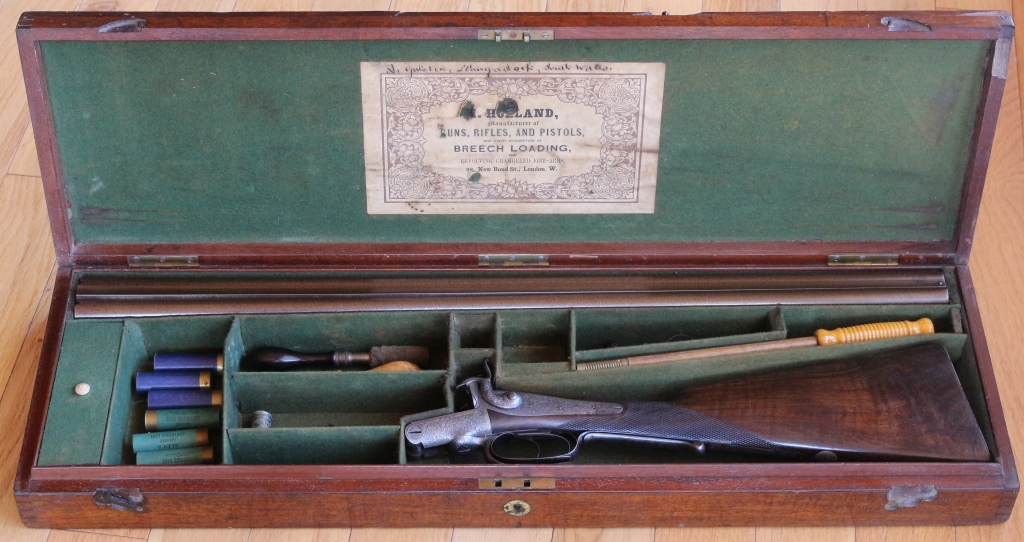
Here is gun number 824, a 12-bore single-bite rotary-underlever sporting gun with back-action locks, made in 1861 for Alan James Gulston of Dirleton and Derwydd, Wales. Gulston was one of the largest landowners in Britain at the time, so he could afford a Holland! It has what was to become the house engraving style, and the rib is signed "H. Holland 98 New Bond St London" on the top rib. More importantly, it is stamped "H.H" on the under rib, convincing me Harris Holland made this gun, it wasn't one that he simply put his name on. It has a mechanical grip safety, a hold-over from percussion-cap guns. The bores are perfect, and it weighs 7 lb 1 oz.
As mentioned in the video, Harris John Holland set up in business as a tobacconist. This was in 1835 at 9 King Street, Holborn, London. Also mentioned in the video is that he was a keen rifle shot and an enthusiast of live-pigeon shooting. During the 1840s, he became involved in dealing in guns, and by 1850 he was a full-time gunmaker. The business moved to 98 New Bond Street in 1858, and his nephew, Henry William Holland, was taken on as an apprentice in 1860 for the usual seven-year term. He became a partner in the business at the end of his apprenticeship in 1867. Harris retired in 1875, and in 1876, the firm's name changed to Holland & Holland.
Harris Holland started making breech-loaders in 1857 when he made six of them. In 1858 he made 14, and in 1859 he doubled his output to 28 breech-loading guns. Production increased very gradually after that, averaging some 30-40 breech-loading sporting guns a year. In 1865 he sold a whopping 66 breech-loaders (!), and by comparison, only 19 percussion-cap guns. All of the breech-loaders up to this point were pinfires, as Harris Holland made his first centre-fire gun in 1866. If these numbers seem low, they were comparable to the other top makers of the day, such as Boss & Co., Purdey, etc., and smaller firms could be making far fewer. This is why any early breech-loader is exciting, to me at least.
Here is gun number 824, a 12-bore single-bite rotary-underlever sporting gun with back-action locks, made in 1861 for Alan James Gulston of Dirleton and Derwydd, Wales. Gulston was one of the largest landowners in Britain at the time, so he could afford a Holland! It has what was to become the house engraving style, and the rib is signed "H. Holland 98 New Bond St London" on the top rib. More importantly, it is stamped "H.H" on the under rib, convincing me Harris Holland made this gun, it wasn't one that he simply put his name on. It has a mechanical grip safety, a hold-over from percussion-cap guns. The bores are perfect, and it weighs 7 lb 1 oz.





















