












































You are using an out of date browser. It may not display this or other websites correctly.
You should upgrade or use an alternative browser.
You should upgrade or use an alternative browser.
Hornady concentricity gauge
- Thread starter Remtac
- Start date


I have one and find it works good, although not as versatile as some such as the RCBS unit which you can perform several functions with.
can you correct the runout with the RCBS ? it appears thr RCBS can only measure concentricity and cannot correct it .The hornady version can measure and correct it .https://www.youtube.com/watch?v=MWSXyeEFxic&t=5s
Last edited:

hunters home
CGN Regular
Yes you can correct it with the Hornady unit,but this brings on other problems such as different neck tension. Some reloaders contend that when you straighten the bullet you change the neck tension from the rest of the good rounds. I have both units and while I like both I would take the RCBS unit if I had to settle on one. I like being able to check case neck run out after sizing or when setting up my sizer die. You can't do this with the Hornady as well as neck thickness or case stretching due to head space or a badly adjusted sizer die. These are some of the things I like to measure.
And no you can't correct bullet run out with the RCBS unit.
And no you can't correct bullet run out with the RCBS unit.
Yes you can correct it with the Hornady unit,but this brings on other problems such as different neck tension. Some reloaders contend that when you straighten the bullet you change the neck tension from the rest of the good rounds. I have both units and while I like both I would take the RCBS unit if I had to settle on one. I like being able to check case neck run out after sizing or when setting up my sizer die. You can't do this with the Hornady as well as neck thickness or case stretching due to head space or a badly adjusted sizer die. These are some of the things I like to measure.
And no you can't correct bullet run out with the RCBS unit.
i wonder if an annealed case would prevent the neck tension issue from correcting the run out with the hornady concentricity gauge , due to the softer neck from being annealed ?
Yes you can correct it with the Hornady unit,but this brings on other problems such as different neck tension. Some reloaders contend that when you straighten the bullet you change the neck tension from the rest of the good rounds. I have both units and while I like both I would take the RCBS unit if I had to settle on one. I like being able to check case neck run out after sizing or when setting up my sizer die. You can't do this with the Hornady as well as neck thickness or case stretching due to head space or a badly adjusted sizer die. These are some of the things I like to measure.
And no you can't correct bullet run out with the RCBS unit.
would be interesting to test fire 5 rounds that have been corrected with the hornady concentric gauge VS 5 rounds that has not been corrected and compare groups and SD and ES . im sure this has been talked about before
Last edited:

"Repairing" concentricity is not something anyone should test.
If your runout is above 2 thou you need to address WHY IT IS not try and fix it after.
yeah makes sense
hunters home
CGN Regular
That is what I find real good about the RCBS unit as you can test for run out at different stages of you reloading process. This way you can identify when and what is giving you run out and correct it. I feel you really need a gauge like this one to properly set up the resizing die where a lot of the run out comes from.

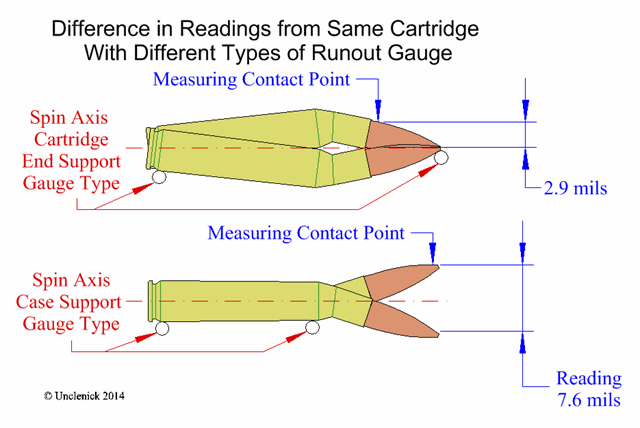
I have both the Hornady and RCBS concentricity gauges, the Hornady gauge will read half the runout because the case is held like it would be in the rifles chamber. Meaning the case being held by the bolt face in the rear and by the bullet in the throat. The RCBS gauge spins the case body in V-blocks and will read twice as much runout as the Hornady gauge.
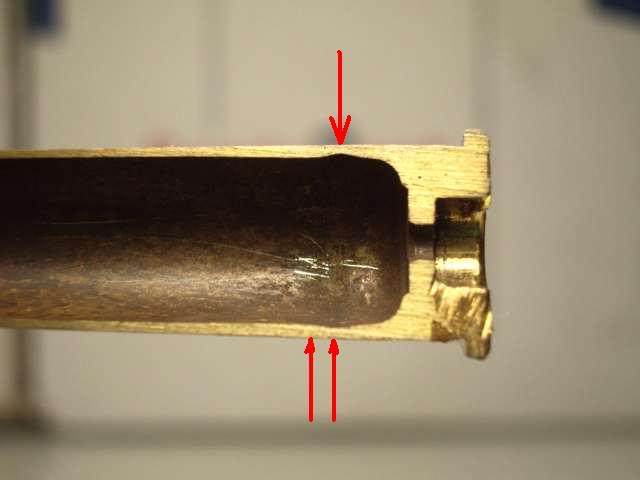
The RCBS case mastering gauge is the Swiss Army knife of gauges and is OK for normal reloading and measures many parts of the case. When not measuring neck or bullet runout you can use it to measure case thinning in the base web area.
The factory loaded Winchester .303 British case below stretched and thinned .009 on its first firing. So you can think of this gauge as a very accurate $100.00 bent paper clip. The biggest problem with this gauge is the V-blocks are painted aluminum and you will wear through the paint over time and the brass case will "drag" on the bare metal. Normally a good gauge rotates the case on ball bearings and the case will spin very easily. The cure for the case dragging is to put some case lube or grease the chamber walls on the V-blocks.
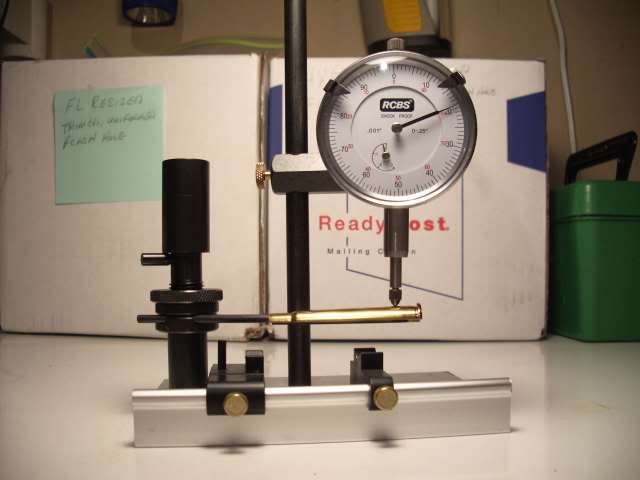
I was using both gauges tonight, I was checking case neck runout with the RCBS gauge and final bullet runout with the Hornady gauge.
If I was going to buy just one gauge it would be the RCBS gauge because it can measure case neck runout. This is a great help when setting up dies for minimum neck runout and finding out where the runout problem starts.
Note, the U.S. Military considers .003 or less bullet runout to be match grade ammunition.
"Now the last scenario, a full-length sized case in which the neck is also fully sized. There is clearance at the neck and in the body of the case, the closest fit anywhere is the bullet in the throat. If the neck to bullet concentricity is good (although it needn't be perfect), then the bullet will find good alignment in the throat and the case body and neck will have minimal influence. Let's not forget that the base of the case is supported by the bolt face or the extractor to a certain degree as well; this is yet another influence on alignment. As you can see, there are several points from base to bullet that can have an effect. My procedure is to minimize the influence of those that I can control, namely the case body and neck, and let the alignment be dictated by the fit of the bullet in the throat and to some extent by the bolt's support of the base. Barring a seriously out of square case head, I don't think the bolt can have a negative effect on alignment, only a slightly positive effect from minimizing "case droop" in the chamber. Given that a resized case will usually have a maximum of 0.001" diametrical clearance at the web, this isn't much of a factor anyway."
Bottom line, with a full length resized case the body of the case does not touch the chamber walls. And the Hornady gauge holds the case like it would be in the chamber. And yet the majority of runout gauges spin the case on the case body as if you were neck sizing only. The bad part of spinning the case on the body is if the case expands more on one side when fired it becomes egg shapped. And when this happens you will read more runout than you actually have if full length resizing.
Below German Salizar from the "Riflemans Journal" is responding to a question about "Partial Neck Sizing" and explaining why full length resizing is a better method.
Meaning the case body will have no alignment effect on the bullet and lets the case have wiggle room to let the bullet self center itself in the bore.
Reloading: Partial Neck Sizing
by German A. Salazar
http://riflemansjournal.########.com/2010/06/reloading-partial-neck-sizing.html
"Now the last scenario, a full-length sized case in which the neck is also fully sized. There is clearance at the neck and in the body of the case, the closest fit anywhere is the bullet in the throat. If the neck to bullet concentricity is good (although it needn't be perfect), then the bullet will find good alignment in the throat and the case body and neck will have minimal influence. Let's not forget that the base of the case is supported by the bolt face or the extractor to a certain degree as well; this is yet another influence on alignment. As you can see, there are several points from base to bullet that can have an effect. My procedure is to minimize the influence of those that I can control, namely the case body and neck, and let the alignment be dictated by the fit of the bullet in the throat and to some extent by the bolt's support of the base. Barring a seriously out of square case head, I don't think the bolt can have a negative effect on alignment, only a slightly positive effect from minimizing "case droop" in the chamber. Given that a resized case will usually have a maximum of 0.001" diametrical clearance at the web, this isn't much of a factor anyway."
The RCBS case mastering gauge is the Swiss Army knife of gauges and is OK for normal reloading and measures many parts of the case. When not measuring neck or bullet runout you can use it to measure case thinning in the base web area.
The factory loaded Winchester .303 British case below stretched and thinned .009 on its first firing. So you can think of this gauge as a very accurate $100.00 bent paper clip. The biggest problem with this gauge is the V-blocks are painted aluminum and you will wear through the paint over time and the brass case will "drag" on the bare metal. Normally a good gauge rotates the case on ball bearings and the case will spin very easily. The cure for the case dragging is to put some case lube or grease the chamber walls on the V-blocks.
I was using both gauges tonight, I was checking case neck runout with the RCBS gauge and final bullet runout with the Hornady gauge.
If I was going to buy just one gauge it would be the RCBS gauge because it can measure case neck runout. This is a great help when setting up dies for minimum neck runout and finding out where the runout problem starts.
Note, the U.S. Military considers .003 or less bullet runout to be match grade ammunition.
"Now the last scenario, a full-length sized case in which the neck is also fully sized. There is clearance at the neck and in the body of the case, the closest fit anywhere is the bullet in the throat. If the neck to bullet concentricity is good (although it needn't be perfect), then the bullet will find good alignment in the throat and the case body and neck will have minimal influence. Let's not forget that the base of the case is supported by the bolt face or the extractor to a certain degree as well; this is yet another influence on alignment. As you can see, there are several points from base to bullet that can have an effect. My procedure is to minimize the influence of those that I can control, namely the case body and neck, and let the alignment be dictated by the fit of the bullet in the throat and to some extent by the bolt's support of the base. Barring a seriously out of square case head, I don't think the bolt can have a negative effect on alignment, only a slightly positive effect from minimizing "case droop" in the chamber. Given that a resized case will usually have a maximum of 0.001" diametrical clearance at the web, this isn't much of a factor anyway."
Bottom line, with a full length resized case the body of the case does not touch the chamber walls. And the Hornady gauge holds the case like it would be in the chamber. And yet the majority of runout gauges spin the case on the case body as if you were neck sizing only. The bad part of spinning the case on the body is if the case expands more on one side when fired it becomes egg shapped. And when this happens you will read more runout than you actually have if full length resizing.
Below German Salizar from the "Riflemans Journal" is responding to a question about "Partial Neck Sizing" and explaining why full length resizing is a better method.
Meaning the case body will have no alignment effect on the bullet and lets the case have wiggle room to let the bullet self center itself in the bore.
Reloading: Partial Neck Sizing
by German A. Salazar
http://riflemansjournal.########.com/2010/06/reloading-partial-neck-sizing.html
"Now the last scenario, a full-length sized case in which the neck is also fully sized. There is clearance at the neck and in the body of the case, the closest fit anywhere is the bullet in the throat. If the neck to bullet concentricity is good (although it needn't be perfect), then the bullet will find good alignment in the throat and the case body and neck will have minimal influence. Let's not forget that the base of the case is supported by the bolt face or the extractor to a certain degree as well; this is yet another influence on alignment. As you can see, there are several points from base to bullet that can have an effect. My procedure is to minimize the influence of those that I can control, namely the case body and neck, and let the alignment be dictated by the fit of the bullet in the throat and to some extent by the bolt's support of the base. Barring a seriously out of square case head, I don't think the bolt can have a negative effect on alignment, only a slightly positive effect from minimizing "case droop" in the chamber. Given that a resized case will usually have a maximum of 0.001" diametrical clearance at the web, this isn't much of a factor anyway."
Last edited:


I too have the hornady unit, and it serves its purpose - as mentioned above, if there is runout, find the cause. In my case, i switched dies and the issues went away, so now I just do random checks and rarely am out more than 3 thou...sort of helped my OCD....
On top of good dies, I found, as prob most others have, the more careful/consistent i was with sizing, trimming, annealing, and neck trimming, the more concentric the ammo came out of the seater die.
I had one rifle give me fits until it was determined the bolt wasn't 100% square - be aware of that.
On top of good dies, I found, as prob most others have, the more careful/consistent i was with sizing, trimming, annealing, and neck trimming, the more concentric the ammo came out of the seater die.
I had one rifle give me fits until it was determined the bolt wasn't 100% square - be aware of that.





















