Have been loading 300 for 20 years picked up a real nice p14.. Was fire forming brass for it this morning.. Off my 7 guns in 302 this has the tightest chamber.. My question is can I work up and load hotter in my p14 than other Lee's? Kind of like the hotter loads for the Ruger no1













































You are using an out of date browser. It may not display this or other websites correctly.
You should upgrade or use an alternative browser.
You should upgrade or use an alternative browser.
Hot 303 in p14
- Thread starter Riley1981
- Start date

Absolutely!! That P14 is a strong, front locking action, and will work with warmer loads than are
advisable with any Lee-Enfield action.
You can usually use loads listed for the 308 Winchester with similar weight bullets. Of course, you
need to work up to these loads from a bit below max.
I have a 1910 Ross, and I have achieved 2600+ fps with the 180 grain bullets, using 3 different powders.
Try: Reloder 15, Vihtavuori N540, IMR 4320, H380, and Ramshot Big Game. D.
advisable with any Lee-Enfield action.
You can usually use loads listed for the 308 Winchester with similar weight bullets. Of course, you
need to work up to these loads from a bit below max.
I have a 1910 Ross, and I have achieved 2600+ fps with the 180 grain bullets, using 3 different powders.
Try: Reloder 15, Vihtavuori N540, IMR 4320, H380, and Ramshot Big Game. D.
Last edited:
Riley What Eagleye said is absolutely true. However there are some safety issues. Not with your P-14 but with other guns. Sounds like you have some Lee-Enfields as well. How do you keep your brass separate ?? How are you re-sizing your cases ?? Most 303's were made as battle rifles and as such most have quite large (some say sloppy ) chambers. Headspace is often quite loose as well. If you FL size a case that has been fired in a loose chamber you will be overworking the necks plus whatever the headspace is on that rifle the case will stretch that much on the next firing. That leads to case head separation about 1/4 inch forward of the case head,often after just a couple firings. You don't want stuff like this happening with a high pressure load. The other issue is if you do not keep the ammo separated it is only a matter of time until you put a high pressure round into a weaker LE and boom ! Hope you don't loose a finger or an eye.
I have a a very good P-14 and yes like Eagleye I load it to higher pressures. To keep things safe there are a few things I do.
1/ I only use one brand of brass in my P-14. All other brands are used in other 303's. I use Win brass because it is hard.
2/ I never FL size my cases. When fire-formed in my rifle I neck size only and I use a 308 Win die (backed out of the press) so the shoulder is not pushed back at all. There is zero headspace so the cases do not stretch and they last as long as any other case. No there are no issues with chambering ammunition loaded this way. It does prevent this ammo from being chambered in SOME other 303's. This is a good thing but don't assume it will stop this ammo from being chambered in EVERY other 303.
Be Safe. Hope this helps
I have a a very good P-14 and yes like Eagleye I load it to higher pressures. To keep things safe there are a few things I do.
1/ I only use one brand of brass in my P-14. All other brands are used in other 303's. I use Win brass because it is hard.
2/ I never FL size my cases. When fire-formed in my rifle I neck size only and I use a 308 Win die (backed out of the press) so the shoulder is not pushed back at all. There is zero headspace so the cases do not stretch and they last as long as any other case. No there are no issues with chambering ammunition loaded this way. It does prevent this ammo from being chambered in SOME other 303's. This is a good thing but don't assume it will stop this ammo from being chambered in EVERY other 303.
Be Safe. Hope this helps
I have been segregating my 303 brass for a long time so no issues there but yest will be careful all my other enfield brass does not chamber well in p14.. Was playing around the p14 chamber is visually tighter when comparing fired cases.. And I use Lee collet dies only because even tho I have quite the stockpile of new brass I don't see 303 brass as often as I use to so trying to get the most out of it have some cases that are going on their 10th reload.. Although they are used for lighter cast loads

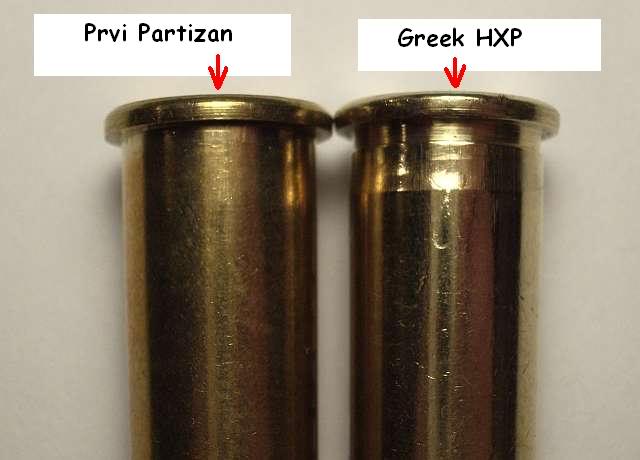
Prvi Parizan .303 British cases are made heavy duty compared to Remington or Winchester cases and I highly recommend them for reloading.
Below a Prvi Partizan .303 British case on the left and a Greek HXP case on the left and both were fired in the same No.4 Enfield rifle. The Prvi Partizan case has a thicker rim, has a larger base diameter and is .010 thicker in the base web area. (built Ford Truck Tough)
Also in 1914 the Enfield rifles chambers had to be reamed larger due to a ammunition scandal in England and who was awarded contracts to make ammunition. Some of this ammunition was so poorly made it caused chambering problems. So the Enfields chamber were reamed larger in diameter and longer to the shoulder location.
Below a "fired" South African .303 British case in a Wilson case gauge, the amount the case is sticking above the gauge is how much longer the "military" chamber is.

The shoulder and neck of the .303 British case was formed "after" the cordite powder was placed in the case. And being a rimmed case shoulder location was not critical.
Below a unfired South African surplus .303 British in the top photo and resting just below minimum headspace.(.064) In the bottom photo is a new unfired Remington case in the Wilson gauge showing how short the shoulder location is on a new case.

Bottom line, our American SAAMI .303 British standards and reloading dies do not match British military chamber standards.
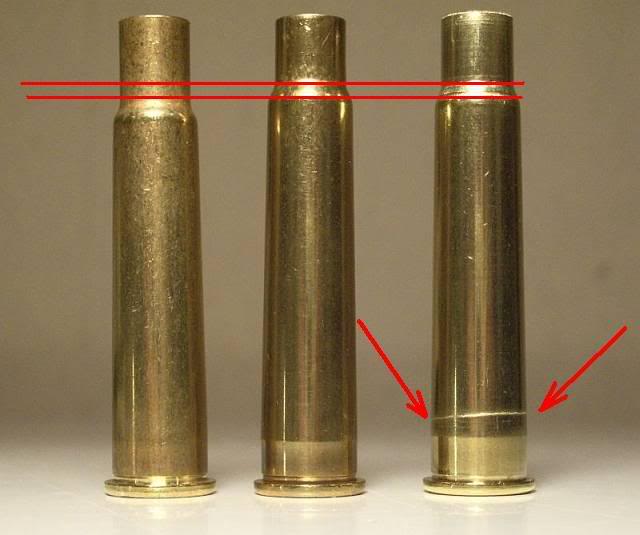
Below on the left a new unfired Remington .303 British case next to fired cases. The case on the far right was full length resized twice and on its third firing started to separate. And this is why your cases should be neck sized only for longer case life.
NOTE, 75% of American troops in WWI carried the M1917 'American Enfield' rifle chambered in 30-06 the same rifle as your P14 rifle. And the M1917 had a stronger action than our M1903 Springfield rifle.
Below a Prvi Partizan .303 British case on the left and a Greek HXP case on the left and both were fired in the same No.4 Enfield rifle. The Prvi Partizan case has a thicker rim, has a larger base diameter and is .010 thicker in the base web area. (built Ford Truck Tough)
Also in 1914 the Enfield rifles chambers had to be reamed larger due to a ammunition scandal in England and who was awarded contracts to make ammunition. Some of this ammunition was so poorly made it caused chambering problems. So the Enfields chamber were reamed larger in diameter and longer to the shoulder location.
Below a "fired" South African .303 British case in a Wilson case gauge, the amount the case is sticking above the gauge is how much longer the "military" chamber is.
The shoulder and neck of the .303 British case was formed "after" the cordite powder was placed in the case. And being a rimmed case shoulder location was not critical.
Below a unfired South African surplus .303 British in the top photo and resting just below minimum headspace.(.064) In the bottom photo is a new unfired Remington case in the Wilson gauge showing how short the shoulder location is on a new case.
Bottom line, our American SAAMI .303 British standards and reloading dies do not match British military chamber standards.
Below on the left a new unfired Remington .303 British case next to fired cases. The case on the far right was full length resized twice and on its third firing started to separate. And this is why your cases should be neck sized only for longer case life.
NOTE, 75% of American troops in WWI carried the M1917 'American Enfield' rifle chambered in 30-06 the same rifle as your P14 rifle. And the M1917 had a stronger action than our M1903 Springfield rifle.
I have been segregating my 303 brass for a long time so no issues there but yest will be careful all my other enfield brass does not chamber well in p14.. Was playing around the p14 chamber is visually tighter when comparing fired cases.. And I use Lee collet dies only because even tho I have quite the stockpile of new brass I don't see 303 brass as often as I use to so trying to get the most out of it have some cases that are going on their 10th reload.. Although they are used for lighter cast loads
Riley It doesn't matter if ammo for other rifles (low pressure ammo) fits in your P-14. The concern is the high pressure ammo loaded specifically for the small chambered P-14 will likely chamber in other weaker actions.





















