How do you set up your shots?

kolkim

Member
Rating - 100%
2   0   0
I've never hunted before and I have some questions about accuracy.

I have a Tikka rifle, and I am not very accurate with it. I look to see accuracy tips on Youtube but everyone uses a bipod. I don't own a bipod but in my mind I can't see a time where you could lay on the ground and use your bipod in the bush. So maybe Bipods aren't good for hunting in the bush, but tall shooting sticks are probably good, or my instructor said he leaned against a tree alot.

So my question is, when you are hunting in the bush, like a forest, how do you shoot? Do you just hold it up and against your shoulder boom, or do you carry shooting sticks, lean the barrel on a stump or branch, or lean your body against a tree.. I'd like an idea.
 
Honestly...all of the above including your hunting buddies back.

Each situation may call for a different approach.

I actually thought about using my hunting buddies back but I thought that might be dangerous since youre looking through the scope and you might not see whats at the end of your barrel lol. Good to know it's a viable option.
 
Use a rest whenever available. Practice lots from a variety of positions off a variety of rests and off-hand. My rule of thumb when planning at shot is:

1st choice: Prone off bipod
2nd choice: sitting with bipod or other rest
3rd: Sitting without rest
4th Standing with rest
5th Standing off hand

I go through that checklist on every stalk or when I see an animal and I'm always planning what my best shooting option is and seeing if I can improve my position with a slight move..
 
I like hunting in a place with thick bush and trails. I walk, then I stand/sit. When not walking, I make sure I have a clear area to watch and shoot if required. Shooting sticks are good, so is a tree or a log, or just laying prone on the trail. What I see when I'm walking? is a roll of the dice to what can happen.
 
I've never used a shooting stick but am considering getting one. I've used sturdy tree branches. I've held on to a tree with my hand and rested the barrel on my forearm, wrist, hand, crook of my thumb. Top of a fence post. A fallen log while sitting or prone. Pack while sitting or prone. I have a bi-pod but I only use it at the range or target shooting. Don't feel like packing that extra weight. Rails/walls of a tree stand. One guy I know found himself a nice wooden walking stick one year with a V on top in the bush. Used it all season. Cost him 60 seconds with his leatherman. Basically anything steady and sturdy at the right height. It's all about convienience and oppurtunity.

When I do shoot with no rest it is usually quick shots while rabbit or grouse hunting. Shotguns are a bit more forgiving. But I practice shooting my hunting rifle with no rest cause I'd hate to be the guy who watches the trophy bull walk away while i scramble to find something solid.

As for accuracy tips in general....control your breathing. Squeeze the trigger. Don't flinch. Those are the fundamentals in my book. Outside of faulty equipment I'd say most problems can be solved by fixing those. And practice practice practice.

I've never used a buddy as a rest for a rifle though.
 
Use a rest whenever available. Practice lots from a variety of positions off a variety of rests and off-hand. My rule of thumb when planning at shot is:

1st choice: Prone off bipod
2nd choice: sitting with bipod or other rest
3rd: Sitting without rest
4th Standing with rest
5th Standing off hand

I go through that checklist on every stalk or when I see an animal and I'm always planning what my best shooting option is and seeing if I can improve my position with a slight move..

Makes sense.

I've never heard of a ching sling, It looks like it would work.
 
I suppose I should ask, how accurate on average are you with that rifle? Inaccurate all the time? Sometimes? Only offhand? Do you have a flinch? Have you tried other ammo types or weights?

You could also try a Ching Sling or Safari Sling. These slings have a loop from the normal front sling mount to a third sling mount located more or less below your chamber/just in front of your magwell. However, most rifles aren't set up for the third sling mount, and it seems like a fair amount of guys would cry at the idea of drilling into their stock.

You pass your weak hand through this loop and get it snug up high on your bicep. When set up properly, these slings can really help with steadying your rifle when aiming offhand.

I suppose the best advice is to scout an area in advance, locate or make good shooting positions. It seems like a lot of guys just find a clearing or cut line, take a seat, and wait for something to walk ito the crosshairs. Beyond that, practice.

Are there any factors that you can identify that seem to be negatively affecting your accuracy? If your rifle too front heavy? In many cases total rifle weight affects handling less than having an unablanced and front heavy rifle. If you're out of breath and your hands are shaking, the best rifle in the world won't help you make that shot.

Are your optics perhaps not well suited? Do you need to search for your target after shouldering the rifle and getting ready to shoot? Some riflestocks or butts are just not suited for certain people, sometimes this can be as quick and dirty as wrapping some cloth around the stock to give you a slightly higher cheek weld. I really hoped I'd be able to use iron sights forever, but that didn't really work out as planned. Some stocks are optimized for a certain type of shooting, a stock good for the bench might be horrible for shouldering, not only because of weight, but also because of shape.

Is your scope positioned properly for the type of shooting you'll be doing? Do you have to lean forwards or backwards when shoulderin the rifle?

I've noticed that a lot of people go for high magnification scopes, ones that are perhaps excellent for target shooting at white paper, but the magnification is too high to easily sight close ranged targets, or the crosshair or reticle gets lost in dark colored backgrounds. I've seen some superfancy scopes that cost several thousand dollars that honestly sucked worse than a $50 tasco for hunting, because the reticle was on the first focal plane and with a massive magnification, as such it was so thin as to be almost invisible at low magnification. Best scope in the world doesn't help you much if you can't see where it's aiming.

My advice is to do a shooting drill, pick a target, give yourself a short amount of time, and take a shot in each of several different positions. Just one shot, because that's the most important one. A 3/4" group at 250 meters doesn't help you any if it takes you five minutes to set up each shot.

Don't feel too bad, I used to shoot 12" groups at 40 meters. Now I'm a sniper at about 4" at 40 meters ;) need more practice.

 
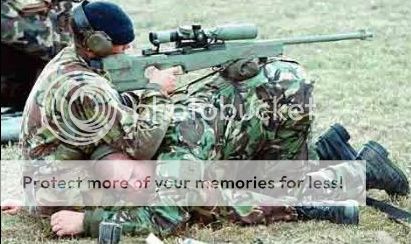
spottershooter.jpg
 
I suppose I should ask, how accurate on average are you with that rifle? Inaccurate all the time? Sometimes? Only offhand? Do you have a flinch? Have you tried other ammo types or weights?

You could also try a Ching Sling or Safari Sling. These slings have a loop from the normal front sling mount to a third sling mount located more or less below your chamber/just in front of your magwell. However, most rifles aren't set up for the third sling mount, and it seems like a fair amount of guys would cry at the idea of drilling into their stock.

You pass your weak hand through this loop and get it snug up high on your bicep. When set up properly, these slings can really help with steadying your rifle when aiming offhand.

I suppose the best advice is to scout an area in advance, locate or make good shooting positions. It seems like a lot of guys just find a clearing or cut line, take a seat, and wait for something to walk ito the crosshairs. Beyond that, practice.

Are there any factors that you can identify that seem to be negatively affecting your accuracy? If your rifle too front heavy? In many cases total rifle weight affects handling less than having an unablanced and front heavy rifle. If you're out of breath and your hands are shaking, the best rifle in the world won't help you make that shot.

Are your optics perhaps not well suited? Do you need to search for your target after shouldering the rifle and getting ready to shoot? Some riflestocks or butts are just not suited for certain people, sometimes this can be as quick and dirty as wrapping some cloth around the stock to give you a slightly higher cheek weld. I really hoped I'd be able to use iron sights forever, but that didn't really work out as planned. Some stocks are optimized for a certain type of shooting, a stock good for the bench might be horrible for shouldering, not only because of weight, but also because of shape.

Is your scope positioned properly for the type of shooting you'll be doing? Do you have to lean forwards or backwards when shoulderin the rifle?

I've noticed that a lot of people go for high magnification scopes, ones that are perhaps excellent for target shooting at white paper, but the magnification is too high to easily sight close ranged targets, or the crosshair or reticle gets lost in dark colored backgrounds. I've seen some superfancy scopes that cost several thousand dollars that honestly sucked worse than a $50 tasco for hunting, because the reticle was on the first focal plane and with a massive magnification, as such it was so thin as to be almost invisible at low magnification. Best scope in the world doesn't help you much if you can't see where it's aiming.

My advice is to do a shooting drill, pick a target, give yourself a short amount of time, and take a shot in each of several different positions. Just one shot, because that's the most important one. A 3/4" group at 250 meters doesn't help you any if it takes you five minutes to set up each shot.

Don't feel too bad, I used to shoot 12" groups at 40 meters. Now I'm a sniper at about 4" at 40 meters ;) need more practice.

Thanks for your time.

I've shot maybe 100 rounds through my rifle and always at this one spot. It's a dirtbiking quarry full of shotgun shells and rifle cartridges. I like this place because it's not too far away from my house but theres no trees, stumps or anything to lean against so the best shooting position I can get is sitting offhand and I have a hard time keeping my rifle scope steady. I don't have a bipod yet. I think if I had some kind of rest I could shoot very accurately.

I also have an SKS, and sitting offhand I have very good accuracy without a scope.
 
IMHO, everyone should work towards attaining basic marksmanship skills before shooting at a live target. But lets dispense with idea of MOA as an index of the accuracy necessary for big game hunting. A more useful index should be based on the target size, which tends to be 12"-16" on deer sized game. Provided you can keep your rounds within 8" at a given range, that is sufficient for a positive outcome. The opportunities a hunter has in thick cover is weighted towards the off hand position, but if you can use a natural rest to support the rifle, your chances of making a first round hit on a stationary target increases dramatically. But in the bush, where the range tends to be short, and the action can be fast, so marksmanship must be balanced against time.

Begin your practice at short range, say 25 yards, shooting off hand. Shoot pairs, working the action of your rifle as quickly as you can between shots. When you become comfortable with that, move back to 50, but now introduce kneeling and seated positions to your off hand. From here you go back to 100, where you can also introduce prone to your positions. If you can continue to increase the range until you can no longer keep your rounds within 4" of your intended point of impact, which defines your maximum range.

Work at getting onto the target quickly, get a repeatable cheek weld, and press the trigger, don't slap it or jerk it. If you find your aiming point swinging off the target, don't decrease weight on the trigger, just wait for the sight to come back to center, then increase the pressure until the shot breaks. With practice, this can be accomplished quickly. Keep at it, and don't get discouraged. Dry firing at home will be beneficial to improving your target acquisition, sight alignment, and trigger control.
 
Is there a difference between a ching sling and a regular sling? Can I just buy a regular sling and use it in the same method?

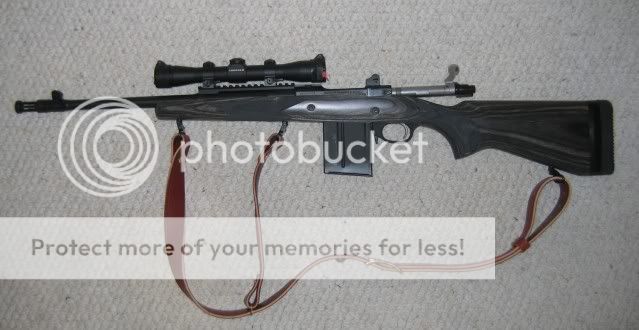
SlingStud2.jpg


Ching sling is different from regular two point slings like everyone's grandpappy have on their rifle.

Well, as you can see in the picture you can use the third piece on a slider to create much the same effect. However many types of ching sling are intentionally designed as such.
 
Back
Top Bottom