So assume I have been doing a poor job of mounting scopes on 12 gauge rifled slug guns and rifles, can someone help me with it, for example mounting rails, rings, torquing, loctite, bubble levels, whatever is imortant. I did a search but couldnt find a primer on it. Thanks in advance.















































You are using an out of date browser. It may not display this or other websites correctly.
You should upgrade or use an alternative browser.
You should upgrade or use an alternative browser.
How to PROPERLY mount a scope... help please
- Thread starter timandkimandshea
- Start date

Good ideos, thank you. All within my reach, except the aligning and lapping of the rings. How crucial are these two things, bearing in mind not shooting crazy long distances ?
Thanks again.
T
Best advice I can give you is to forget lapping the rings and purchase Burris Signature scope rings (https://www.burrisoptics.com/signature-rings) with the self centering synthetic 'gimbals' in the rings instead. They illustrate redfield style bases at the link but you can get these rings to suit various bases (ie weaver style) ...
Buy good rings and don’t ever worry about lapping them.
As for all the levels and BS.. I wouldn’t bother using multiple levels. Shoulder the rifle, and have someone rotate the scope till it lines up with a plumb line. This would make the rifle fit your body, and the scope be plumb with gravity.
As for all the levels and BS.. I wouldn’t bother using multiple levels. Shoulder the rifle, and have someone rotate the scope till it lines up with a plumb line. This would make the rifle fit your body, and the scope be plumb with gravity.

Buy good rings and don’t ever worry about lapping them.
As for all the levels and BS.. I wouldn’t bother using multiple levels. Shoulder the rifle, and have someone rotate the scope till it lines up with a plumb line. This would make the rifle fit your body, and the scope be plumb with gravity.
Absolutely not.
This is terrible advice.
If you do this, and your bore axis is off vertical you will introduce very complicated math at longer range.
I suppose if all your shooting is done at close range you'll be fine, but you may soon find yourself off several inches at medium range, and complete misses at longer range

https://www.shootingillustrated.com...t occurs when the scope,a 3-degree rifle cant.
Last edited:
Do whatever you want, but I find that to be ridiculous.
You don’t require the rifle to be level.. so long as the reticle is plumb with gravity there won’t be an issue. If you try to keep the rifle level after doing what I suggested, then yes you will put yourself off at a distance. But why fight the position in which the rifle sits naturally in your shoulder? Would you rather not comfortably have the rifle lined up with your body? And then have the reticle plumb with gravity? So it’s not a constant fight to maintain that rifle at a level state?
Have a plumb reticle, and having one off 3 degrees is not the same thing, but again do what ever makes you happy. Dealing with all these levels and stuff is ridiculous.
This is why there is such things as adjustable butt plates. So that the recoil pad sits comfortably with your body, then allowing the rifle to maintain its “level” status. Then go ahead and level that reticle with the rifle.
You don’t require the rifle to be level.. so long as the reticle is plumb with gravity there won’t be an issue. If you try to keep the rifle level after doing what I suggested, then yes you will put yourself off at a distance. But why fight the position in which the rifle sits naturally in your shoulder? Would you rather not comfortably have the rifle lined up with your body? And then have the reticle plumb with gravity? So it’s not a constant fight to maintain that rifle at a level state?
Have a plumb reticle, and having one off 3 degrees is not the same thing, but again do what ever makes you happy. Dealing with all these levels and stuff is ridiculous.
This is why there is such things as adjustable butt plates. So that the recoil pad sits comfortably with your body, then allowing the rifle to maintain its “level” status. Then go ahead and level that reticle with the rifle.
Do whatever you want, but I find that to be ridiculous.
You don’t require the rifle to be level.. so long as the reticle is plumb with gravity there won’t be an issue. If you try to keep the rifle level after doing what I suggested, then yes you will put yourself off at a distance. But why fight the position in which the rifle sits naturally in your shoulder? Would you rather not comfortably have the rifle lined up with your body? And then have the reticle plumb with gravity? So it’s not a constant fight to maintain that rifle at a level state?
Have a plumb reticle, and having one off 3 degrees is not the same thing, but again do what ever makes you happy. Dealing with all these levels and stuff is ridiculous.
This is why there is such things as adjustable butt plates. So that the recoil pad sits comfortably with your body, then allowing the rifle to maintain its “level” status. Then go ahead and level that reticle with the rifle.
What? "You don't require the rifle to be level"
Are you serious? Lol

OkayShooter
CGN Ultra frequent flyer
- Location
- Nova Scotia
Don't always trust that the scope caps are squared and true, when you put a level on it.
I will always dial the adjustments in, so I can put a level across the body.
I will always dial the adjustments in, so I can put a level across the body.

Do whatever you want, but I find that to be ridiculous.
You don’t require the rifle to be level.. so long as the reticle is plumb with gravity there won’t be an issue. If you try to keep the rifle level after doing what I suggested, then yes you will put yourself off at a distance. But why fight the position in which the rifle sits naturally in your shoulder? Would you rather not comfortably have the rifle lined up with your body? And then have the reticle plumb with gravity? So it’s not a constant fight to maintain that rifle at a level state?
Have a plumb reticle, and having one off 3 degrees is not the same thing, but again do what ever makes you happy. Dealing with all these levels and stuff is ridiculous.
This is why there is such things as adjustable butt plates. So that the recoil pad sits comfortably with your body, then allowing the rifle to maintain its “level” status. Then go ahead and level that reticle with the rifle.
Read the article, or talk to an expert.
Or live in ignorance.
But don't bring others who want to learn something down to your level of knowledge.
- Location
- Western Manitoba
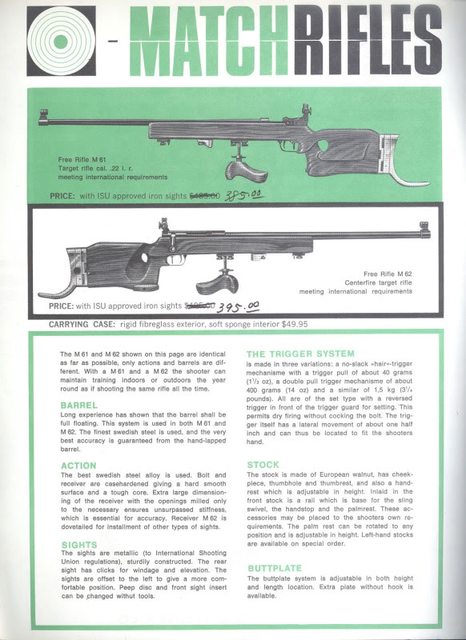
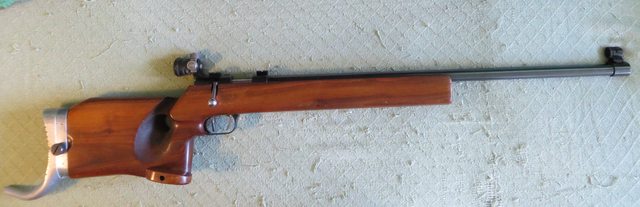
Alignment and plumb is a thing or is not - depends. I have a Schultz and Larsen Model 61 "free rifle" - it is a .22 single shot - weighs around 15 pounds or so. Its only purpose is to pound .22 bullets into a 1/4" circle at 50 meters - over and over again. The front aperture sight base, from the factory, is offset at least a full bullet hole - so perhaps .25" to the left of the bore centreline - sighted for 50 meters, the rear sight will be to the left even more. What the gun was made for - to compete in World's and Olympics in 50 meter small bore free rifle events. Probably would be my last choice in a gopher patch. But for the one thing it was meant to do, it did not have many peers in the late 1960's.
From that rifle's sights, I suspect that once you have zero'd scope or sights at target distance, to your stance, then you are on. But if sights or scope are not actually square and plumb to the bore, does not translate to any another distance, without error. This rifle and sight system was not designed for "any other" distance - 50 meters target aiming at a 4 point something inches diameter black bull is what it was for. Sort of limiting - but so are the double set triggers, 15 ounce rear sight assembly, no ejector, and several other features.
From that rifle's sights, I suspect that once you have zero'd scope or sights at target distance, to your stance, then you are on. But if sights or scope are not actually square and plumb to the bore, does not translate to any another distance, without error. This rifle and sight system was not designed for "any other" distance - 50 meters target aiming at a 4 point something inches diameter black bull is what it was for. Sort of limiting - but so are the double set triggers, 15 ounce rear sight assembly, no ejector, and several other features.
Last edited:
Thats is 100% true
The rifle doesnt need to be level. Just the reticle.
By the way what exactly are you "levelling" on a rifle.
Sure, you can "level" the action races, the optics rail, the action itself,
So what exactly are you leveling on a rifle.
Rifle need to be positioned to track well with recoil, then the scope levelled to thst position.
The rifle doesnt need to be level. Just the reticle.
By the way what exactly are you "levelling" on a rifle.
Sure, you can "level" the action races, the optics rail, the action itself,
So what exactly are you leveling on a rifle.
Rifle need to be positioned to track well with recoil, then the scope levelled to thst position.
Thats is 100% true
The rifle doesnt need to be level. Just the reticle.
By the way what exactly are you "levelling" on a rifle.
Sure, you can "level" the action races, the optics rail, the action itself,
So what exactly are you leveling on a rifle.
Rifle need to be positioned to track well with recoil, then the scope levelled to thst position.
You are placing the vertical axis of the reticle in line with the bore...
If the rifle is not "level" or in line with that, then you add horizontal error into your trajectory.
Alignment and plumb is a thing or is not - depends. I have a Schultz and Larsen Model 61 "free rifle" - it is a .22 single shot - weighs around 15 pounds or so. Its only purpose is to pound .22 bullets into a 1/4" circle at 50 meters - over and over again. The front aperture sight base, from the factory, is offset at least a full bullet hole - so perhaps .25" to the left of the bore centreline - sighted for 50 meters, the rear sight will be to the left even more. What the gun was made for - to compete in World's and Olympics in 50 meter small bore free rifle events. Probably would be my last choice in a gopher patch. But for the one thing it was meant to do, it did not have many peers in the late 1960's.
From that rifle's sights, I suspect that once you have zero'd scope or sights at target distance, to your stance, then you are on. But if sights or scope are not actually square and plumb to the bore, does not translate to any another distance, without error. This rifle and sight system was not designed for "any other" distance - 50 meters target aiming at a 4 point something inches diameter black bull is what it was for. Sort of limiting - but so are the double set triggers, 15 ounce rear sight assembly, no ejector, and several other features.
The Schultz and Larsen Model 61 had its best years in the 1950's and early 1960's. It's offset sights were a product of the rifle design and components also doing double duty as a centerfire model. The reason for the offset sights was so that the problem of mirage from a hot centerfire barrel would be less of an issue for the shooter. The rifle in .22LR was equally capable of being used at both 50 and 100 yards. If the sights could be used for shooting at one distance, they were good for the other as well.
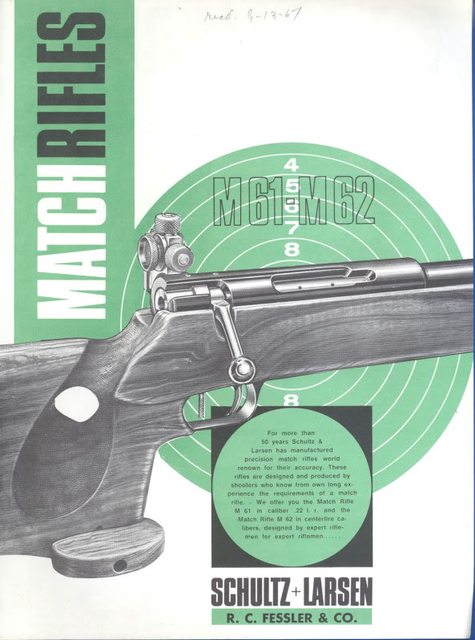
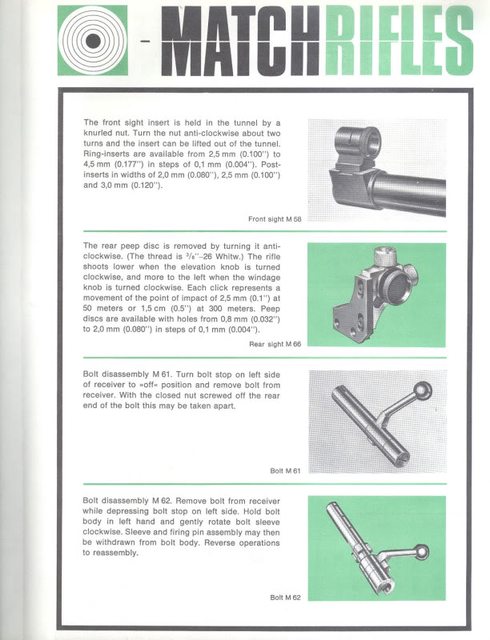
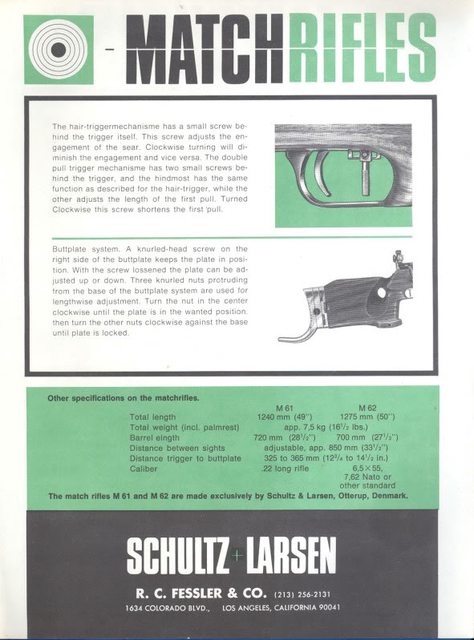
The offset front sight can be seen in this S&L M61/M62 contemporaneous brochure in the left image on the bottom row. An actual picture of the rifle follows.
(See below for the effect of cant.)
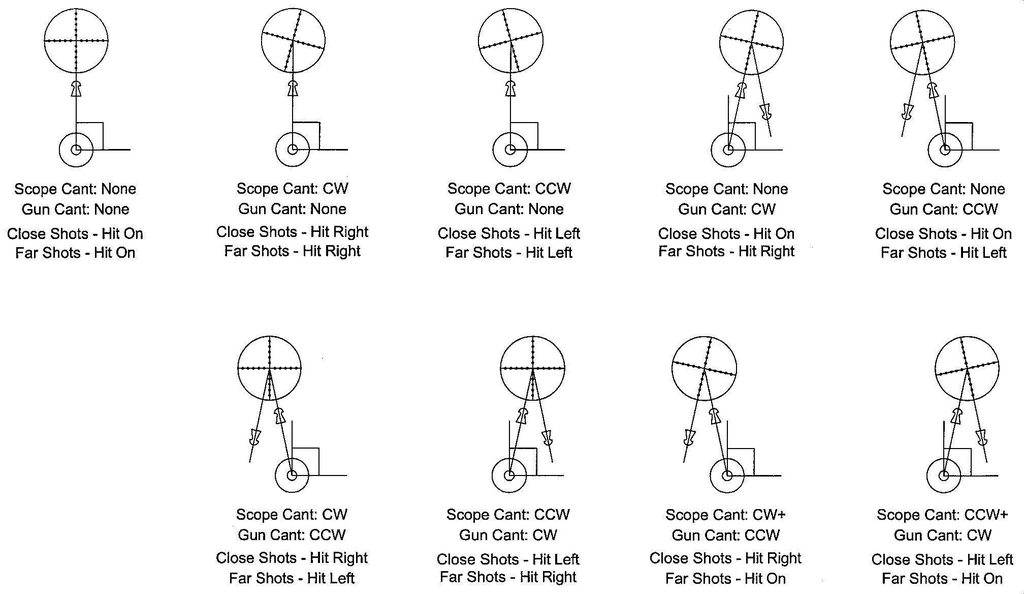
When the rifle or scope have cant -- that is, they are not in line or plumb with each other -- the impact on POI can be seen in the image below. While it was originally made to show airgun shooters the problems that occur when either or both the rifle or scope are not correctly aligned, it remains valid for powderburners.
The Schultz and Larsen Model 61 had its best years in the 1950's and early 1960's. It's offset sights were a product of the rifle design and components also doing double duty as a centerfire model. The reason for the offset sights was so that the problem of mirage from a hot centerfire barrel would be less of an issue for the shooter. The rifle in .22LR was equally capable of being used at both 50 and 100 yards. If the sights could be used for shooting at one distance, they were good for the other as well.
The offset front sight can be seen in this S&L M61/M62 contemporaneous brochure in the left image on the bottom row. An actual picture of the rifle follows.
(See below for the effect of cant.)
When the rifle or scope have cant -- that is, they are not in line or plumb with each other -- the impact on POI can be seen in the image below. While it was originally made to show airgun shooters the problems that occur when either or both the rifle or scope are not correctly aligned, it remains valid for powderburners.
What is CW and CCW etc? Thank you this is quite useful.
- Location
- Western Manitoba
Clock-Wise; Counter Clock-Wise