












































You are using an out of date browser. It may not display this or other websites correctly.
You should upgrade or use an alternative browser.
You should upgrade or use an alternative browser.
How To Refinish a Marlin Stock?
- Thread starter waynewjw
- Start date

Many ways to skin a cat What i would do if the wood is in good condition is use a chemical stripper to remove the old finish. If it's got scratches or chips i'd just sand it down with 120 grit emery cloth. Depressions in the wood can be lifted if the scratch or gouge is just pressed into the wood rather than wood removed, by using steam from an iron and a wet cloth. Just keep steaming till the dent lifts.
Once the old finish is removed I'd further sand it smooth with 320 grit emery cloth. Sand with the grain at all times and collect this sanding dust, it will come in handy later. Dont collect the first rough sanding dust though.
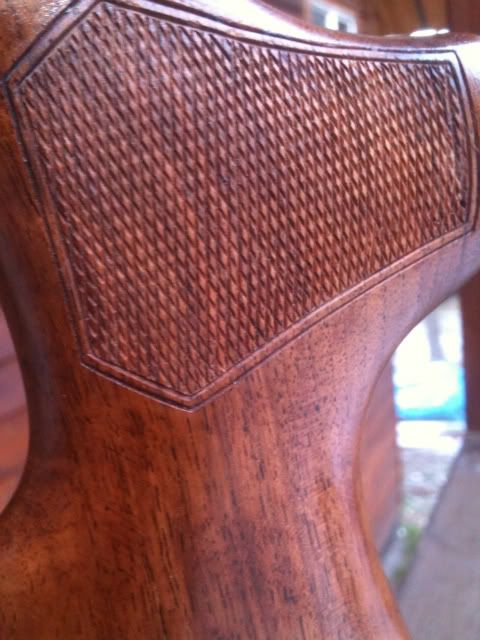
Finish it off with a final sanding of 400 grit until all sanding marks are gone. Also at this time any checkering can either be recut with needle files or taped off with masking tape.
Now you can finish with any number of finishes including boiled linseed oil, Tung oil, tru oil... whatever. I'd use tung oil so i'll give tips on that. I find it gives the nicest finish, to my eyes anyway. Though the steps would be the same with BLO.
Mix tung oil (i use circa 1850 brand) and mineral spirits 50/50 and give the stock a heavy soaking in this, after 1/2 hour wipe it down and let it dry for no less than 2 days.
Next step is very important if you want a high quality finish. Lightly sand the stock again with 400 grit. Now, take out your saved sanding dust and add enough tung oil to make it a wet paste. Using a clean cloth you lightly smear the paste all over the stock perpendicular to the grain to fill in the grain holes. Keep smearing until you have the stock covered but with little apparent residue left on the surface. let dry 2 days.
Next, you sand off the stock again, very lightly with 400 grit again. For best results, you repeat the above process 2-6 times to ensure you have totally filled in all the grain. Once you are happy with the smoothness of the surface you can apply the finishing coat.
I again use tung oil mixed with a couple drops of japan dryer which will help to make a very tough finish and it will dry quicker. Apply the mix with the tips of your fingers, rubbing it the length of the stock with quite a bit of pressure so that it becomes quite warm. Keep looking at it from different angles to make sure you dont have any areas with more or less varnish.
I like to let it dry at least 24 hours per coat for this process, and i apply about 6 coats. Every 2nd coat i use oil soaked 800 grit to smooth out the finish, and i dont sand the last coat.
Once done, i use a coat of johnsons paste wax to seal the finish. It takes me on average about 2-3 weeks to complete a high quality finish, from start to,... finish.
It takes a stock from this (notice how you can see the holes in the grain)


To this (no holes in the grain)


Once the old finish is removed I'd further sand it smooth with 320 grit emery cloth. Sand with the grain at all times and collect this sanding dust, it will come in handy later. Dont collect the first rough sanding dust though.
Finish it off with a final sanding of 400 grit until all sanding marks are gone. Also at this time any checkering can either be recut with needle files or taped off with masking tape.
Now you can finish with any number of finishes including boiled linseed oil, Tung oil, tru oil... whatever. I'd use tung oil so i'll give tips on that. I find it gives the nicest finish, to my eyes anyway. Though the steps would be the same with BLO.
Mix tung oil (i use circa 1850 brand) and mineral spirits 50/50 and give the stock a heavy soaking in this, after 1/2 hour wipe it down and let it dry for no less than 2 days.
Next step is very important if you want a high quality finish. Lightly sand the stock again with 400 grit. Now, take out your saved sanding dust and add enough tung oil to make it a wet paste. Using a clean cloth you lightly smear the paste all over the stock perpendicular to the grain to fill in the grain holes. Keep smearing until you have the stock covered but with little apparent residue left on the surface. let dry 2 days.
Next, you sand off the stock again, very lightly with 400 grit again. For best results, you repeat the above process 2-6 times to ensure you have totally filled in all the grain. Once you are happy with the smoothness of the surface you can apply the finishing coat.
I again use tung oil mixed with a couple drops of japan dryer which will help to make a very tough finish and it will dry quicker. Apply the mix with the tips of your fingers, rubbing it the length of the stock with quite a bit of pressure so that it becomes quite warm. Keep looking at it from different angles to make sure you dont have any areas with more or less varnish.
I like to let it dry at least 24 hours per coat for this process, and i apply about 6 coats. Every 2nd coat i use oil soaked 800 grit to smooth out the finish, and i dont sand the last coat.
Once done, i use a coat of johnsons paste wax to seal the finish. It takes me on average about 2-3 weeks to complete a high quality finish, from start to,... finish.
It takes a stock from this (notice how you can see the holes in the grain)
To this (no holes in the grain)
Sorry, me again... I know you are looking for other opinions but i'd also like to add that the finish i prefer is obviously a long drawn out process that is not 100% necessary to get a stock that looks ok. It is a method for producing a very high quality finish typically used on fine expensive gunstocks.
You can get a perfectly satisfactory finish by either using a chemical stripper or sanding the stocks down with 150 grit, followed by 400 grit, and then using tru oil as per mfg instructions. you just apply it with either a clean cloth, or my preferred method, your fingertips. Spread it even and thin... and apply a few coats with a day dry time per coat... done.
Or you can prep the same and use a clear varathane which looks quite nice on marlin walnut. let a mix of 50/50 varathane/mineral spirits soak in deep for a day, and then apply a few more coats with a clean cloth or fingertips. You can then seal it with a spray on varathane brand clear coat.
Like i said, many ways to skin a cat. The technique i outlined about "filling the grain" is not necessary to protect the wood and brighten it up a bit, but if done properly it makes it look professionally done.
Hopefully someone else will chime in with some other preferred methods and give you some more options, or elaborate on the ones ive given.
Good luck, and we are expecting before and after pics!
You can get a perfectly satisfactory finish by either using a chemical stripper or sanding the stocks down with 150 grit, followed by 400 grit, and then using tru oil as per mfg instructions. you just apply it with either a clean cloth, or my preferred method, your fingertips. Spread it even and thin... and apply a few coats with a day dry time per coat... done.
Or you can prep the same and use a clear varathane which looks quite nice on marlin walnut. let a mix of 50/50 varathane/mineral spirits soak in deep for a day, and then apply a few more coats with a clean cloth or fingertips. You can then seal it with a spray on varathane brand clear coat.
Like i said, many ways to skin a cat. The technique i outlined about "filling the grain" is not necessary to protect the wood and brighten it up a bit, but if done properly it makes it look professionally done.
Hopefully someone else will chime in with some other preferred methods and give you some more options, or elaborate on the ones ive given.
Good luck, and we are expecting before and after pics!

waynewjw
CGN Regular
MikeyStew
I like the end result as you've described.... and not looking for shortcuts. If it takes some time to get a quality job, then that's what I'll have to do. And the final result on your falling block is pretty spectacular.
I like the end result as you've described.... and not looking for shortcuts. If it takes some time to get a quality job, then that's what I'll have to do. And the final result on your falling block is pretty spectacular.
Thanks for the compliments. There is a ton of information on the Internet pertaining to stock finishing. I think it's easiest to tackle by breaking it down to the 3 steps. The soak, which penetrates deep into the wood and really protects it. The filling of the grain which gives it the smooth appearance, and the finish which can be anywhere from zero (matte) to 6 or more coats (high gloss/luster). I did a stock once and just lightly oil sanded the filler coat and wiped it off and dried it and it looked very nice, but no gloss whatsoever.
Originally marlin used a varnish of some sort, probably a specific blend of BLO solvents and dryers, but somewhere along the line they switched to marshield which has the appearance to me of a spray on varathane. Marshield has never appealed to me, and while tough, it looks cheap and undeserving of the fine rifles the accompany.
You will get a similar result from BLO as you would tung oil. But, modern BLO Is not true BLO, but rather raw linseed oil with dryers and other synthetic additives in it to imitate the real thing. Its an inferior product if you ask me. Circa 1850 tung is pure raw tung oil and mineral spirits.
Good luck however you choose to proceed, and remember... Pics.
Originally marlin used a varnish of some sort, probably a specific blend of BLO solvents and dryers, but somewhere along the line they switched to marshield which has the appearance to me of a spray on varathane. Marshield has never appealed to me, and while tough, it looks cheap and undeserving of the fine rifles the accompany.
You will get a similar result from BLO as you would tung oil. But, modern BLO Is not true BLO, but rather raw linseed oil with dryers and other synthetic additives in it to imitate the real thing. Its an inferior product if you ask me. Circa 1850 tung is pure raw tung oil and mineral spirits.
Good luck however you choose to proceed, and remember... Pics.

- Location
- i dont want to talk about it
nice work mikeystew, i have done a few stocks using closer to the second method you elaborated on, but the first method with the wood powder paste loooks OUTSTANDING, thanks for the lesson!! My old belguim FN browning pump .22 is in for a much needed overhaul. 

- Location
- Brant County, Ontario
Very informative post, definitely a lot of time and patients. Thanks for sharing.






















