ID ASSIST REQUESTED- Remington Enfield

Mrclean1982

Member
Rating - 100%
58   0   0
Location
Western Canada
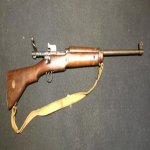
I have a Enfield in 303. Off and on I have been trying to background it but now I am hitting some walls and not learning anything new other then the history of all the different type of Enfields is very expansive.

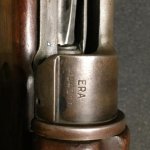
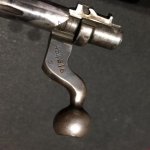
I believe it is a pattern 14, I know it was made by Remington in the US(ERA stamped) in ???? (higher 400,000 serial). That a Brit inspected it for quality after it was made (Brit inspection mark). I basically know nothing else about it.

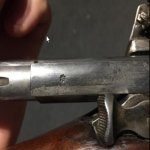
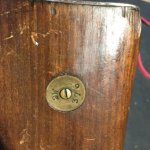
I am interested what some of the proof marks mean including the Stock disc what does that mean? Basically any information you could provide as to its history would be cool.
Here are some pics. If you have any other questions let me know.

Thanks CGN community!
E1.jpgE2.jpgE3.jpgE4.jpgE5.jpgE6.jpgE7.jpg
 

Attachments

  • E1.jpg
    E1.jpg
    36.7 KB · Views: 244
  • E2.jpg
    E2.jpg
    27.6 KB · Views: 245
  • E3.jpg
    E3.jpg
    22.3 KB · Views: 245
  • E4.jpg
    E4.jpg
    12.9 KB · Views: 245
  • E5.jpg
    E5.jpg
    18.7 KB · Views: 245
  • E6.jpg
    E6.jpg
    25.3 KB · Views: 244
  • E7.jpg
    E7.jpg
    33.4 KB · Views: 245
I don't have all your answers, but to start. ERA was the Eddystone plant, a subsidiary of Remington Arms Co. Remington plant P14's were stamped "RE" and Winchester made ones are stamped "WRA". All the P14's were chambered in 303 British, for Britain and allies, so had to be "accepted" by British inspectors before manufacturer got paid - this was a commercial arrangement, not a state's armoury making the arms, and there was a great fuss about the three manufacturers making parts that were not interchangeable with each other.
Second, the stock has been cut off and the front hand guard is missing, so, what you have is a "sported" P14, not original at all.
 
The serial # puts it as April, 1918 production, out of Eddytstone.

The brass disc is a Unit Marking Disc - basically, what unit the rifle was issued to. The British stopped doing marking discs in late 1915, early 1916, because... Why bother? When entire regiments could evaporate in an afternoon going over the top, keeping track of exactly which unit a rifle was issued to was a bit fussy, even for the British.

Peacetime armies LOVE paperwork, so they started back up with the discs shortly after the war.

2W 376 places the rifle with the 376 Queen's Own Dorset Yeomanry howitzer battery (Territorial Army) during the period they were attached to the Wessex Army Field Brigade, between 1929-1939.

http://www.odcmp.org/503/rifle.pdf

https://en.wikipedia.org/wiki/Queen%27s_Own_Dorset_Yeomanry

At the outbreak of war, the unit battery numbering got all higgledy piggledy, and 376 was re-numbered (a couple of times, it gets confusing), but by and large was kept on the Big Island as part of the home army.

What you have is a rifle that had what would have been called "good timing" for a lot of young men of the era - alive for both, too young for the 1st, too old for the 2nd, which allowed it to live a long and healthy life beyond the expectancy of those with the unfortunate luck to be born early enough, or late enough, to catch one of the two big shows.

After WWII, it would have been surplussed in near pristine condition (a Home Army artillery regiment would have had little use for their rifles, other than cleaning them for inspection and parade). At that point, Bubba got hold of it, took a hacksaw to the stock, and made a "Dern gud Moose gun" out of it.

Cheers.
 
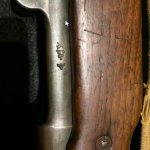
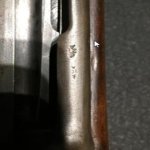
In photo #3, the three marks are British acceptance stamps. The lower mark is called the "broad arrow" Brit mark
Photo with * mark on bolt denotes a Mk2 rifle The bolt face and breech end of the chamber is different and bolts are not interchangable
 
...just got to put it out there that the metal appears not fked with.

This is good. If all the metal is unsullied, then you might investigate a new set of wood for it... thats your call tho, obvs.
 
Back
Top Bottom