Just curious,about the purpose

vstar650ca

CGN Regular
Rating - 0%
0   0   0
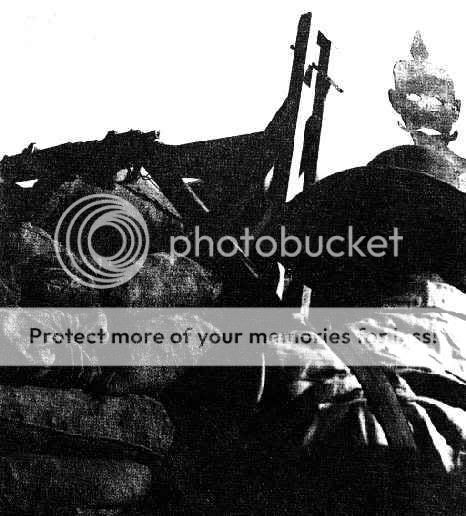
O.K guys I am reading a book about the history of the military sniper,anyway in the book it shows a WW1 German sniper taking a bead with his scoped Mauser with his head above the trench,on his helmet he has what looks like a hunk of 1" plate steel attached to the front of his helmet,now me thinking the trenches in WW1 where about 500 yards apart at most,I would think taking a .303 round on that piece of steel might not penetrate the plate ,but would likely break the buggers neck like a dried twig.What,s funny about the photo is there are 2 older looking "Fritze,s" standing down in the trence watching.Makes me wonder if it wasn,t a "Let,s get the new guy to try the plated helmet deal"
 
No, those plated helmets were developped for machinegunners and also used by snipers so that counter-sniping might not be as effective.

It's sloped in such a way that most hits would glance off the helmet at an angle, diffusing some of the energy. Lots of Germans survived head shots in this manner.

In 1917, field regualtions also called for painting these German helmets (Stahlhelm) camouflage for the same reason.
 
Claven2 said:
No, those plated helmets were developped for machinegunners and also used by snipers so that counter-sniping might not be as effective.

It's sloped in such a way that most hits would glance off the helmet at an angle, diffusing some of the energy. Lots of Germans survived head shots in this manner.

In 1917, field regualtions also called for painting these German helmets (Stahlhelm) camouflage for the same reason.
Thanks Claven2,still you have to think the Germans ears would sure ring and he sure have a stiff neck for a day or two, if he got nailed on the plated helmet
 
I've seen pictures of metal cuirasses (breast plate) for machine gunners as well.

Also, I think the Germans used large metal (2 or 3 feet wide) plates as protection when sniping as well.
 
slicknick said:
Still a whole lot better than being dead
Very true,although I think I would rather use the steel loop hole method than exposing my face below the helmet to enemy fire
 
Being a sniper in WW1 was a risky business in any case. Remember that all such pictures are at least partially posed, that snipers took every advantage of their wood craft skills,shooting skills to allow them to " safely " engage the enemy.These folks were learning their trade as they went, mistakes were often fatal. Lots of ideas were thought to be good ones until actually tested in combat where they were quickly discarded. It is easy to view the past with some dubiousness based on hindsight but snipers didn't have a lot of hindsight to work with as the science of sniping was still evolvin and new wars brought new problems to be solved. Dependuing on what war time history you read snipers tended to disdain any equipment that impeded their ability to move quickly. In any case extra armor such as the helmet plate was usually too heavy to wear for long, it was a stopgap measure at best and eventually fell from general use. The use of body armor in WW1 would be an interesting reserach project with a book at the end of it. Personally I would like to see just a good book on all the varieties of sniping rifles used in WW1. Interesting subject! Joe
 
vstar650ca said:
,now me thinking the trenches in WW1 where about 500 yards apart at most,I would think taking a .303 round on that piece of steel might not penetrate the plate ,but would likely break the buggers neck like a dried twig.

Actually trenches were normally much closer together. Snipers were often shooting at targets less than 200m away. Read "A Rifleman Went To War" for more insight into the sniper duels.

No, a hit in a heavy steel helmet will not break anyone's neck. Remember that the momentum of the bullet is the same as that of the rifle. The rifle does not break the shooter's shoulder. And if you put the stock against your head when you fired, it would hurt but it would not break your neck.
Of course as pointed out above, it beats a hole in the head, and it isn't like they want to be shot, they are just taking precautions.
 
There where places where the trenches where so close (25m!!!) that the sides talked to eachother during lulls!

The plate you mention was originally used by sentries, who had to look over the parapet of the trench every so ofter to make sure no one was sneaking over during the day. At night, the sentry was supposed to be looking over the top all the time they where on duty. To see movement in the dark, they felt (rightly, but I'm glad it wasn't MY head) it was better to watch all the time to catch small changes.
 
The plates worked until the British started using rifles suitable for hunting in Africa. A .404 Jeffrys or similar round, punched a nice hole through the plate, helmet, and whatever was in the helmet.;)

A machine gunner would have very little of his face exposed if he was using the sights.
 
It HAD to have worked better than Sam Hughes' "McAdam Shield-Shovel" (McAdam was his secretary); the shovel was thin enough that it was useless as armour, and the hole made it useless as a shovel, yet we still bought thousands of the bloody things;

a202396.jpg


http://www.cefresearch.com/phpBB2/viewtopic.php?p=6487&sid=ee11ea07f2ee07fb62e9a7c4e9d1e525
 
Last edited:
John Sukey said:
The plates worked until the British started using rifles suitable for hunting in Africa. A .404 Jeffrys or similar round, punched a nice hole through the plate, helmet, and whatever was in the helmet.;)

A machine gunner would have very little of his face exposed if he was using the sights.
John the book I am reading mentions the Brits trying heavy hunting rifles,the Germans simply put another loop hole plate in front of the other
 
I'm told, and have read that on troops both sides seldom strapped their helmets down, and would rather them fly off of hit then risk snapping ones neck with the impact.
 
Sometimes the trenches were built near the opposite party's trenches to minimize time spent running during a bayonet charge... advanced observation outposts were just short of a hand grenade throw.
During WWI in Verdun, one of my grandfather's comrades, a Basque, took advantage of a trip to the rear and came back with a "grande chistéra" (you know, that rattan woven glove the Jai-Alai players use).
They used it to lob grenades very accurately and at great distances into the german trenches and make their opponent's life miserable.
Think, improvise and win!
PP.
 
Last edited:
Back
Top Bottom