Keys to making a muzzle brake?

rubberdown

CGN frequent flyer
Rating - 100%
15   0   0
Location
Ontario
I have all the tools to make my own muzzle brake, and could make it completely custom to my liking, but was wondering if there are any key features that must be put into the making of such an item? I know for the most part they are not just for looks, and they have function, so does the machining on the inside diameters have to be made in any particular way, other than the proper threads and the through hole being bigger than the barrel I.D.? Are the holes or slots machined into it important or are they just to let the gasses escape?

Thanks, still might be easier just to buy one, but I'm entertaining the idea of making one myself.

Woops, forgot to add it will be for me Norinco M4 with 10.5" barrel when it gets here.
 
Note that there is a difference between a break and a compensator. Battlecomp, FSC556 and the like are compensators. They are nowhere near as effective as muzzle breaks, but muzzle breaks create a lot of concussion and side blast.

The most effective breaks either vent rearwards (SJC Titan, Miller Hammerhead, TTI Eliminator), or have very large surface area (JP Recoil Eliminator, Bennie Cooley .925 OD). One that would be pretty easy to make it the Benny Hill "Rolling Thunder ". It's supposed to be as effective as the Titan. You'll note that they all vent mostly out the sides, and very little out of the top. If you vent too much out of the top, it can push the muzzle down quite hard and have the effect of just changing the direction of the muzzle flip.

Rule of thumb for baffle hole diameter is 1mm (0.040") larger than bullet dia.
 
Last edited:
Do you have a lathe? I don't mean for that to sound like I'm being a prick but there are a lot of people who think they have the tools to make a brake, but not the tools to make one properly ;)

Make sure that the bore of the brake is concentric and true to the bore of the barrel so that you do not have a bullet smashing into the brake at 2500+ fps

Your first baffle is going to take the brunt of the blast so you will notice a lot of erosion there.

Are the holes or slots machined into it important or are they just to let the gasses escape?

Yes and no. They have to be there for gas to escape. Their orientation, size, quanyity, etc, etc, etc, all have an effect on recoil and noise. There are some very simple designs that likely had little-to-no testing but work very well.

On the other hand, there are some brake designs that have been highly tested and tuned to achieve optimal performance. Can you notice the difference? Maybe. Maybe not.
 
Last edited:
Do you have a lathe? I don't mean for that to sound like I'm being a prick but there are a lot of people who think they have the tools to make a brake, but not the tools to make one properly ;)

Make sure that the bore of the brake is concentric and true to the bore of the barrel so that you do not have a bullet smashing into the brake at 2500+ fps

Your first baffle is going to take the brunt of the blast so you will notice a lot of erosion there.


Yes and no. They have to be there for gas to escape. Their orientation, size, quanyity, etc, etc, etc, all have an effect on recoil and noise. There are some very simple designs that likely had little-to-no testing but work very well.

On the other hand, there are some brake designs that have been highly tested and tuned to achieve optimal performance. Can you notice the difference? Maybe. Maybe not.

I supervise a full machine shop and have been making stuff on the lathes and mills for 22 years, ya I have the tools, but I DO understand your question as a lot of people think machining is a simple task when they are not actually a machinist ;)
 
I'll keep looking for a sharp lookin affordable one, and if I cant find one I like priced well, I'll grab a chunk of steel or aluminum and get to it when my gun gets here.

 
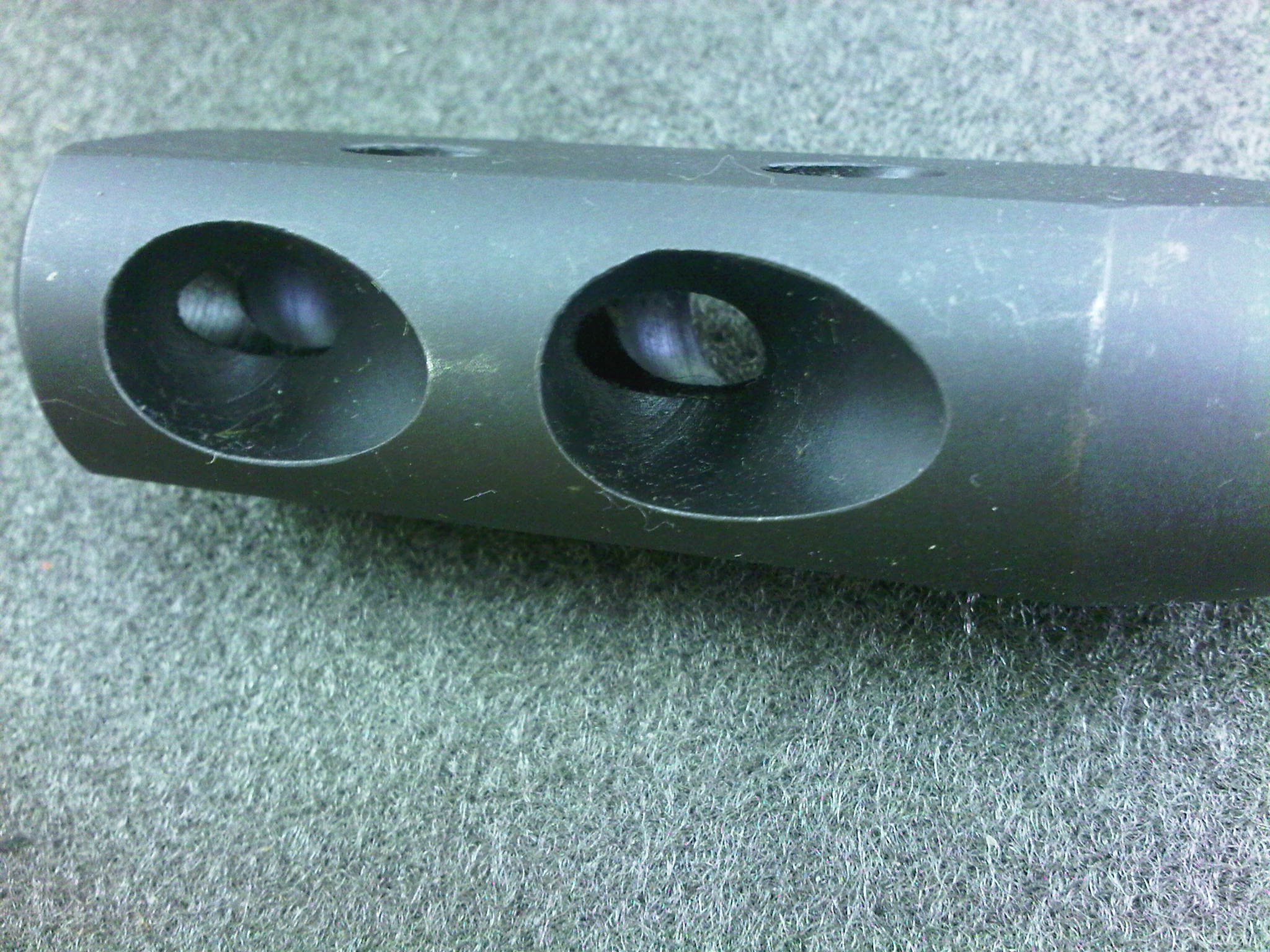
Here is a picture of the baffles on the Hammerhead:

IMG00367-20110623-0944.jpg


On the Hammerhead and the Eliminator, they plunge with a ball nose endmill, on the Titan they just use a regular endmill. Part of the trick is for the bottom of the cut to create a rounded or angled feature that re-directs the gas rearwards at a 30 or 45 degree angle.
 
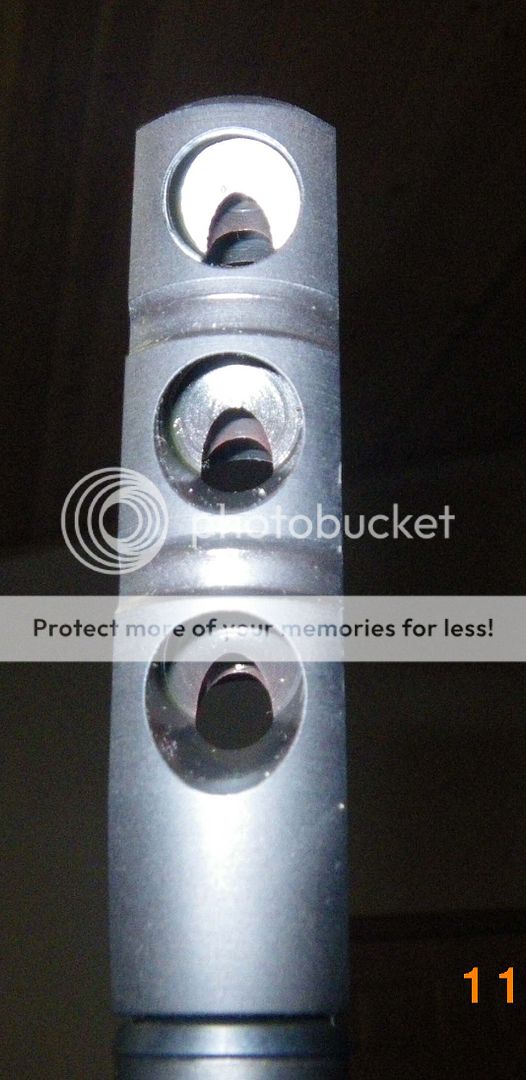
Here is a good shot off the Titan baffles:

Comp2.jpg


Whether it's a ball nose, or a standard endmill, the feature they create acts like a wedge.
 
Thanks kombayotch, one final question, to ensure the flats are at the top and bottom side of the barrel or holes out to the sides, is there a lock nut that comes with these ones to ensure its aligned correctly, or will I have to thread it onto my barrel and mark where to machine the holes (out the sides) and then take it off and finish the machining and re-install once complete?
 
You can just use a crush washer or a peel washer to clock it.

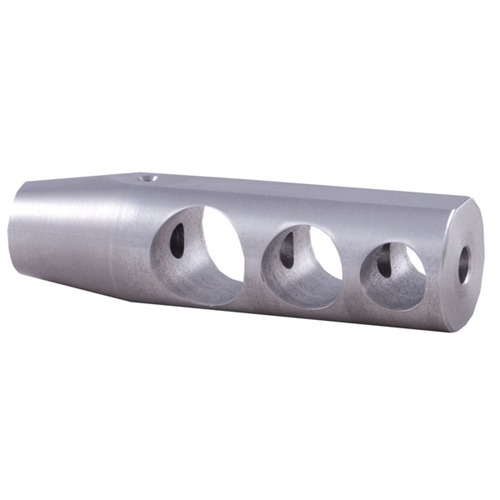
Here is the rolling thunder break:
l_100003689_1.jpg
 
Last edited:
If you look at the picture in post #7, you can see at the bottom the washer. That's a crush washer. It's also on backwards ;)
 
I'll keep looking for a sharp lookin affordable one, and if I cant find one I like priced well, I'll grab a chunk of steel or aluminum and get to it when my gun gets here.

Do not use aluminum. Muzzle gasses on a 10.5 AR will eat it up in one short range session! There were pics on here somewhere were someone put an airsoft aluminum muzzle brake on an AR and it chewed it up and spit it out! Even steel muzzle devices like the Noveske KX3 will get eaten up over a relatively short amount of rounds, think 2-3000, if rapid fired.
 
Do not use aluminum. Muzzle gasses on a 10.5 AR will eat it up in one short range session! There were pics on here somewhere were someone put an airsoft aluminum muzzle brake on an AR and it chewed it up and spit it out! Even steel muzzle devices like the Noveske KX3 will get eaten up over a relatively short amount of rounds, think 2-3000, if rapid fired.

Interesting, so maybe a bit of a heat treat should be done too, nothing to hard to make them brittle, but enough to make them a little tougher than non heat treated steel. Maybe a 48 to 52 rockwell for a hardness....
 
Interesting Thread.

As someone with a little bit of experience with this (and I say just a "little bit" because that is all it is) I'll offer my opinion. Given that you say you have access to a full machine shop, you are way ahead of the curve. IMO you have two ways to go about doing this:

1) Just start building muzzle brakes based on what you think looks cool, or steal designs from pictures you see on the net. The legalities of stealing someones deign notwithstanding, this is the easy route to take. You can probably make something that works OK, and that may or may not ruin your rifle, barrel crown, or burn through within 1000 rounds. As a matter of FACT, this is the way most muzzle device "designers" go about their business. One only has to go on the web-sites of many well known devices and read all kinds of crap about how the device is supposed to work or why it works so well. Most of it is rubbish! Fabrications based on why they think their devices works. But there is no real understanding of the principals involved, and hence, no real way to innovate, because all they can do is build by trial and error.


2) You could do the hard work and try to gain some understanding of how muzzle brakes work. There are no reading materials out there that will tell you: "if you do this, that will happen." There is no "Complete Dummies Guide to Muzzle Brakes." Most of what you can find is very heavy technical reading. Those precious few texts and manuals are full of heavy mathematics, calculus, and physics. Unless you are VERY interested, you will find most of it quite boring. And if you happen to be VERY interested (as I am) a lot of what you will read will be above your understanding due to the heavy scientific nature of the material. But, if you are determined enough, even if you don't understand all of the concepts or mathematics discussed, you can find some useful information that will allow you to hit the ground running with more understanding than most of the so called "designers" out there. Your original prototypes are more likely to be successful, with much less redesign and tweaking to get to a finished product.

Good luck with it, and please post your results, which ever route you decide to take.
 
Last edited:
Thanks Clobbersauras for making me think I will likely ruin my barrel :(

On the bright side, I am in the manufacturing of metal parts trade myself, and have several friends that own their own shops (machine shops, laser and forming shops, etc etc), one of which that is making his own (legally with proper permits from the Canadian Government) AR-15's and I sent him a text today to see if he also makes these muzzle brakes. Just so happens he is going to give me one for my new rifle, so once I get the gun, and the brake, I'll post some pics. EVEN BETTER NEWS, he is going to set me up (killer promo deal) with one of his new AR-15's in a few months when his barrels are done!!!
 
Clobbersauras - wasn't it you who posted up a few weeks / months ago a series of videos testing about a dozen brakes and compensators? I can't recall who the two lads were in the videos (4 or 5 of them), but thought it was well done.

It could be of great use to Rubberdown to see which of each type (B's Vs C's) design work best under different applications.
 
Thanks Clobbersauras for making me think I will likely ruin my barrel :(

I didn't say it was likely. It's possible to do though, if you don't get it right.

Clobbersauras - wasn't it you who posted up a few weeks / months ago a series of videos testing about a dozen brakes and compensators? I can't recall who the two lads were in the videos (4 or 5 of them), but thought it was well done.

It could be of great use to Rubberdown to see which of each type (B's Vs C's) design work best under different applications.

[Youtube]ZtVB4IubWyc[/Youtube]
 
The more I think about it, the less I trust their "tests". Way too dependant on the operator. You can run the same brake multiple times in that full auto test and get different results since its a human manipulating the rifle. I also find it annoying that they refuse to give an overall conclusion.

These are better tests and agree with the conclusions that 3 gunners who have tried them have posted consistently on forums.
http://www.scribd.com/doc/22829784/AR15-Compensators-pt-1
http://www.scribd.com/doc/22829785/AR15-Compensators-pt-2

I have several of the breaks/comps they test, and have tried them on different length barrels. Have also shot them next to some of the others. Battlecomp and FCS556 feel the same, but they aren't even close to the Titan in performance (have all three). They're just nicer to use in the modified prone position. Surefire also performs better (feels the same as the Dlask A6), but its not as good as the Titan in performance. Although, its also better in the modified prone since it doesn't blast debris AT YOU like the Titan does.
 
Back
Top Bottom