












































You are using an out of date browser. It may not display this or other websites correctly.
You should upgrade or use an alternative browser.
You should upgrade or use an alternative browser.
Latest Acquisition
- Thread starter Road King
- Start date



- Location
- vancouver island
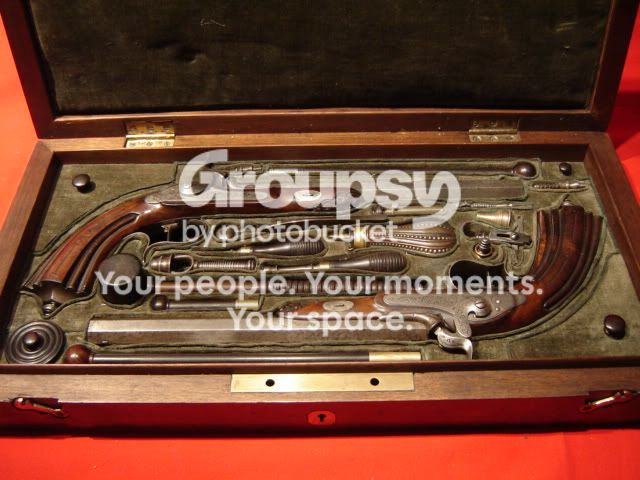
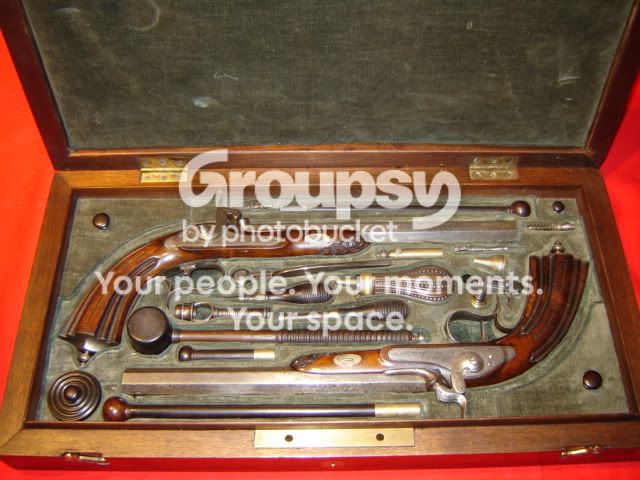
LePage style duellers-
WOW- what a stunning find! have been looking out for similar for a long time. are they belgian proofed or original LePage? regards,bill
WOW- what a stunning find! have been looking out for similar for a long time. are they belgian proofed or original LePage? regards,bill

Got Juice?
CGN Ultra frequent flyer
- Location
- Peoples Republik of Kanukkistan
VERY nice find. I shudder to think of what that cost you, but thanks for posting the pictures.

These pistols were made by F.P. Devisme who was one of the more popular gunmakers of the mid 19th century in Paris France. I heard about these pistols over 2 years ago and was only recently able to aquire them. Two years was a long wait and intercepted them within a week of going to be shown to a collector in the US.


- Location
- Algoma region
Wow indeed!
Brilliant find.
Brilliant find.

Are those the set that Jean Plammondon sold out of P&S 2 years ago? Nice find.
I don't think so as they have been with the family that I purchased them from for a long time.

The pistols are fabulous and the casing is over the top.....Thanks for letting us see them.
Was there a story that came with these pistols,they are dueling pistols and probably belonged to some important person? Do you know if they were ever used for the intended purpose? My concept of what these guns represent is based solely on Hollywood movies and T.V. is there more to it than defending ones honor?
It seems kind of crazy that in those days if someone did something you didn't like you would lend them a gun so they can shoot at you.
Was there a story that came with these pistols,they are dueling pistols and probably belonged to some important person? Do you know if they were ever used for the intended purpose? My concept of what these guns represent is based solely on Hollywood movies and T.V. is there more to it than defending ones honor?
It seems kind of crazy that in those days if someone did something you didn't like you would lend them a gun so they can shoot at you.
I don't have a lot of history on the pistols as the owner that had them has died and I purchased these from the family. They are not sure as to where he aquired them but he was a collector and I had purchased a few guns from him in the past. He was originally from Romania and may have brought these guns from Europe. The falling is a bit of information that I have found on the maker and also a bit history on duelling.
F. P. Devisme - Paris France - 1815 to 1867
F. P. Devisme was one of the more popular French gun makers of the mid 19th century. F.P. Devisme manufactured a wide variety of firearms including single shot pistols, double barrel percussion rifles and shotguns. After 1858 this maker manufactured cartridge weapons of the same style as his percussion arms. The quality of all his products is uniformly high. He received gold medals at the 1851 London Exhibition and Paris Exhibition in 1867.
Given his reputation for advanced systems and quality work, many of Devisme's guns were owned by European Royalty and Heads of State.
During the American Civil War he supplied weapons to and evidently had strong connections to the Southern Government prior to and during the Civil War. One of his master pieces was owned and used by Jefferson Davis, President of The Confederacy. Both Robert Lee and John Bell Hood were armed with swords made by Devisme.
The legal proscription of duelling in Belgium and France enacted after the collapse of the First Empire left the burgeoning gun trade in duelling pistols with a dilemma which was overcome by the promotion of pistol shooting for a sport. In this manner the production of pistols of duelling type continued little changed as late as 1865 under the guise of the adjusted nomenclature. This pair is typical and preserved in good condition.
Duelling Pistols
________________________________________
Duelling, in Europe, was a privilege of the upper class. Laws and customs required that officers and gentleman defend their honourable status. In the 1760’s social pressures had pushed the sword out of fashionable dress attire. The sword had been the weapon of choice, on the field of honour, before that time. The use of pistols became more popular, and by 1770 gun makers in Europe were producing custom sets of pistols designed exclusively for duelling. Duelling was, after all, conducted with exquisite politeness, according to a code that was honourable and fair. Society treated it as a private matter, allowed only among the countries elite the “upper strata’ men with unquestionable honour, those that by their very social standing had earned the right to take the life of another. Intellectuals rationalized it, Poets romanticized it, Politicians defended it, and so it flourished for 70 years across all of Europe and North America.
The foundation for justifying duelling goes way back to laws from A.D. 501. The basic presumptions were: 1) Brave men did not deserve to suffer, 2) Cowards did not deserve to live, 3) God would protect the party whose quarrel was just. The Judicial Duel was the universal way disputes were resolved in Europe. In the era of Knights there were small wars where teams were sent against each other, in one "no death" event 60 people died. There was a lot to gain by besting someone; their clothes, horse, weapons, rings, home, wife. There is little question if you talk about formal duelling in general that the French were “ The Fathers”. This site focuses on Duelling Pistols and their reign as the weapon of choice. As time went by the monarchs of Europe established many guidelines, but one of importance to the justification of duelling was “The Rules and Articles of War”. This document was designed to cover how countries would interact when in conflict. It was also specific about an officer’s behaviour. An officer that submitted to insults or was involved in behaviour unbecoming to a gentleman could be court marshalled. In order to maintain your status, rank, and social standing you had to be willing and able to duel.
A set of duelling pistols in your home became the statement of the upper class. Its mere presence said you were in the class and would be allowed to duel. The guns made everyone aware that you were a man of honour and had the courage to defend your family honour. Officers and Gentlemen were the social police of the era. The bad boys of the day had to watch their consumption, interactions, contacts with females, statements, etc. Specific actions could generate an immediate challenge. Officers were court marshalled and gentlemen lost their social standing for not acting as “a gentleman was expected to act”. This included third party issues where the officer or gentleman was merely present and it was felt they should have challenged the actions of a third party to the first party. Fighting a duel was in fashion, and the young bloods seeking notoriety were anxious to have an opportunity to display their skills. Kings, Presidents, Senators, Supreme Court Justices, all participated in duels, Andrew Jackson is said to have fought in 14 duels.
In order to discourage duelling among his officers "Fredric the Great" built a gallows on the field of honour to hang the survivor. By the 1830’s factors began to exert a negative influence on duelling in England. Many people had died, too many gentlemen seemed ready to defend their honour. Public opinion was turning in England. By 1837 Queen Victoria had coerced the military into disavowing duelling. By 1844 “The Rules and Articles of War” were amended, officers could give and accept apologies and remain perfectly honourable. Officers would actually be court marshalled for not taking active measures to prevent a duel. And the duel quickly fell from social grace in England, Canada, and the Northern States of America. In New Orleans, site of the famous "Duelling Oaks - where up to 12 duels were fought in one day", the police began to enforce the laws against duelling in 1855. Duelling continued in the Southern States of America until the Civil War. In France and Germany duelling was commonplace until WWI. Major bloody wars with mass deaths impacted societies view on individual dispute resolution, the mindset that justified duelling also justified wars, and society had seen enough of blood based solutions to disputes.
Many things are personal opinion; I have reached the following conclusions. In the duelling pistol trade the English were “The Fathers”. They made the first sets; had major innovation that improved design, handling qualities, and accuracy. The English clearly lead the way. The French were “The Fathers of the Duel” from the beginning and went design crazy with cased gun sets. They produced very elaborate sets that were beautiful pieces of art. Actual duels in France evolved to social showmanship, in some years hundreds of duels were fought and no deaths. They had a purpose; they made a clear public statement that the two individuals (or the parties they represented) disagreed. The potential for loss of life was minimized, but the romance of the duel survived in France. The Germans were the unique holdout in Europe. Some say it was a statement of Germanys evolution away from the rest of Europe. Germans fought duels right up to World War I. The duels were deadly, someone usually died. Other places are known for having first-class makers of Duelling Pistol Sets; Belgium, Prague, Vienna, and America.
Women did it too!
Usually, when women participated in duels, it was viewed as an oddity, a strange spectacle that was more an amusement than a deadly contest. The weapons the women used were often altered so the duellists could not harm each other, or the contest was stopped before blood was shed.
However, there was at least one famous female duellist, a French opera singer named La Maupin. By some accounts, her father trained her at sword fighting, while some claim she had an affair with a fencing master who gave her lessons. To support herself and her husband, she began performing at inns and taverns, singing and fencing while dressed as a boy, although she did not seem to conceal her true gender. It was simply easier to sword fight without frilly skirts and dresses to worry about.
The most famous of these female duels is the 1792 duel between Lady Almeria Braddockand Mrs. Elphinstone, regarding a comment over Lady Braddock’s true age. The ladies duelled first with single shot pistols. The duel came within a foot of fatal when Mrs. Elpinstone’s shot went through Lady Braddock’s hat. Despite the calls of their seconds (every principle duellist must have a second, a sort of right hand man - or Madame, in this case) to cease and desist, the determined ladies switched to swords. A short round of fencing ensued, and Mrs. Elphinstone was wounded in the arm. Through her pain, she agreed to write a letter of apology. Honour restored, the ladies curtsied and headed home
In America some duels were carried on in the approved European manner, as in the famous duel between General Andrew Jackson and Charles Dickinson which took place in 1806. Both were crack shots with a pistol and after fireing first Dickinson was amazed to find hids man still standing. Jackson then took careful aim and shot Dickinson dead. Only then it was discovered that Dickinson's shot had struck Jackson in the chest, breaking two ribs and inflicting a pain ful but not dangerous wound. Jackson had calmly avoided showing any sign of injury.
Missing to one side or diliberately firing to one side to satify honour without causing injury were not without their hazards for seconds. In a duel on Bagshot Heath in 1822 one of the seconds was shot and died shortly after; this was not an isolated incident, seconds being reported killed or wounded by duellers on quite a number of ocasions.
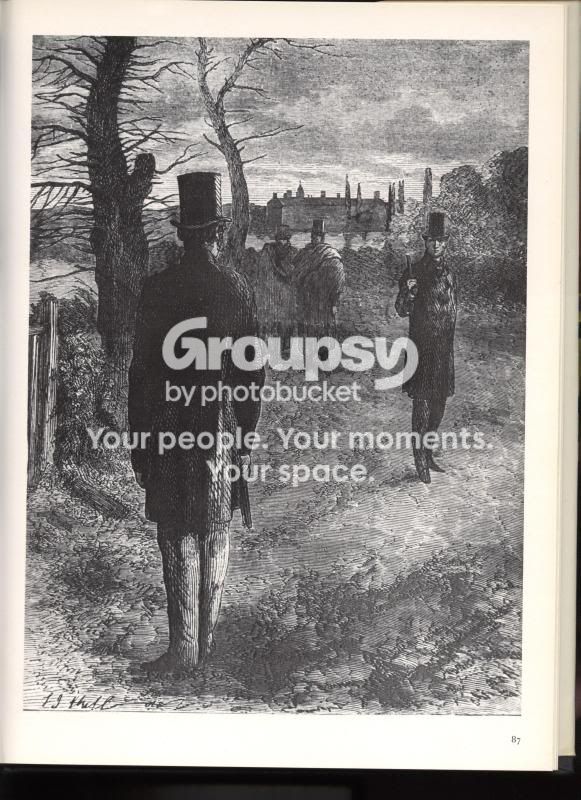
This picture is a duel between Duke of Wellington and the Earl of Winchilsea, 1829. It derived basically from the Earl's violent objection to the Roman Catholic Relief Bill which Wellington had help bring in. He saw his chance to damage Wellingtion's reputation when the duke became patron to the estabilishment of King's College, London. The charges of Popery were eventally answered with a challenge.
For the full story of the duel go to the following site.
http://www.kcl.ac.uk/depsta/iss/archives/wellington/duel08.htm
F. P. Devisme - Paris France - 1815 to 1867
F. P. Devisme was one of the more popular French gun makers of the mid 19th century. F.P. Devisme manufactured a wide variety of firearms including single shot pistols, double barrel percussion rifles and shotguns. After 1858 this maker manufactured cartridge weapons of the same style as his percussion arms. The quality of all his products is uniformly high. He received gold medals at the 1851 London Exhibition and Paris Exhibition in 1867.
Given his reputation for advanced systems and quality work, many of Devisme's guns were owned by European Royalty and Heads of State.
During the American Civil War he supplied weapons to and evidently had strong connections to the Southern Government prior to and during the Civil War. One of his master pieces was owned and used by Jefferson Davis, President of The Confederacy. Both Robert Lee and John Bell Hood were armed with swords made by Devisme.
The legal proscription of duelling in Belgium and France enacted after the collapse of the First Empire left the burgeoning gun trade in duelling pistols with a dilemma which was overcome by the promotion of pistol shooting for a sport. In this manner the production of pistols of duelling type continued little changed as late as 1865 under the guise of the adjusted nomenclature. This pair is typical and preserved in good condition.
Duelling Pistols
________________________________________
Duelling, in Europe, was a privilege of the upper class. Laws and customs required that officers and gentleman defend their honourable status. In the 1760’s social pressures had pushed the sword out of fashionable dress attire. The sword had been the weapon of choice, on the field of honour, before that time. The use of pistols became more popular, and by 1770 gun makers in Europe were producing custom sets of pistols designed exclusively for duelling. Duelling was, after all, conducted with exquisite politeness, according to a code that was honourable and fair. Society treated it as a private matter, allowed only among the countries elite the “upper strata’ men with unquestionable honour, those that by their very social standing had earned the right to take the life of another. Intellectuals rationalized it, Poets romanticized it, Politicians defended it, and so it flourished for 70 years across all of Europe and North America.
The foundation for justifying duelling goes way back to laws from A.D. 501. The basic presumptions were: 1) Brave men did not deserve to suffer, 2) Cowards did not deserve to live, 3) God would protect the party whose quarrel was just. The Judicial Duel was the universal way disputes were resolved in Europe. In the era of Knights there were small wars where teams were sent against each other, in one "no death" event 60 people died. There was a lot to gain by besting someone; their clothes, horse, weapons, rings, home, wife. There is little question if you talk about formal duelling in general that the French were “ The Fathers”. This site focuses on Duelling Pistols and their reign as the weapon of choice. As time went by the monarchs of Europe established many guidelines, but one of importance to the justification of duelling was “The Rules and Articles of War”. This document was designed to cover how countries would interact when in conflict. It was also specific about an officer’s behaviour. An officer that submitted to insults or was involved in behaviour unbecoming to a gentleman could be court marshalled. In order to maintain your status, rank, and social standing you had to be willing and able to duel.
A set of duelling pistols in your home became the statement of the upper class. Its mere presence said you were in the class and would be allowed to duel. The guns made everyone aware that you were a man of honour and had the courage to defend your family honour. Officers and Gentlemen were the social police of the era. The bad boys of the day had to watch their consumption, interactions, contacts with females, statements, etc. Specific actions could generate an immediate challenge. Officers were court marshalled and gentlemen lost their social standing for not acting as “a gentleman was expected to act”. This included third party issues where the officer or gentleman was merely present and it was felt they should have challenged the actions of a third party to the first party. Fighting a duel was in fashion, and the young bloods seeking notoriety were anxious to have an opportunity to display their skills. Kings, Presidents, Senators, Supreme Court Justices, all participated in duels, Andrew Jackson is said to have fought in 14 duels.
In order to discourage duelling among his officers "Fredric the Great" built a gallows on the field of honour to hang the survivor. By the 1830’s factors began to exert a negative influence on duelling in England. Many people had died, too many gentlemen seemed ready to defend their honour. Public opinion was turning in England. By 1837 Queen Victoria had coerced the military into disavowing duelling. By 1844 “The Rules and Articles of War” were amended, officers could give and accept apologies and remain perfectly honourable. Officers would actually be court marshalled for not taking active measures to prevent a duel. And the duel quickly fell from social grace in England, Canada, and the Northern States of America. In New Orleans, site of the famous "Duelling Oaks - where up to 12 duels were fought in one day", the police began to enforce the laws against duelling in 1855. Duelling continued in the Southern States of America until the Civil War. In France and Germany duelling was commonplace until WWI. Major bloody wars with mass deaths impacted societies view on individual dispute resolution, the mindset that justified duelling also justified wars, and society had seen enough of blood based solutions to disputes.
Many things are personal opinion; I have reached the following conclusions. In the duelling pistol trade the English were “The Fathers”. They made the first sets; had major innovation that improved design, handling qualities, and accuracy. The English clearly lead the way. The French were “The Fathers of the Duel” from the beginning and went design crazy with cased gun sets. They produced very elaborate sets that were beautiful pieces of art. Actual duels in France evolved to social showmanship, in some years hundreds of duels were fought and no deaths. They had a purpose; they made a clear public statement that the two individuals (or the parties they represented) disagreed. The potential for loss of life was minimized, but the romance of the duel survived in France. The Germans were the unique holdout in Europe. Some say it was a statement of Germanys evolution away from the rest of Europe. Germans fought duels right up to World War I. The duels were deadly, someone usually died. Other places are known for having first-class makers of Duelling Pistol Sets; Belgium, Prague, Vienna, and America.
Women did it too!
Usually, when women participated in duels, it was viewed as an oddity, a strange spectacle that was more an amusement than a deadly contest. The weapons the women used were often altered so the duellists could not harm each other, or the contest was stopped before blood was shed.
However, there was at least one famous female duellist, a French opera singer named La Maupin. By some accounts, her father trained her at sword fighting, while some claim she had an affair with a fencing master who gave her lessons. To support herself and her husband, she began performing at inns and taverns, singing and fencing while dressed as a boy, although she did not seem to conceal her true gender. It was simply easier to sword fight without frilly skirts and dresses to worry about.
The most famous of these female duels is the 1792 duel between Lady Almeria Braddockand Mrs. Elphinstone, regarding a comment over Lady Braddock’s true age. The ladies duelled first with single shot pistols. The duel came within a foot of fatal when Mrs. Elpinstone’s shot went through Lady Braddock’s hat. Despite the calls of their seconds (every principle duellist must have a second, a sort of right hand man - or Madame, in this case) to cease and desist, the determined ladies switched to swords. A short round of fencing ensued, and Mrs. Elphinstone was wounded in the arm. Through her pain, she agreed to write a letter of apology. Honour restored, the ladies curtsied and headed home
In America some duels were carried on in the approved European manner, as in the famous duel between General Andrew Jackson and Charles Dickinson which took place in 1806. Both were crack shots with a pistol and after fireing first Dickinson was amazed to find hids man still standing. Jackson then took careful aim and shot Dickinson dead. Only then it was discovered that Dickinson's shot had struck Jackson in the chest, breaking two ribs and inflicting a pain ful but not dangerous wound. Jackson had calmly avoided showing any sign of injury.
Missing to one side or diliberately firing to one side to satify honour without causing injury were not without their hazards for seconds. In a duel on Bagshot Heath in 1822 one of the seconds was shot and died shortly after; this was not an isolated incident, seconds being reported killed or wounded by duellers on quite a number of ocasions.
This picture is a duel between Duke of Wellington and the Earl of Winchilsea, 1829. It derived basically from the Earl's violent objection to the Roman Catholic Relief Bill which Wellington had help bring in. He saw his chance to damage Wellingtion's reputation when the duke became patron to the estabilishment of King's College, London. The charges of Popery were eventally answered with a challenge.
For the full story of the duel go to the following site.
http://www.kcl.ac.uk/depsta/iss/archives/wellington/duel08.htm






















