












































Lee-Enfield gurus, I have a problem

tootall

Moderator
Moderator
Rating - 100%
54   0   0
Location
BC
I have a Longbranch No 4 that usually gives me good results.
However, at a recent Tactical match, I had numerous feed problems.
http://www.canadiangunnutz.com/forum/showthread.php?t=104193&page=15
I don't think I bent the feed lips on the mags, so I don't think that is the problem Also, I was using three different mags that day, so that tends to rule out a bad mag.
I had them fully seated in place, so that is not a factor.
The gun had previously done well in competition, with no FTF issues. So now i am looking for the source of the problem.

One thing I am wondering about, is the rim diameter of the ammo used. In previous events, I had been using Kynock ammo mostly, and some Canadian and Indian ammo. (all cheap WW2 surplus corrosive stuff I bought a decade ago in the US)
This time I used a mix of stuff, mostly Australian made, with MH and MJ headstamps. After going through the picked up brass, I noticed that the Aussie stuff has scratches on the side of it where the bolt rode over top of the round during the FTF. This helps to identify which rounds where the ones that didnt feed. i went through all the brass I collected, and only the Aussie ones had the scratch, none of the Can. ammo did. So I measured the rim diameter with a micrometer.
Cartridges of the World gives a rim dia. of .540
DAC VII 44 had a rim dia. of .532
DAC Vii 1942......................530
MH VII 1942 (no scrarch).....527 to 529 (several samples)
MH VII 1941 (scratched)......522
MJ VII 1941 "...................525


So,.... i am wondering if the difference in rim diameter is what caused all of my problems? The one flaw in the theory is that my friend was sing the same ammo in his Faz No 5, and had no problems at all.
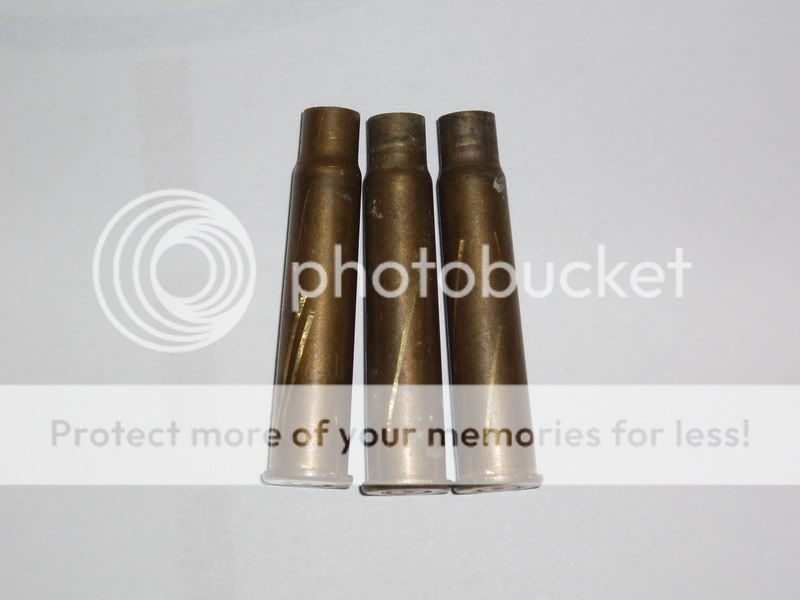
PA260150.jpg


As you can see, the scratches run the same direction in all three cases, and spiral to the right.
 
Last edited:
Can you describe the feed problem you where having? The circular nature of the scratches almost makes me wonder if they where caused on extraction or lock up in the chamber rather than by the bolt. Alternativly, your rims where locking together in the magazine causing hard feeding (in a worst case they won't feed at all, ask me how I know :redface: , clear that one with the clock running). PS, don't swap mags, you can charge her quicker with stripper clips, she was never disigned to have the mags swapped for loading.
 
#1. Check your chamber for a burr
#2. Check your bolt & feed rails in the receiver
#3. Were you using soft point bullets? They often have feeding problems in enfield actions.

Except for the spiral, it looks like your front lip of the mag is too tight, catching the rounds as they are pushed forward by the bolt.

Make up some dummy rounds and try feeding them from the mag.

From your story it sounds like you are mixing your brass, this is a really bad idea in a centre-fire rifle cartridge, though most people I know do it in pistols.

Do not switch mags, that is a recipe for disaster & missfeeding right there.

I don't think that the minor variation in rim diameter is going to cause a problem like this.
 
Last edited:
There are many possibilities. The rim has to be pushed up enough in the mag to contact the bottom edge of the bolt face when you cycle the bolt.

Any chance you short-stroked the action?

Is the bottom of the bolt face crisp, or is the edge peened and rounded?

Remove the mag from the rifle and close the bolt half-way down the length of the receiver so you can see the bolt head when looking into the empty magwell. Puch on the bolt through the magwell. Does it ride up towards the charger bridge? If so, the receiver is worn out of spec.

A .010" difference in rim diamete should NOT be sufficient to cause feeding problems in a Lee action.

If all else fails, swap out the trigger guard or remove the current one and give is a slight bend where the mag well rails meet the trigger bow so that the kingscrew tab points lower toward the ground (for direction orientation, imagine the position the trigger guard is in when you shoulder the rifle - you want the trigger guard kinscrew tab to angle lower toward the ground from the face of the trigger guard bow. Don't bend it alot - just 1 degree or so, we're talking about a very minor dimensional change here.

This will have the effect of raising the mag locking tab higher into the magwell which will get the back of the mag up higher in relation to the bolt face when cycling the action and should aid feeding.

If all that fails, take it to a gunsmith.
 
why use 3 mags????????????????? You can reload a Number 4 mag from chargers (stripper clips) faster than you can change mags....... and you don't get ANY misfeeds that way, either. And you don't dent the feed lips. That's why they didn't issue spare mags for the rifles. In Number 4s, you will find many rifles with the mag serialed to the action...... just to let ya know that you don't need spares.
 
I always mix my brass, and I have never seen scratches like that on them. :eek:

Looks like something is wrong with a feeding lip on the magazine.

Also I'd be surprised that a milsurp match would let you swap mags, when your rifle was never built to do this. I'd go one good box Magazine, and use chargers.
 
I know we discussed this at the match, but I have to agree with this statement:
Do not switch mags, that is a recipe for disaster & missfeeding right there.

I don't recall if HL was switching mags or not and if they were a different set or the same ones you were using.
 
Thanks for the replies.
A few more things to clarify.
-The scratches are only on a few rounds, so this is not coming from the chamber. It happens when the bolt rides OVER the round, rather than pushing it into place.

-I do not remember if it happens to rounds stacked only to one side or the other as found in the mag. Although looking at the marks, I suspect perhaps these cases were on the right half of the stack.

-It is definitely not a "rim-over" situation. I understand the importance of aligning the rims correctly.

-As noted above, I have shot previous courses without problem. This was the first time this has occured. If it happened the first time I came out, I might never have returned!

-As for the stripper clip VS mag change thing, i tried loading from strippers before. It seems that you have to pre-test all the clips,as some are very tight. It took two thumbs to drive the rounds down.

-All ammo was milsurp FMJ, no SP used.

-HowardL was also swapping mags into his No 5

-I will check out the condition of the bolt face, and of the bolt to reciever play. However as this gun is seldom used, and has not been since the last match, I doubt that much wear could occur.

-When I get to a range again, I am going to try out various lots of ammo, and make notes.

More ideas as I think of them. Thanks again for replying
 
Heres another longshot.... 303 cases typically have a relief cut just ahead of the rim - this facilitates proper engagement of the extractor. I got some Herters brass years ago, about half were missing this relief cut. They fed poorly in LE's, and not at all in my P-14's.
Look at the case on the right in your photo - I doesnt appear to have the relief cut, and I believe you can see a nick in the case from the extractor near the base, and the scuff in line with this. Looks like the extractor cannot pick up and seat the rim, causing the case to rotate off the bolt head face.
 
Last edited:
The relief cut only appears on ammo made in the past 40 years. The original service ammo made for the LE did not have it and worked fine.
The LE and especially the No4 should not be reloaded by changing mags. This will result in jamming.
 
Calum said:
I always mix my brass, and I have never seen scratches like that on them. :eek:

snip...

DO NOT MIX BRASS IN ANY CENTRE FIRE RIFLE CALIBER.

While .303 British does not operate at more than moderate pressures (40-45,000 PSI !!!!), you are taking a huge risk with mixing brass.

Do you read reloading manuals? There is a VERY GOOD reason that the primer & case used are specified!

There is such a large potential variation in case capacity between different head stamps that you almost couldn't believe it.
As an example: With JUST commercial WW-Super .303 headstamped brass, I had a case weight variation of OVER 15 GRAINS!

Imagine adding up to 15 grains of powder indiscriminately to various cases on your bench!! :runaway:


Now I may be misunderstanding your terminology. You may be producing separate loads taylored for each case type in your cartridge box. If so, then fill your boots.
 
LE: I don't think they are reloads. They seem to be corrosive surplus Australian made berdan primed service ammunition rounds giving the problems.
 
green said:
The relief cut only appears on ammo made in the past 40 years. The original service ammo made for the LE did not have it and worked fine.
The LE and especially the No4 should not be reloaded by changing mags. This will result in jamming.

And yet, as mentioned before, I ran a previous event without any problems, and I was swapping then also.
This is a new problem, and as best as I can figure, the ammo is the only thing changed.
 
Lee Enfield said:
DO NOT MIX BRASS IN ANY CENTRE FIRE RIFLE CALIBER.

While .303 British does not operate at more than moderate pressures (40-45,000 PSI !!!!), you are taking a huge risk with mixing brass.

Do you read reloading manuals? There is a VERY GOOD reason that the primer & case used are specified!

There is such a large potential variation in case capacity between different head stamps that you almost couldn't believe it.
As an example: With JUST commercial WW-Super .303 headstamped brass, I had a case weight variation of OVER 15 GRAINS!

Imagine adding up to 15 grains of powder indiscriminately to various cases on your bench!! :runaway:


Now I may be misunderstanding your terminology. You may be producing separate loads taylored for each case type in your cartridge box. If so, then fill your boots.


As Claven2 correctly notes, these are not reloads, but original milsurp rounds from the 40's.

And yes, i am well aware of the issues of casually swapping components without regard to safety.
I weigh all of my brass prior to loading, and if I am building a test load for load development I will also weigh my bullets too. just to keep them within a few TENTHS of a grain.
No worries, I appreciate your concern.:)
 
Sometime it smooths up the feeding out of the chargets if you take some very fine (400) sandpaper or crocus cloth and polish the surfaces of the chargers where the cartridges slide.

44Bore
 
Mad minute? Is that how many rounds fired in one minute?
I recall reading somewhere about an instructor firing off 39 ACCURATE shots at 300 yards in a minute!
 
The Mad Minute. British Army Rifle Team blokes once told me 28.
As for the scarring on top of the brass, this is typical on .303 ammo rideing up too high as they entre the chamber of a Lee Enfield. Magazine lip adjustment of a few thou. will often take care of this problem. I know.
 
I'm also told that his thumb and index finger never left the bolt, and he used his middle finger to pull the trigger.

I have tried this, and with a little practice one can get off some impressive quick shots. :)
 
Back
Top Bottom






















