https ://www.americanrifleman.org/articles/2020/8/12/lee-enfield-no-5-jungle-carbine-an-exploded-view/
Lee-Enfield No. 5 'Jungle Carbine:' An Exploded View
by American Rifleman Staff - Wednesday, August 12, 2020
During World War II, jungle fighting experience in the Pacific Theater led the British military to the conclusion that a rifle shorter and lighter than the standard-issue, bolt-action, .303 cal. No. 4 rifle was required.
The No. 4 was 44 1⁄2" long, weighed 8 lbs., 11 ozs., and had been adopted in 1939 to replace the Short, Magazine Lee-Enfield (SMLE)—renamed the No. 1 Rifle in 1926—that had served with modifications since 1902 (Jan./Feb. 1995, p. 52).
Coincidentally, late in 1942, experiments had begun at the Royal Small Arms Factory Enfield with lighter No. 4s. The result became the No. 5 rifle (better known unofficially as the “Jungle Carbine”), and the guns were made from shortened and lightened No. 4 rifles that were originally designated “No. 4 Lightened.”
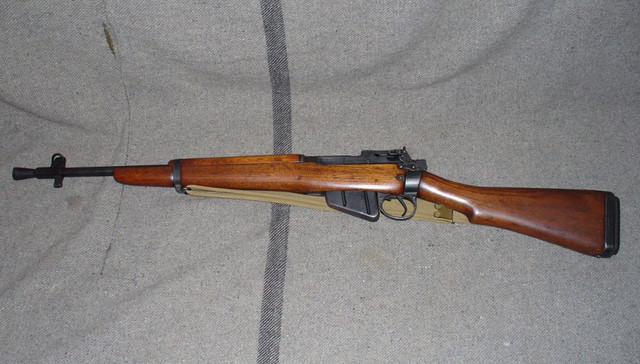
The No. 5 Mark I, as finalized in March 1944 and officially adopted on Sept. 12, 1944, had an overall length of 39 1⁄2", a 20 1⁄2" barrel with a “flash eliminator” similar to that used on the Bren light machinegun, a buttpad assembly with a rubber recoil pad, a side-mounted rear sling swivel and a shortened fore-end.
The bolt handle, receiver and barrel were lightened by removing metal from non-critical areas, as were several other parts. The one-piece top handguard resembled that of a sporterized gun, as much of the forward portion of the barrel was exposed. A new No. 5 Mk I blade bayonet, affixed by a lug integral to the flash eliminator, was added in lieu of the spike bayonet as used with the No. 4.
The No. 5’s aperture rear sight was adjustable out to a more realistic 800 yds., as opposed to 1,300 yds. for the No. 4. Two “marks” of rear sight were made; the Mark I was of milled steel while the body of the Mark II was of stamped steel. The No. 5 had a 10-round-capacity box magazine and was loaded by five-round stripper clips.
The No. 5 was quite popular with the troops and was even proposed to replace the No. 4 in general service, but the “Jungle Carbine” was plagued by a “wandering zero” problem that proved to be the handy little rifle’s undoing. After much investigation, the accuracy problem was found to be “inherent in the design,” and the No. 5 was declared obsolete in July 1947, though some of the rifles were produced through the end of the year.
According to Ian Skennerton in his excellent reference on this family of rifles, The Lee-Enfield Story, 169,807 No. 5 Mk I rifles were manufactured at Royal Ordnance Factory (ROF) Fazakerley and 81,329 at the Birmingham Small Arms (BSA) Shirley Plant. This is a relatively small number as compared to the more than 4 million No. 4 rifles made during World War II alone.
Markings are generally found on the left side of the receiver, and typically include the mark, date of manufacture and maker’s markings, such as “ROF(F)” for Fazakerley made-guns or “M47C” for BSA Shirley production.
Commonwealth countries also experimented with shortened, lightened rifles. “Rifle No. 6” was the designation given the Australian efforts, though only prototypes and trials rifles were produced. Australia never switched its production to the No. 4, so the No. 6 was based on the No. 1 rifle as produced at the Lithgow Small Arms Factory in New South Wales. The No. 6s looked like the No. 5 because of the flash eliminator and cut-down (though grooved) fore-end, but used either a No. 1 buttplate or a swinging trap with the sling swivel on the bottom.
Ishapore, the principal Indian arsenal, also never switched over to making the No. 4 rifle and experimented with No. 1-based “India Pattern Jungle Carbines,” but they were not formally adopted. Canada’s Longbranch experimented with a number of “No. 4 Canadian Lightweights” with a one-piece stock and other changes, though these, too, were never put into production.
Instructions
Disassembly of the unloaded No. 5 begins with depressing the magazine catch (32) and removing the magazine. Open the bolt and move it partially rearward, then depress the bolt release (9) and allow the bolt head (12) to ride on its rail over the release (Fig. 1). Rotate the bolt head up and draw the bolt assembly rearward and out of the receiver (38). It may be necessary to flip up the backsight (2) to allow the bolt head to clear the receiver.
Lee Enfield directions
Turn the bolt head counterclockwise and off the breechbolt (11) (Fig. 2). Twist the cocking piece (17) until it moves to the lower of its two notches, taking most of the compression off the mainspring (36). Turn out the slotted striker screw (45) on the rear of the cocking piece.
The striker (44) is screwed into the cocking piece. There are two notches on either side of the striker’s shoulder about 1" down from the pin’s tip. To remove the striker, insert a takedown tool from the front until the projections on either side of its point engage the notches and simply turn out the firing pin (Fig. 3).
Fore-end (23) removal begins with unscrewing the front sling swivel band screw (47) and removing the sling swivel band (46). Next, turn out the front guard screw (25) and the trigger pin (51), allowing the trigger guard (50) with the trigger (49) attached to be pulled off of the fore-end. The stock’s fore-end is now free to drop off the bottom of the barreled action.
To remove the buttstock (16), turn out the top and bottom retaining screws (14 and 15) and slide the buttpad assembly off the rear of the buttstock. Insert a long-bladed screwdriver into the recess in the buttstock and turn out the stock bolt (48).
Reassembly of the No. 5 is in the reverse order.
click image to enlarge
Lee-Enfield No. 5 'Jungle Carbine:' An Exploded View
by American Rifleman Staff - Wednesday, August 12, 2020
During World War II, jungle fighting experience in the Pacific Theater led the British military to the conclusion that a rifle shorter and lighter than the standard-issue, bolt-action, .303 cal. No. 4 rifle was required.
The No. 4 was 44 1⁄2" long, weighed 8 lbs., 11 ozs., and had been adopted in 1939 to replace the Short, Magazine Lee-Enfield (SMLE)—renamed the No. 1 Rifle in 1926—that had served with modifications since 1902 (Jan./Feb. 1995, p. 52).
Coincidentally, late in 1942, experiments had begun at the Royal Small Arms Factory Enfield with lighter No. 4s. The result became the No. 5 rifle (better known unofficially as the “Jungle Carbine”), and the guns were made from shortened and lightened No. 4 rifles that were originally designated “No. 4 Lightened.”
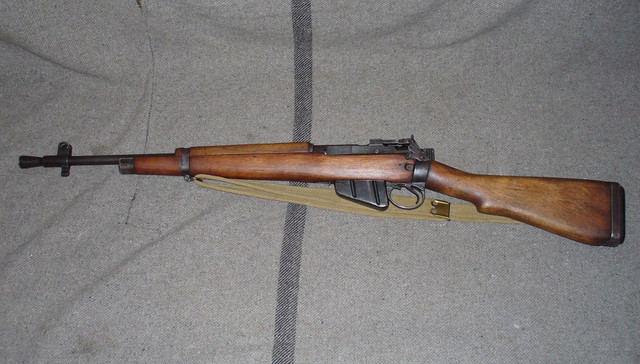
The No. 5 Mark I, as finalized in March 1944 and officially adopted on Sept. 12, 1944, had an overall length of 39 1⁄2", a 20 1⁄2" barrel with a “flash eliminator” similar to that used on the Bren light machinegun, a buttpad assembly with a rubber recoil pad, a side-mounted rear sling swivel and a shortened fore-end.
The bolt handle, receiver and barrel were lightened by removing metal from non-critical areas, as were several other parts. The one-piece top handguard resembled that of a sporterized gun, as much of the forward portion of the barrel was exposed. A new No. 5 Mk I blade bayonet, affixed by a lug integral to the flash eliminator, was added in lieu of the spike bayonet as used with the No. 4.
The No. 5’s aperture rear sight was adjustable out to a more realistic 800 yds., as opposed to 1,300 yds. for the No. 4. Two “marks” of rear sight were made; the Mark I was of milled steel while the body of the Mark II was of stamped steel. The No. 5 had a 10-round-capacity box magazine and was loaded by five-round stripper clips.
The No. 5 was quite popular with the troops and was even proposed to replace the No. 4 in general service, but the “Jungle Carbine” was plagued by a “wandering zero” problem that proved to be the handy little rifle’s undoing. After much investigation, the accuracy problem was found to be “inherent in the design,” and the No. 5 was declared obsolete in July 1947, though some of the rifles were produced through the end of the year.
According to Ian Skennerton in his excellent reference on this family of rifles, The Lee-Enfield Story, 169,807 No. 5 Mk I rifles were manufactured at Royal Ordnance Factory (ROF) Fazakerley and 81,329 at the Birmingham Small Arms (BSA) Shirley Plant. This is a relatively small number as compared to the more than 4 million No. 4 rifles made during World War II alone.
Markings are generally found on the left side of the receiver, and typically include the mark, date of manufacture and maker’s markings, such as “ROF(F)” for Fazakerley made-guns or “M47C” for BSA Shirley production.
Commonwealth countries also experimented with shortened, lightened rifles. “Rifle No. 6” was the designation given the Australian efforts, though only prototypes and trials rifles were produced. Australia never switched its production to the No. 4, so the No. 6 was based on the No. 1 rifle as produced at the Lithgow Small Arms Factory in New South Wales. The No. 6s looked like the No. 5 because of the flash eliminator and cut-down (though grooved) fore-end, but used either a No. 1 buttplate or a swinging trap with the sling swivel on the bottom.
Ishapore, the principal Indian arsenal, also never switched over to making the No. 4 rifle and experimented with No. 1-based “India Pattern Jungle Carbines,” but they were not formally adopted. Canada’s Longbranch experimented with a number of “No. 4 Canadian Lightweights” with a one-piece stock and other changes, though these, too, were never put into production.
Instructions
Disassembly of the unloaded No. 5 begins with depressing the magazine catch (32) and removing the magazine. Open the bolt and move it partially rearward, then depress the bolt release (9) and allow the bolt head (12) to ride on its rail over the release (Fig. 1). Rotate the bolt head up and draw the bolt assembly rearward and out of the receiver (38). It may be necessary to flip up the backsight (2) to allow the bolt head to clear the receiver.
Lee Enfield directions
Turn the bolt head counterclockwise and off the breechbolt (11) (Fig. 2). Twist the cocking piece (17) until it moves to the lower of its two notches, taking most of the compression off the mainspring (36). Turn out the slotted striker screw (45) on the rear of the cocking piece.
The striker (44) is screwed into the cocking piece. There are two notches on either side of the striker’s shoulder about 1" down from the pin’s tip. To remove the striker, insert a takedown tool from the front until the projections on either side of its point engage the notches and simply turn out the firing pin (Fig. 3).
Fore-end (23) removal begins with unscrewing the front sling swivel band screw (47) and removing the sling swivel band (46). Next, turn out the front guard screw (25) and the trigger pin (51), allowing the trigger guard (50) with the trigger (49) attached to be pulled off of the fore-end. The stock’s fore-end is now free to drop off the bottom of the barreled action.
To remove the buttstock (16), turn out the top and bottom retaining screws (14 and 15) and slide the buttpad assembly off the rear of the buttstock. Insert a long-bladed screwdriver into the recess in the buttstock and turn out the stock bolt (48).
Reassembly of the No. 5 is in the reverse order.
click image to enlarge