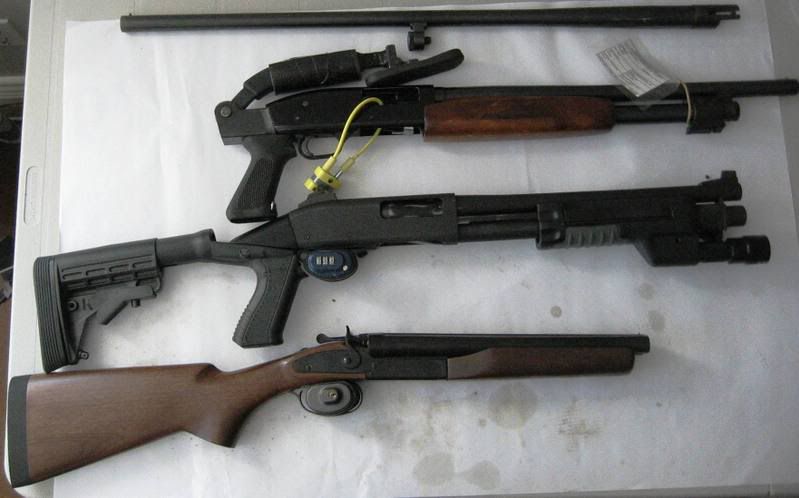
To be used effectively, the shotgun must have a shoulder stock. This means that you can significantly reduce barrel length to stay within the 26" OAL rule, with the proviso that barrels shorter than 18.5" are manufactured to the shorter length. Why it matters who wields the hacksaw I don't know, but that's the rule. Having said that I don't particularly like the very short barrels that require the magazine tube to be shortened, effectively reducing the number of rounds you have access to prior to reloading and raising the risk of one's hand slipping forward off a wet forend, into the path of the muzzle just as the gun fires. I think 14" is a practical minimum barrel length.
While I tend to like things like sidesaddles, longish magazine tubes, rifle sights, choke tubes, and a flashlight on my bear gun, these accessories can add a significant amount of combined weight. The purpose of the choke tubes is not so much to make you gun more versatile, which it can, but to increase the thickness of the muzzle to protect it from damage.
Based on your requirements, I would look for a plain Jane 12 gauge Mossberg 500 or a Remington 870 with a 14"-20" smooth bore barrel. I would opt for a cylinder bore choke tube to protect the muzzle. I prefer a ghost ring and post sight, but a bead can work. Remington's bead front sight is superior to Mossbergs in that it is on a pedestal where the Mossberg is attached directly on the barrel. Due to the height of the receiver, this will cause the Mossberg shooter to hit high, even at very short range. The LOP should be cut down from the common 14"+ to 13"-13.5" including the thickness of a good recoil pad, making the gun a little faster to get into action. The LOP is better even if its a bit too short rather than too long, as guns with long LOPs are very slow to get into action; especially when we are all geared up for cold or wet weather in bulky clothing. A wood stock is easier to shorten than is a plastic one. But the ribbed plastic forends are much tougher than wood, and less slippery when wet.
From the standpoint of strength, your sling should be attached to a sling adapter that clamps around both the barrel and magazine tube, rather than a QD stud in the magazine cap. I would choose a simple 1.25" nylon web sling. Keep it short and tight except when you carry the gun slung. If the gun has to be retrieved in an emergency, the sling is out of the way and won't snag on anything.
I make of point of never shooting cracker shells in my personal guns. These things are corrosive and will quickly ruin the finish on the inside of the barrel unless an unreasonable level of care is taken. A better choice is to carry a blank firing pistol for launching scare cartridges. As a rule I think it is a poor practice to load anything but lethal cartridges in your protection gun. You can end up shooting a slug at a bear you intend only to scare, or worse, fire a less lethal round when you need to kill the bear in an emergency. If you intend to have more than one type of ammunition in camp, load the magazine to capacity with slugs leaving the chamber empty. This allows you to single load anything else you shoot through the gun. Always top off the magazine after any shooting.
The point of bringing up the question of ammunition has to do with the cleaning accessories you intend to have in the bush with you. Having too much is unnecessary, but having none is unwise. All to often these life saving tools are abused to extent that they won't work and everyone is surprised when the click instead of bang! At the very least you need tools to strip the gun, which ordinarily is either a pin punch for the pins that secure the trigger group or a small screw driver if the pins have been replaced with screws, as would be the case if you installed a sidesaddle. A thin piece of metal that fits the notches, and that you can hold in a small crescent wrench is all you need to undo the retaining nut that holds the wood or plastic furniture to the forend tube. You need a jointed cleaning rod, and I would opt for a steel rod like the ones made for the M-16 rather than an aluminum one, which could be easily broken. The steel rod needs a shotgun brush adaptor, a brush, a jag, and a zip lock full of cotton patches. Solvent is optional, boiling water with dish soap works in a pinch, evaporates quickly and doesn't produce rust, but a good grade of gun oil and a water displacing aerosol is mandatory. One area that often gets overlooked during the cleaning process is the forend tube under the wood or plastic furniture. If the gun gets wet, as soon as possible, strip the furniture off the forend and wipe the metal dry inside and out. A little light grease smeared on the retaining nut threads makes the job easier. Take care of your gun and it will take care of you.