Low pressure signs? And what to do about it?

Pic works yeah.

Not sure if that is nessesarily low pressure. Low pressure will usually also leave the primer look sort of pushed back out of the case.

Now that you can post pics, what do your primers look like on your lower charges?
 
That load should not be producing low pressure. Sooty necks often indicates the cases need annealing (or replacing if you don't anneal) as the brass has gotten too hard. How many firings on these cases? I usually anneal every 5-7 firings but depending on your load it can harden with fewer firings.
 
That load should not be producing low pressure. Sooty necks often indicates the cases need annealing (or replacing if you don't anneal) as the brass has gotten too hard. How many firings on these cases? I usually anneal every 5-7 firings but depending on your load it can harden with fewer firings.
Right, I’ve been told that a couple times, but this is brand new brass.
 
The 1st pic you put up I though maybe looked a little on the dirty side.

You're second pic showing case necks does not look like anything abnormal really to me.

Maybe just carry on...?

Primers look good as far as I can see in the pics.
 
It may be that your rifle has a generous neck area of the chamber. I would measure a fired case neck [not resized],
and compare it to a new case neck with a seated bullet to see what the difference is. any more than .005" is generous,
and will tend to soot the necks more than will a tighter neck. Dave.
 
Any time you make a workup load starting at the suggested start load and work up you will see carbon on the case necks.

The rifles throat length can effect chamber pressure and soot on the case neck. Example I have a Savage .223 that has a longer throat than my Ar15 rifles and can loaded "warmer" than the manual.

Using slower burning powders can effect the amount of soot on the case neck. Also the case neck thickness and uniformity can effect soot on the neck.

Your photo looks like it has a lot of carbon buildup and not simply a light coating. Is there any chance there is still lube on the case necks preventing them from forming a tight seal?
 
Any time you make a workup load starting at the suggested start load and work up you will see carbon on the case necks.

The rifles throat length can effect chamber pressure and soot on the case neck. Example I have a Savage .223 that has a longer throat than my Ar15 rifles and can loaded "warmer" than the manual.

Using slower burning powders can effect the amount of soot on the case neck. Also the case neck thickness and uniformity can effect soot on the neck.

Your photo looks like it has a lot of carbon buildup and not simply a light coating. Is there any chance there is still lube on the case necks preventing them from forming a tight seal?
So is not resizing brass a remedy for this? I only have a FL die though, maybe I need the neck sizing die in this case... I doubt there is lube on the case neck still, but I will consider that during next prep, thank you
 
So is not resizing brass a remedy for this? I only have a FL die though, maybe I need the neck sizing die in this case... I doubt there is lube on the case neck still, but I will consider that during next prep, thank you

Full length resizing is my preferred sizing method and I only neck size cases like my .303 British cases to extend case life.

Anytime someone asks about carbon on their case necks it makes me wonder if they started at the suggested start load and worked up to a max load.

So again the biggest cause of carbon on the neck is low pressure and the case neck not sealing in the chambers neck area.

If your case neck was a engines piston you would be getting blow by because the rings are not sealing the combustion.
 
Last edited:
Full length resizing is my preferred sizing method and I only neck size cases like my .303 British cases to extend case life.

Anytime someone asks about carbon on their case necks it makes me wonder if they started at the suggested start load and worked up to a max load.

So again the biggest cause of carbon on the neck is low pressure and the case neck not sealing in the chambers neck area.

If your case neck was a engines piston you would be getting blow by because the rings are not sealing.

Got it, I did start at minimum and work up as recommended in manual for a beginner, I’m going to work above middle and up to the max load to see if that changes anything.
 
Got it, I did start at minimum and work up as recommended in manual for a beginner, I’m going to work above middle and up to the max load to see if that changes anything.

Just remember that the reloading manuals are "guide lines" and not written in stone. This is because there are so many variations in firearms and reloading components. Also the SAAMI and the reloading manuals will list the maximum chamber pressure for the oldest and weakest firearms still being used.

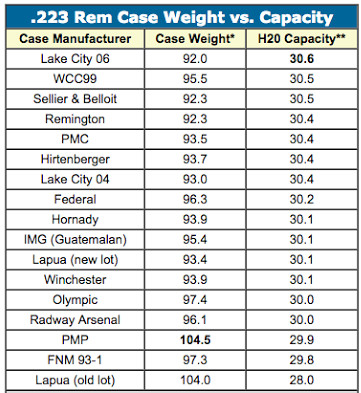
Below is a example of chamber pressure and case capacity, the top Lake City case at 30.6 H2O case capacity and the bottom old Lapua case at 28.0 capacity.

The same charge of 25.0 grains of H335 will be slightly below 50,000 psi in the Lake City case. And the old Lapua with less case capacity will and the same powder charge will be 6,000 psi higher pressure.

LjAQ7L9.jpg


Below the max load for a AR15 is 26.0 grains of H335 with Lake City 5.56 cases at approximately 55,000 psi. "BUT" the same charge in the old Lapua .223 case would increase chamber pressure over 60,000 psi.

HCX23La.jpg


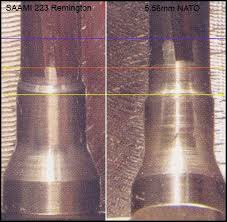
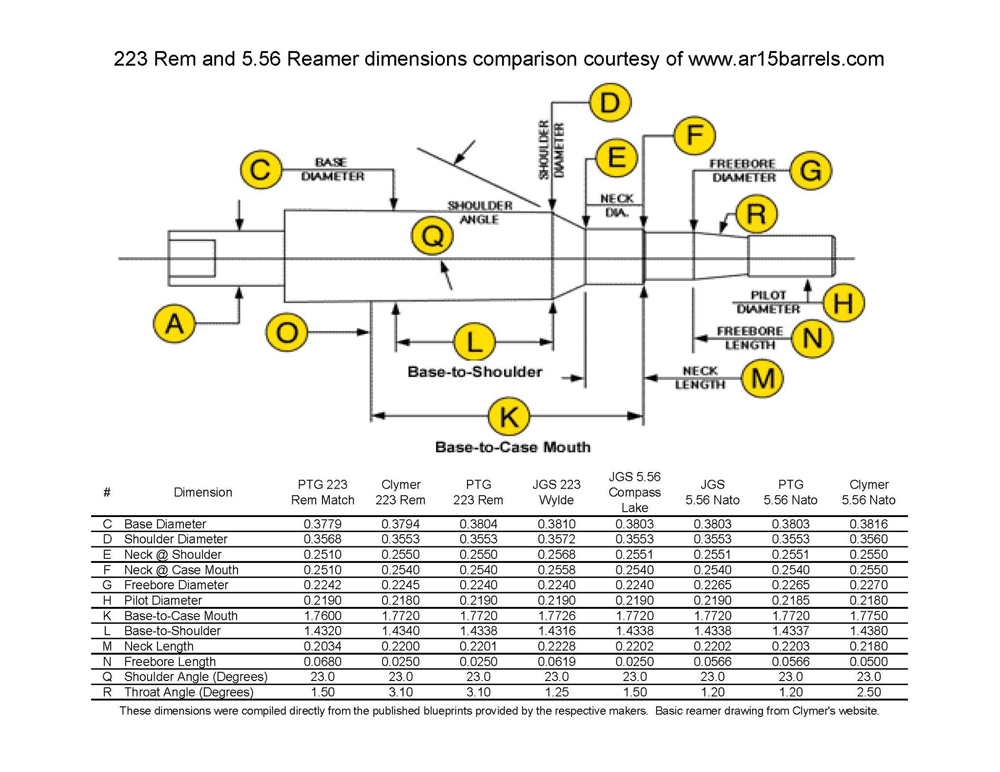
Below the shorter throat length of a .223 with 1in12 or 1in14 twist rate and the "longer" throat length of a AR15 with a 1in7, 1in8 or 1in9 twist rate. And again the throat length in my Savage .223 with a 1in9 twist is longer than the AR15 rifles. Meaning my Savage .223 could be loaded "warmer" than manuals listing the shorter throated 1in12, 1in14 twist rifles.

tviAISD.jpg
 
Excellent info, thank you. I’m still digesting. So what is the best way to determine the throat length of a particular rifle? In my case the Sauer has a twist rate of 1:11. I’m feeling more confident to move up and away from min-med loads and test some more towards the max.
 
Excellent info, thank you. I’m still digesting. So what is the best way to determine the throat length of a particular rifle? In my case the Sauer has a twist rate of 1:11. I’m feeling more confident to move up and away from min-med loads and test some more towards the max.

Below your brass will vary in hardness between brands and the link below tells you how to check your cases for excess pressure.

Simple Trick for Monitoring Pressure of Your Rifle Reloads
http://www.hodgdonreloading.com/reloading-education/tips-and-tricks/simple-trick-monitoring-pressure-your-rifle-reloads

Below there is more than just throat length, you have throat diameter and throat angle that also effects pressure along with how far off the lands you are. I would seat your bullets according to the manual and make a workup load checking for excess pressure. Then when you know the max "safe" powder charge then start playing with how far of the lands you are.

Just remember the manuals do not tell you the throat length of the firearm used in testing. So its up to you to find the "safe" max pressure your rifle can handle, and how much you want to back off to get a safe margin and not abuse your brass.

wjAOlWq.jpg


Below this case photo was from accurateshooter.com, this long range shooter would increase the load until he got ejector marks. He then backed off the load 1 or 2 grains and then knew the elastic limits of the brass and how much pressure the case could take. This is a less accurate method than measuring the base expansion just above the extractor groove.

KtO65uH.jpg


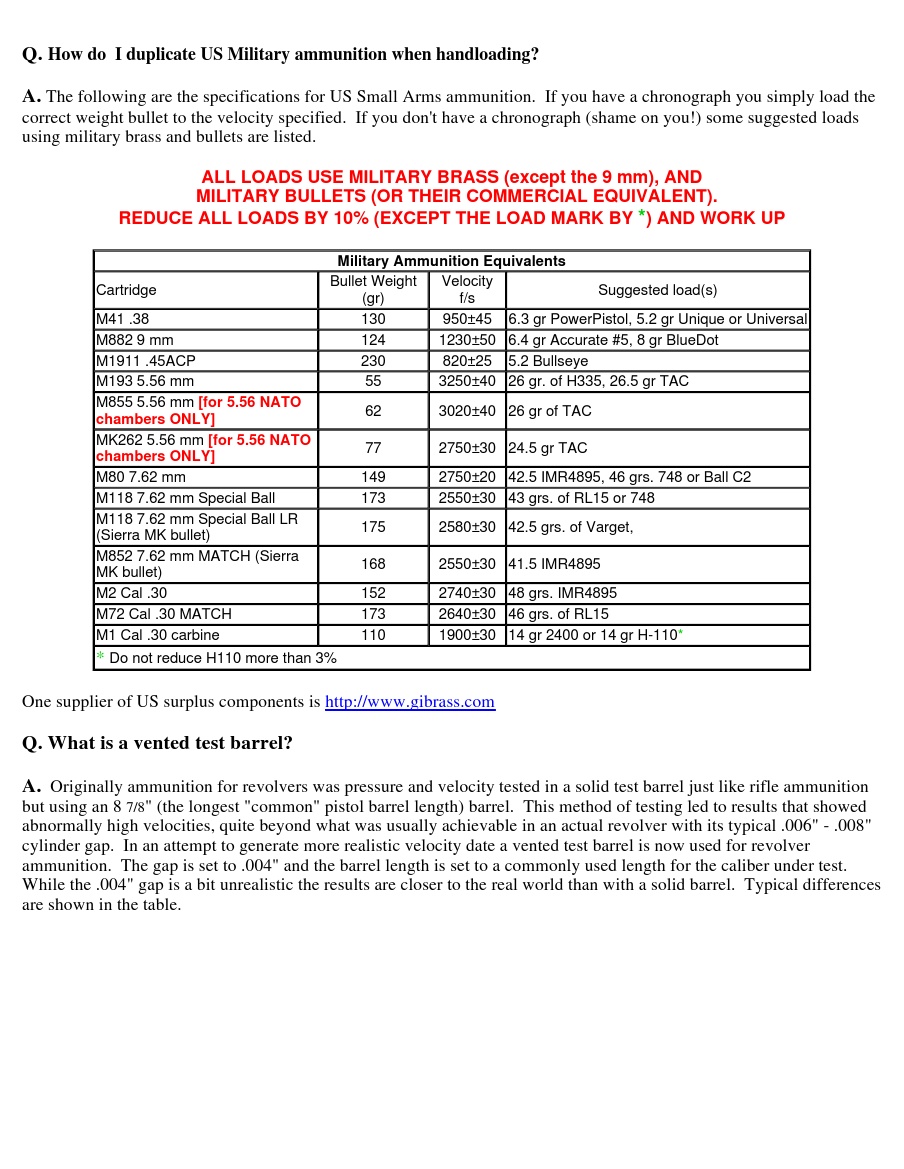
Again the load data in the manuals is "ball park" and varies, example in the Lyman manual some of the data comes from pressure test barrels and a universal receiver. The test barrel will have a chamber and bore at minimum SAAMI dimensions. This will generate the highest chamber pressures that can be normally encountered. Other data will come from actual firearms and will have a strain gauge glued to the barrel to measure pressure. Meaning the type of pressure measuring equipment can vary along with the pressure readings.

Bottom line, you could workup a safe load in one rifle and in another rifle of the same calibre your primers or brass will show higher pressure.
 
Thanks again, I’m finding this part a bit harder to wrap my head around but helpful none the less. Just to be clear, The measurement is taken “ahead of the extractor groove” in other words measuring base diameter? I would normally be just checking for pressure signs but this seems to def be an accurate trick once you get the hang of it. It says with .308 .0005-.0006” is max, so would u try to stay in .0001ish below that? And I wonder if you will also see pressure signs at the .0006 expansion measurement..
 
Last edited:
Thanks again, I’m finding this part a bit harder to wrap my head around but helpful none the less. Just to be clear, The measurement is taken “ahead of the extractor groove” in other words measuring base diameter? I would normally be just checking for pressure signs but this seems to def be an accurate trick once you get the hang of it. It says with .308 .0005-.0006” is max, so would u try to stay in .0001ish below that? And I wonder if you will also see pressure signs at the .0006 expansion measurement..

Again measuring the base diameter of the case above the extractor groove is a "ball park" pressure guesstimate. What it does tell you is the strength and hardness of the brass used. Meaning how hot you can load that brand of case, some cases are stronger than others and last more reloadings before the primer pocket stretches and the primers become loose.

Very few reloaders have pressure measuring equipment so most of us use a chronograph or just visually inspecting our fired cases.

IBJQA9p.gif


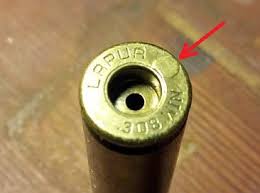
Question, are your primers protruding from the base of the case? Lay a straight edge on the primer and look for daylight around the primer. If the primers are protruding and you have soot on the case neck its a very good sign of low pressure.

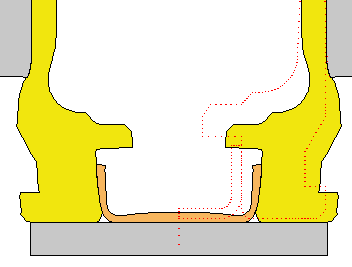
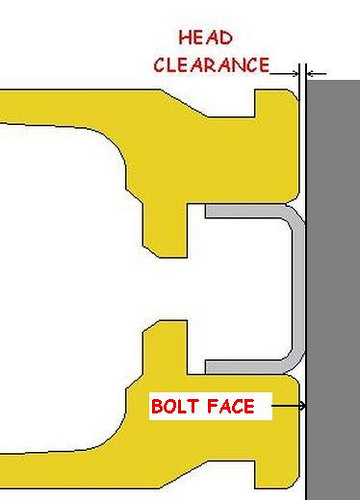
Example, my 30-30 Winchester primers always protrude because the chamber pressure is too low at 38,000 cup or 43,000 psi to force the rear of the case against the bolt face. This is why I make work up loads and check at what point in the load the primers become flush with the base of the case. At this point the chamber pressure is high enough to make the brass stretch to meet the bolt face and where you start putting stress on the brass.

Below at low pressure the primers will protrude from the base of the case.

HK76WCp.jpg
 
Not typical carbon deposits! Could this be unburnt powder? Has the powder been contaminated or exposed to moisture? Is there case lubricant left on the case shoulder?
 
Again measuring the base diameter of the case above the extractor groove is a "ball park" pressure guesstimate. What it does tell you is the strength and hardness of the brass used. Meaning how hot you can load that brand of case, some cases are stronger than others and last more reloadings before the primer pocket stretches and the primers become loose.

Very few reloaders have pressure measuring equipment so most of us use a chronograph or just visually inspecting our fired cases.

IBJQA9p.gif


Question, are your primers protruding from the base of the case? Lay a straight edge on the primer and look for daylight around the primer. If the primers are protruding and you have soot on the case neck its a very good sign of low pressure.

Example, my 30-30 Winchester primers always protrude because the chamber pressure is too low at 38,000 cup or 43,000 psi to force the rear of the case against the bolt face. This is why I make work up loads and check at what point in the load the primers become flush with the base of the case. At this point the chamber pressure is high enough to make the brass stretch to meet the bolt face and where you start putting stress on the brass.

Below at low pressure the primers will protrude from the base of the case.

HK76WCp.jpg
Got ya, thanks! Very helpful, I will def check primers. I guess now, using this info, is to decide where to comfortably work up to. When you start seeing these pressure signs, like flush primers with case head is that a point to stop at? I’m not as concerned about brass life as much as finding a comfortable pressure, that hopefully gets me in a better range for accuracy.
 
Not typical carbon deposits! Could this be unburnt powder? Has the powder been contaminated or exposed to moisture? Is there case lubricant left on the case shoulder?[/QUOTE


The Carbon looks to be from the brass not sealing in the throat of chamber. The powder is not contaminated or exposed to moisture. I highly doubt there is lubricant left on the neck, but in the future I will def pay more attention to that to insure a tight seal. But I dbt it’s the cause bc of the consistency of the Carbon on all of the brass. I’m leaning towards low charged loads being the culprit.
 
Last edited:

That load should not be producing low pressure. Sooty necks often indicates the cases need annealing (or replacing if you don't anneal) as the brass has gotten too hard. How many firings on these cases? I usually anneal every 5-7 firings but depending on your load it can harden with fewer firings.
This was brand new brass, does anyone ever anneal new brass?
 
Back
Top Bottom