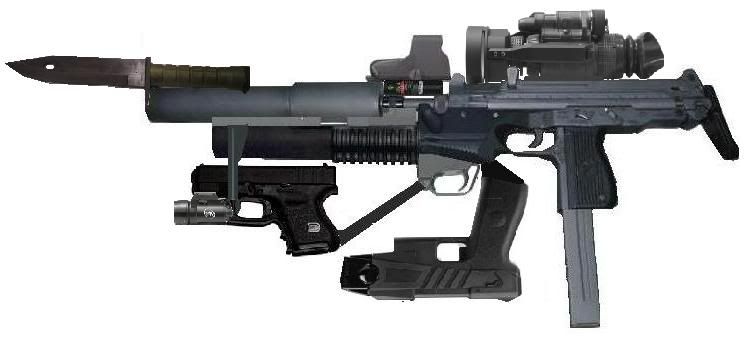






























M4 + Taser

echo4lima

CGN frequent flyer
Rating - 100%
25   0   0
Location
GVRD
Just when you thought you had every imaginable attachment for your M4gery...

M26 / X26 Taser Gun
Electro-Muscular Disruption (EMD) Weapon

Taser International


The M-26 / X-26 advanced Taser gun fires two probes up to 21 feet from a replaceable air cartridge. These probes are connected to the weapon by high-voltage insulated wire. The M-26 uses a new ElectroMuscular Disruption (EMD) weapon technology that can completely override the central nervous system and directly control the skeletal muscles. When the probes make contact with the target, the Taser gun transmits a powerful electrical pulse along the wires and into the target's body through up to 2 inches of clothing. The EMD effect causes an uncontrollable contraction of the muscle tissue that results in physical debilitation regardless of pain tolerance or mental focus.

Taser guns utilize compressed nitrogen to project two small probes up to 15, 21 or 25 feet (21 and 25 foot cartridges sold to law enforcement, military and aviation security agencies only) at a speed of over 160 feet per second. These probes are connected to the Taser device by insulated wire. An electrical signal is transmitted through the wires to where the probes make contact with the body or clothing, resulting in an immediate loss of the person’s neuromuscular control and the ability to perform coordinated action for the duration of the impulse. The technology is effective regardless of pain tolerance, drug use, or body size – factors that cause other non-lethal options to have decreased effectiveness. Recent software upgrade of the X26 weapon has improved the effect of the weapon over the maximum five second discharge. Prior Tasers delivered 19 pulses per second for the first 2 seconds of each discharge, then decrease to 15 pulses per second thereafter. Current upgraded weapons deliver the optimal 19 pulses throughout the activation. Current Taser guns are available with digital firing signature, which records any activation of the weapon. An integrated camera can also be mounted on the weapon to assist post-action debriefing.
Taser can be integrated with M-16 or m4 via the Rail mount

Taser is operated primarily by law enforcement officers, but in recent years it is augmenting other sidearms as a non lethal weapon. For military applications of Taser is now enhanced with an X-Rail mount, which enables integration of Taser gun with M16, M4 and MP5 assault rifles, using the standard Picatinny Rail Interface. Using Taser guns with M16 enable troops to selectively use the firepower, and respond to various levels of threats with minimum risk casualties to innocent civilians.
taserx26.gif


TASER-rail.jpg
 
Last edited:
Oh and this article, interesting that the mil is starting to consider using Tasers for less than lethal confrontations...

Advanced M26 TASER Stun Pistol. Adapted for Army use from a commercial design, the M26 nonlethal weapon is utilized for crowd control and detainee management. It provides the soldier with a less-than-lethal option appropriate to control personnel situations. and was presented a certificate of appreciation by the 101st Division commander.

M26Taser.jpg
 
Last edited:
G.I.'S IN IRAQ GET TASERS, OTHER "NON-LETHALS"

The U.S. military has given hundreds of its troops electricity-spewing taser guns, rubber bullets, and other so-called "non-lethal" weapons to help keep order in Iraq. One of the reasons why, according to a report prepared for the Army: Saddam's thugs used such tactics, too.

"The previous regime used batons to beat the populace, and electrical torture devices on dissidents. Thus judicious use and control of the riot baton and introduction of the TASER has intimidated the former members of the regime, and saved soldiers and civilians lives," reads a personal report, circulating through the Defense Department, from recently retired Lt. Col. Wesley "Bo" Barbour, now a contract employee for the Army's Training and Doctrine Command.

Earlier this year, Barbour lead an Army team that trained 110 soldiers in the use of tasers and other weapons designed to hurt, not to kill. The idea is to give G.I.'s a way to quell resistance, control crowds and subdue prisoners of war – without causing unwanted Iraqi civilian casualties.

"These are tools to enable commanders to break the cycle of violence," Barbour said. "Instead of shooting them dead and promoting further violence, you modify their behavior."

The taser's value as a particularly ferocious behavior-modification tool became clear at a prisoner-of-war camp holding "high-value detainees currently depicted in the 'deck of cards'" -- the list of the 55 most wanted leaders of Saddam Hussein's government.

Members of the 800th Military Police Brigade had to use lethal force several times to quell prisoner uprisings, the report says. But such rebellions reportedly came to an end after a military police officer demonstrated the taser's power--more than 50,000 volts of electricity, enough to cause muscles to fail after a shock of a few seconds.

"Holy ####! That was the expression" when the prisoners saw the taser demonstration, said Sergeant Major Charles Slider, with the Military Police School based out of Ft. Leonard Wood, Missouri. He was part of Barbour's team in Iraq. "They moved away, they got it in line. It was a significant event for them."

Amnesty International has called on the U.S. and its allies to stop using tasers "until there has been a full and independent investigation into the medical and other effects of these weapons and it has been proved that such weapons can be used in accordance with the international human-rights standards."

James Lewis, a defense analyst with Washington's Center for Strategic and International Studies, calls such a demand misguided.

"These technologies always seem to generate concerns about mistreated prisoners and abused human rights," he said. "But if the choice is between an M-16 [rifle] and a taser, which would we have them use?"

In As Samawah, along the Euphrates River, non-lethal weapons of a different sort were employed. Iraqis trying to get into "a walled facility containing food and water" there were blasted with wood baton rounds by the 551st Military Police Company. The non-lethal ammunition "knocked the infiltrators off the wall," the report notes. The show of force was "deemed to be effective at blocking any further incursions."

Members of the 977th Military Police Company fired 12 gauge rubber pellet rounds at Iraqi civilians in the town of Ad Diwaniyah, to keep them away from Marines conducting house-to-house searches.

“Before I fired them, I thought non-lethals were [bad]," one staff sergeant told Barbour. "I am now convinced we need them on every patrol.”

But this view is far from universal in the American military community. Out of the Defense Department's gargantuan $401 billion budget for next year, only a relatively small sum, $44 million, is devoted to its Joint Non-Lethal Weapons Directorate.

"As long as they're killing us, there's a feeling that there's nothing we can do with non-lethal," said Charles "Sid" Heal, an internationally-known non-lethal weapons expert, who recently retired after 34 years in the Marine Corps Reserve. He served with the 3rd Air Naval Gunfire Liaison Company during Operation Iraqi Freedom. "The concern is that if we're not willing to kill, we're diluting that lethal message. We're telling our adversaries to go ahead and resist."

In early April, when Baghdad fell, Army military police units attached to the 1st Marine Expeditionary Force (1 MEF) began carrying a non-lethal arsenal during search, security, and crowd-control missions. But by June, these troops were told to "withdraw" the non-lethal munitions." Instead, they were issued "shoot to kill orders to ensure the population got the message about attacks against US forces," according to Barbour's report.

But if non-lethal tactics aren’t accepted by American forces in Iraq, they may never find a role in the U.S. military. For years, tasers, rubber bullets, and the like have been used in police departments around the world. Now that American forces are performing police-like duties in Iraq, "this is the big test for non-lethals," said John Pike, director of GlobalSecurity.org.

"Non-lethal weapons are basically designed for stability and support operations. Well, Iraq is the mother of all stability and support operations. It's going to be revealing how they work," he said.

One weapon that did not work well, according to Barbour's round-up, was the M-84 flash-bang grenade – designed to stun large groups of people with bright light and loud noise. In May, a crowd became rowdy at a "food and fuel distribution point" in the city ok Al Kut. Members of the 194th Military Police Company threw M-84's. But the grenades "demonstrated little effect upon the crowd." The Iraqis "quickly regrouped," and were cowed only after taking multiple rubber pellet rounds.

All told, 36 Army platoons – of about 30 soldiers each – have received non-lethal "capabilities sets" from the Army. The standard-issue sets contain flash-bang grenades, rubber bullets, and wood baton rounds, as well as the "modular crowd control munition" – a non-lethal cousin of the claymore mine that fires 600 rubber balls, instead of steel spheres.

96 more "capabilities sets" are now in the Pentagon's labyrinthine ordering process. At least 36 of those are scheduled to arrive in Iraq in the next 90 to 120 days, Barbour said. That's enough to give about another thousand U.S. soldiers in Iraq non-lethal gear.

The sets do not include the taser stun guns. However, the Defense Department has recently set up a $1 million fund for agencies that want to purchase the electrical weapons.

Amnesty International's Alistair Hodgett calls that bad news.

"There's never been a comprehensive, independent study of how it affects people," Amnesty International's Hodgett says. "And until we've done that, we shouldn't be putting this technology into people's hands."

But tasers have been tested over and over again by police departments around the world, stun gun proponents retort. They maintain that the weapons have never caused a fatality, after years of closely-monitored use.

The taser has been accused of contributing to deaths, however. Earlier this month, for example, a Florida man died after being subdued by local police with the dart-shooting stun gun. It may take weeks to determine whether or not the taser shots were responsible, according to the Miami Herald.

"There's never been a comprehensive, independent study of how it affects people," Amnesty International's Hodgett said. "And until we've done that, we shouldn't be putting this technology into people's hands."

Barbour disagrees, of course. By giving G.I.'s a less deadly option to check prisoners of war and rabble-rousers, the taser will actually reduce civilian casualties, he maintains. And it allows U.S. troops to be more aggressive.

With the taser, he said, "You can shoot first and ask questions later, because you can reverse the effect."
 
Don't think a civvie can own one...

Knowing the laws up here, you would need a ATT for it though...it would be restricted ta-boot
 
Tasers are illegal in Canada. Couple of years ago, there was a whole media issue covering the 'taser gun running' that was(is) occurring due to common distribution of sales in the US. Tasers have the power to stop and arguebly(according to the report) are a favourite of gangsters.
 
They are working on a really nifty one that is fired out of a shotgun like a beanbag, except it sticks in and zaps as well. It's wireless and extends the range at which they can be deployed signifigantly.
 
they are also working on, and have apparently tested, one that travels down a laser beam, so no more wires needed, just a laser. From what I read, the laser beam somehow helps to carry the current. Not too sure on all that though.
 
I can't see a problem with mounting the Taser on an AR. :) :cool:

Kinda of a good idea since many police services mount OC projectors on long guns for SWAT work. I've seen plenty of instances where the long gun became an impact weapon or an aerosol weapon so why not an electrical-discharge weapon? This makes alot of sense when you consider that OC runs the strong risk of cross-contaminating everyone present (children, old folks, team-mates, small furry animals).

I also really like the idea of a laser guided electrical discharge but it does kinda take the fun out of getting upclose and personal which alot of police administrators don't like these days!!!!
 
I'm sick of hearing Amnesty International's crap. A taser is a less-lethal device that gives a soldier or cop an intermediate level of force that will probably allow the recipient of said force to get up alive after the incident (hopefully in handcuffs)

Without the taser present the other options are not enough force or too much, either way, a worse situation than having a hostile person getting a jolt and maybe having a risk of heart failure - which is a lot better odds of survival than a firearm being employed!
 
I think AI wants the troops to speak nicely to the bad guys... after all, democracy is secured through discourse, is it not? *note the tongue being firmly in cheek.*
 
Back
Top Bottom