Magazine Article on magnification and accuracy?

wilbar

Regular
Rating - 100%
9   0   0
Hi guys,

I think my wife cleared the magazine rack into the recycling...I vaguely remember giving the OK. Now I'm trying to track down an article from the last 6 months or so(memory is on trial) BC Outdoirs or Outdoor Edge. TJ Schwanky I think did an accuracy comparison at 400yds between a scope set at 5x and 10x or higher. The more I think about this the fuzzier the details get.

If any one remembers the article and can tell me what Magazine and which issue that would be great. If you can summarize and give us the group sizes even better.

Just toying with selling, upgrading, and downsizing mag and weight. Rembering the article I thought it might be useful info before I start trading.

Thanks,
Willy
 
Ok, I haven't found the magazine kicking around the house yet but the Article I'm looking for is called "The Magnification Myth" by Al Voth in BC Outdoors fall hunting and shooting 2015. Can anyone summarize his testing and results?

Thanks,

Willy

 
That would be BC Outdoors Magazine, Vol. 71, #5 (Sept/Oct 2015 issue.) If you want, send me a PM with your e-mail address, and I'll scan and e-mail you the article directly.
 
Essentially he tests 3 optics and four different power levels:

(1x), (5x), (10x, 20x) @ 100y, 200y, 300y, 450y

Average group results from all distances expressed in MOA:
1x = 1.25"
5x = 0.78"
10x = 0.74"
20x = 0.77"

Basically the summery is, you don't need a telescope on your rifle.
 
Thanks for all the help.

When it's hard to resist a trend it can be helpful to have a bit of a reality check like Al gives in the Article. The factor that constantly plays back to me is that it takes practice. I noticed consistent improvement in my group sizes last year as the shooting time began to add up.

If I could duplicate his results of a 1 MOA group at 450yds from a field.position I would be super happy!

Devils advocate:

Data can be interpreted many ways. The article uses "hunter MOA" not true MOA. Al proved his point by shooting a 4.58" group at 450yds with 5x, but his groups with higher magnification were smaller 2.99" @10x and 2.31" @20x. His point was that he could make the shot confidently with 5x. However he did shoot smaller groups with the same rifle and load at the same distance with 10x and 20x. One thing that stood out to me was the group size at 5x increased in a linear fashion from .58moa@100 to 1.02moa@450. 10x group size stayed virtually the same throughout the test 0.65moa@100 to 0.66moa@450. 20x actually improved as range increased from 0.82moa@100 to 0.51moa@450.

My conclusion:

My brother in law who got me looking for this article is right. He often says that the military rule of thumb is 1x for every 100 yds. A variable scope up 10x can provide an edge in accuracy but the tiny increase in accuracy offered by the 20x is not worth the weight and bulk of a bigger scope at the ranges I hunt(under 400yds).

Thanks again for helping me find the article,

Willy
 
Last edited:
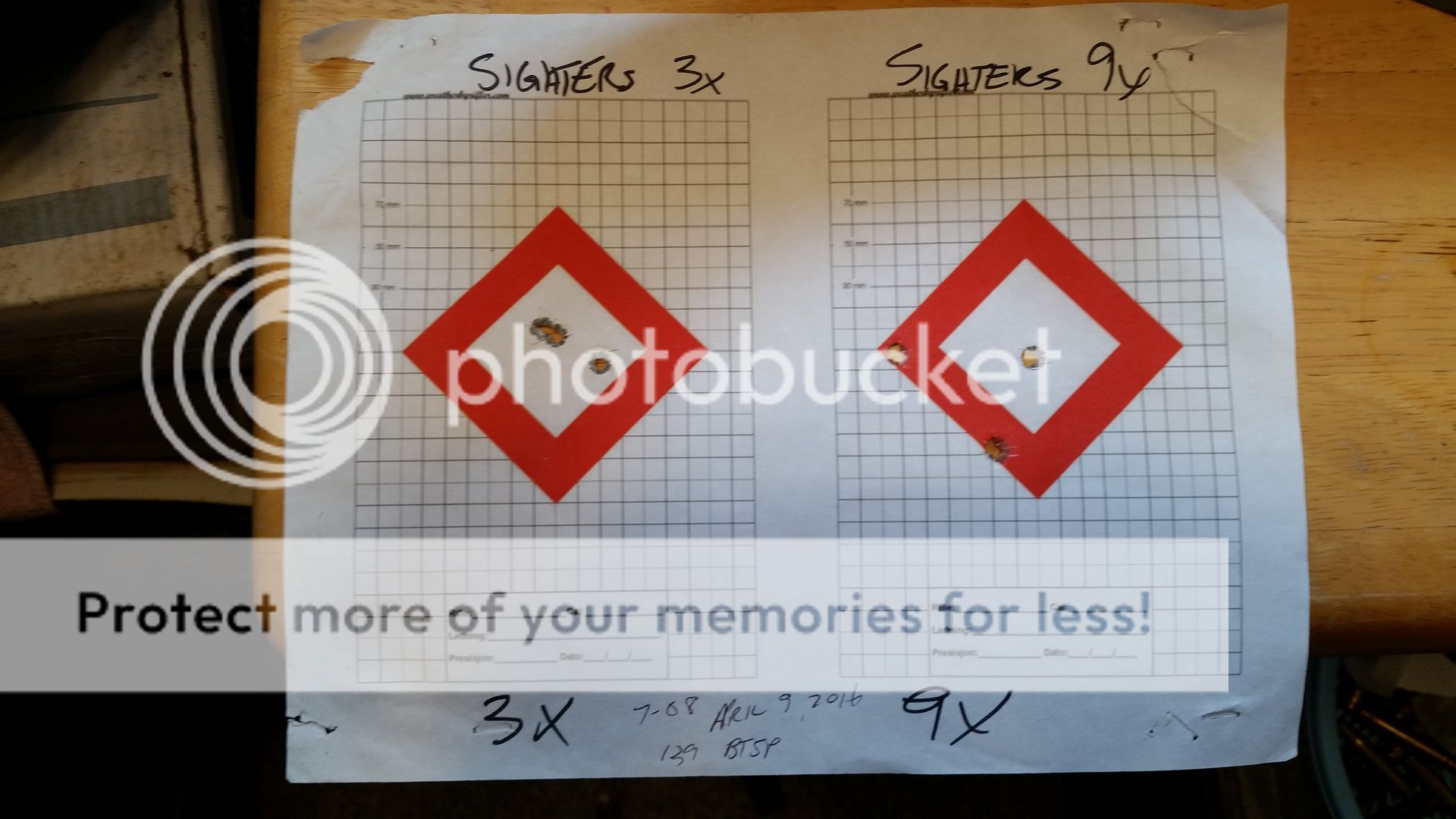
So I went to the range today and tried a few different things. I shot two groups from a "good" load I use as a standard. One at 3X and one at 9X. I shot each group by itself. This is a load that I developed from a clean barrel so it does open up after a few shots as a rule( I have other targets showing that). The 3X group was 0.75". The targets are printed on a single 8.5x11" piece of "letter" size paper. At 3X my Burris Fullfield II crosshairs completely cover the diamond but this still allows me to line them up carefully since if they're off a tiny bit I see some red poking out. These cross hairs are very thick as well, almost twice as thick as my Burris Fullfield II I purchased 2 years earlier and ridiculous compared to a VX3 and Conquest I was also shooting today. At any rate I was still surprised. Shot from a Steady Point "lead sled" style rest. 100yds at Ridgedale in Matsqui this morning.

20160409_150100_zpsljfga1yc.jpg


This sure warrants more experimentation and gives me the confidence not to crank up my scope for a 50yd shot ;-)

Willy
 
We were always told magnification only magnifies your errors. I think where magnification pays off is target identification. As far as "field" shooting goes. While you may be able to hit that 400 yd coyote on 1x you may not be able to identify and align on the kill zone.
 
Scopes are merely a device to help the shooter aim better. As long as the shooter can consistently break the shot in the same POA with proper follow through, the bullets will land within the mechanical limits of the rifle and ammo.

If the target, reticle and mag allow the shooter to have this consistent POA, any more mag is of little benefit.

In this test, the author is using a rifle that has a mechanical accuracy range of around 3/4 min. As long as the aiming error overlaps with the rifle accuracy, the groups stay consistent.

This becomes more problematic when the size of the target at distance is obscured by the reticle at low mag. how do you aim on something you can't see?

Now take a far more accurate rifle and the benefits of mag become more obvious.

If you have a SR BR rifle that could literally put them through one very small hole - say 1/8 min, aiming error of 1/8" at 100yds would be a massive percentage increase in the rifles group size.

would you even see that aiming error in a system that was SUB MOA at best?

Here increased mag pays dividends as your aiming error can be reduced to a few thousandths of an inch from shot to shot. why competition rifle scopes have BOTH magnification AND high resolution glass.

In F class, I compete out to 1000yds and the common scopes used can let you see, resolve 3/16 to 1/4" at that distance. that is the width of the scoring rings and all scopes used let you aim on or either side of the ring .... or you get another scope.

Why do you need resolution that good? Because we are trying to adjust for and hit a 5" circle at that distance and many top rifles will group inside that circle for 17 to 22rds mechanically. We have to make very small adjustments sometimes to get that group centered on that center ring.

Even with scopes going to 80X, many will "only" use 30 to 35X... up to 45x on a clear and calm day. Less on days when mirage is thick like soup.

Most of the military scopes in western forces use scopes to around 24X. From Leupold, S&B, NF, and TT, many tactical professionals want the extra mag to not just aim but also identify their target... ie separate the target from a group of non-targets. The days of the fixed 10X are very long gone.

So, the author makes some good points but he is also looking through the eyes of a hunter. Many shooting competitions encourage the use of very high mag scopes with high resolution glass.

As always, it just depends on what you trying to achieve and what tool helps to best accomplish this task.

Jerry
 
Thanks Jerry,

I thought it was interesting how he interpreted his data. His 450yd group with 10X was almost 1/2 the size of the 5X group which tells me there is a definite advantage. The difference from 10-20X was not much at all at 450yds and since the article was aimed at hunters that distance seems like a relevant distance to compare at.

My little test was with ammo that you previously pointed out I had tuned to a clean barrel and groups tend to open up quickly which could account for my results. I'll have to try again with ammo tuned according to the method I learned on your website.

Willy
 
Last edited:
For serious accuracy testing you need to use an aimpoint that works well with your reticle. For most duplex-style reticles you should use a square aimpoint and hold on the corner (any corner you like) which will give you a much finer aimpoint than trying to hold on a diamond or a circle. I have had good results with the old 2" white bullseye but the bottom line is "aim small miss small". If you're tight to the corner of an orange square on a white piece of paper with a black crosswire (ie you can see no white between the crosswire and the orange square and no orange protruding past the crosswire) you will reduce the aiming error while shooting groups. Of course, as reticles change you might have to adapt but by and large I've found a square aimpoint to be the best. And the better that you can see the aimpoint, the better you can shoot.
 
For serious accuracy testing you need to use an aimpoint that works well with your reticle. For most duplex-style reticles you should use a square aimpoint and hold on the corner (any corner you like) which will give you a much finer aimpoint than trying to hold on a diamond or a circle. I have had good results with the old 2" white bullseye but the bottom line is "aim small miss small". If you're tight to the corner of an orange square on a white piece of paper with a black crosswire (ie you can see no white between the crosswire and the orange square and no orange protruding past the crosswire) you will reduce the aiming error while shooting groups. Of course, as reticles change you might have to adapt but by and large I've found a square aimpoint to be the best. And the better that you can see the aimpoint, the better you can shoot.

BUM, great info... scale the target to suit the reticle at distance. The target has to be big enough for proper aiming.

wilbar, when you can aim better then the rifle can group, you have more then enough mag for that application.... and you might need to build a more accurate rifle :)

Jerry
 
I'll have to give the square a go. I find it easier to see if my crosshairs are cutting through the points of the diamond than if a small circle is evenly divided.

I'm working on tuning to a dirty barrel and I'm getting more consistent results. My 7-08 has turned in several groups half inch or better even a quarter inch group but not consistently. I'm in the market for a 223 for target shooting, but building a rifle will have to wait for the kids to move out ;-)
 
I like to use one of the us Palma ones. Think it's called short range sighter. It's a 2"x2" square with the four corners black. It allows you to set your cross hairs between the squares and align the reticle. There are 5 targets to an 8.5x11" piece of paper and it all marked in grids.
 
There are orange stickers that you can buy that work nicely for the task.

I like where Jerry is going...the never ending accuracy chase. it' sliek supper. Too much meat, you need more potatoes, too much potatoes, you need more meat.

Now I hope roast beef is for supper.
 
Back
Top Bottom