Maltby No4 MkI* ???

student of history

CGN Regular
Rating - 100%
76   0   0
Hi Gents,

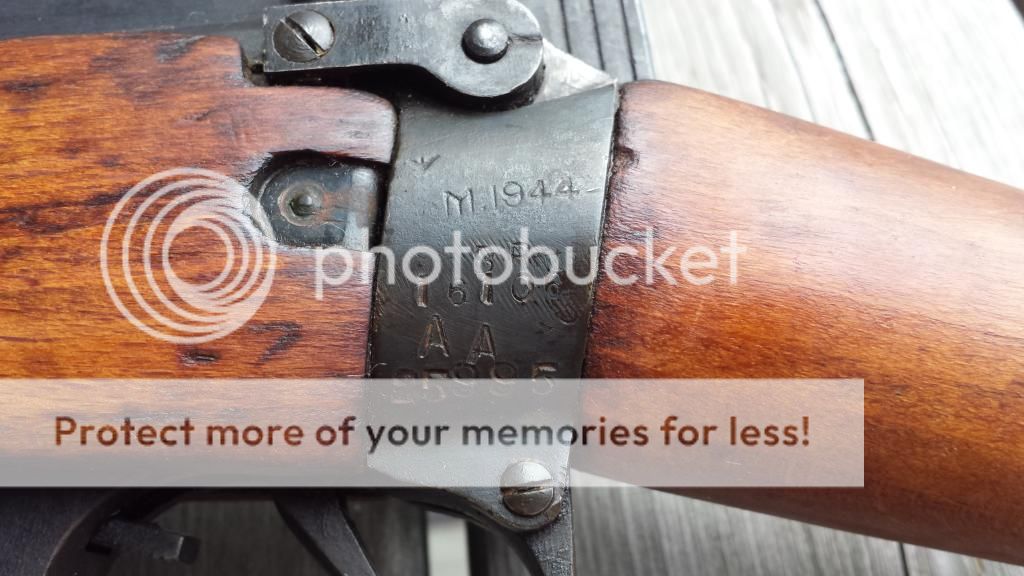
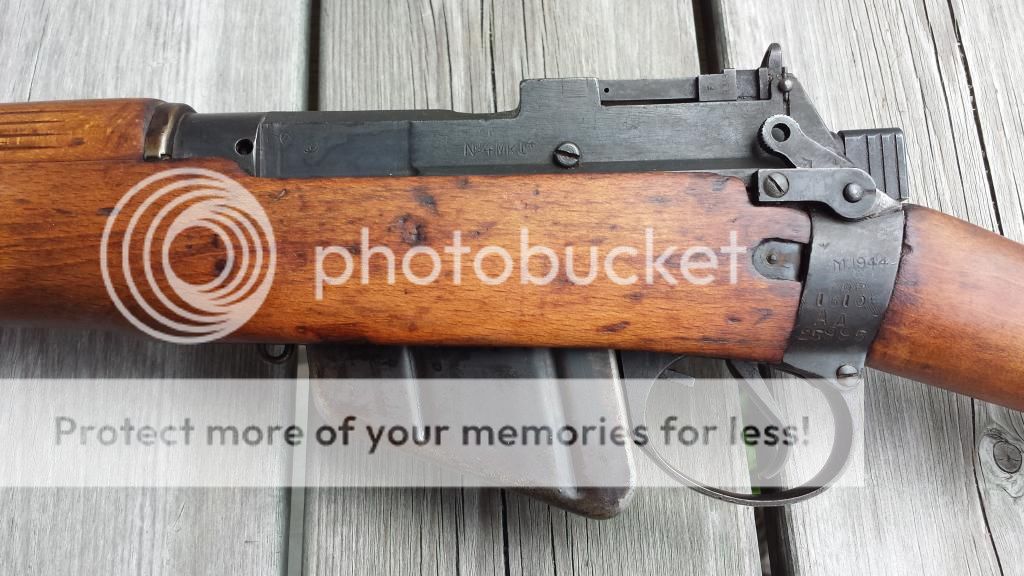
Recently I came across this interesting No4 MkI* Enfield manufactured at ROF Maltby. I don't typically collect Commonwealth firearms so a few of the markings have me a little bit puzzled. The first aspect which is confusing to me is the presence of the *. I was under the impression that the Brits only manufactured the No4 MkI? My second question has to do with the fact that the rifle seems (at least to me) to have two serial numbers? Based on the fact that the bottom number begins with 2 my feeling is that it was put on there by ROF Fazakerley but the rifle isn't marked FTR so I'm wondering what's going on there? Could it perhaps have something to do with the BLR (Beyond Local Repair) marking on the butt stock? Finally I'll note that the bolt and mag are complete un-serial numbered. Un-serial numbered mags seem pretty common to me but what about the bolt?

Any info would be greatly appreciated.

- Chris


It's definitely British and a No4 MKI. I don't know what the asterisk refers to.

It is also the AA series. There was a discussion about that series quit a while ago. I couldn't find it on the search function.


The rifle has likely been upgraded because of the rear sight and it may even have been stripped to the receiver only, rebuilt and reissued.

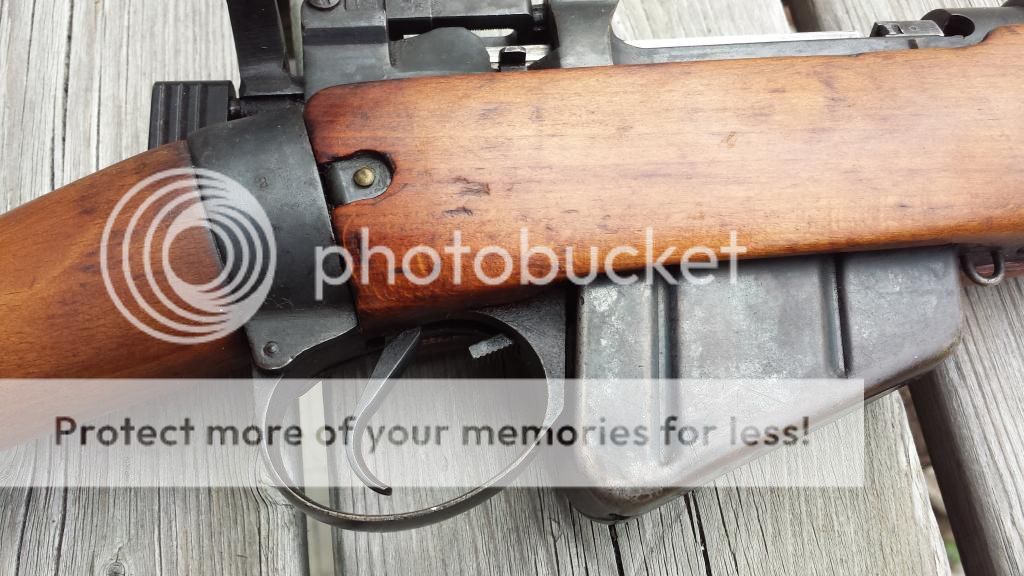
It may also have had a trigger upgrade to a hung from the receiver trigger.

I had an AA series rifle that was marked similarly. It had the hung trigger and the upgraded rear sight.

Those dual serial numbered rifles are interesting. To bad they can't talk.

From what I can find, The double A should be a prefix followed by a 5 digit serial number. This is in between the two numbers. Likely, because they seem to have used different stamps and there wasn't enough room for all in a row.

The upper number is unusual for the date of manufacture.

The double A usually indicates that is where its place is in the production lineage, after all of the other single letter prefixes had been used up.

It may have been taken off the line, repaired and reassigned a new serial number because the original number had been assigned to another receiver for ease of record keeping.

I am sure smellie will have the answer.
 
Last edited:
Not bad cosmetic condition, but there are a few head scratchers here;

1. The receiver is indeed marked No4 Mk1*, yet the bolt release is the conventional No4 Mk1. I don't see the cutaway area in the rt side receiver area to disengage the bolt head as does the No4Mk1*. The Brit factories never built the No4 Mk1*, except for prototypes. Long Branch and Savage made them all.

2. The BLR marking on the butt isn`t a good thing, if this is the original butt. BLR means beyond local repair which meant that the piece was sent to a higher maintenance echelon for inspection, repair or condemnation. One of the reasons why No4s were often marked BLR is because of worn bolt lug seats in the receiver.

3. The rifle should have a bolt that is serial numbered to the receiver.

4. Don`t know why the receiver has a dual serial number. This flies in the face of everything the military did about serial number control.

I`d want to have this one checked closely, especially the issue of bolt lug seats and bolt lug bearing in the seats before putting any money down.
 
For some unknowen reason, Maltby had put out some #4s with the mk1* stamp. It was a mistake that many feel we will never know why.
As to the double serial #, if it were issued to another countries service, they could have added their own numbers. Nt unheard of. IT looks like a rebuild. The steel butt plate was usually North American. A nice rifle non the less.
 
The " * " was Maltby jumping the gun. They considered making No.4 Mk.1* rifles in 1944 but never did. They did stamp a number of receivers Mk.1* in error though. I have one marked like that as well. The AA #### on the left wrist is not a serial. It is apparently an Indian territorial marking indicating a region or military district. I've seen it on No.4's, SMLE's and even a 1944 Long Branch I have.

My Maltby Mk.1"star" cor comparison purposes:

 
Last edited:
Thanks for the replies gentlemen. I've done some supplementary research and found that approximately 50,000 rifles were accidentally stamped with the * at Maltby in 1944 - so it appears to be a factory error.

According to Ian Skennerton the AA marking is simply a letter prefix used at Maltby, Fazakerley & BSA Shirley during the war. Like the letter blocks on German Mausers the prefixes repeated once they got through the alphabet... So once the A-Z prefixes were used, the system would repeat beginning with AA then carry on to AB, AC and so on. For that reason, I don't think the the AA marking mean it was used by the Indians. If that were the case would it not have the "Ishapore screw" installed?

To me it looks like a second serial number that was applied by Fazakerley after the fact (which would make sense because AA seems to be later in the production process). Is it not possible that the rifle was sent to Fazakerley for repair (hence the BLR marking) where it was potentially re-numbered? The type I sight also has a Fazakerley marking on it which leads me to believe this may be the case but again, Commonwealth firearms aren't my main area of interest so these are simply my thoughts.

EDIT: I also noticed what appears to be a Canadian Broad Arrow on the butt plate.

I'd really appreciate it if the big hitting Enfield collectors could take a minute to weigh in.
 
Last edited:
The butt plate is very likely Cdn. As for the BLR mark on the butt, that may have been changed out at some point. If the rifle is a rebuild, then the mark will not apply. Faz would not have re-serialed the rifle. That was done somewhere else.
 
I've got a 1943 Maltby here No BB12--- that is NOT asterisk marked.

With regard to the BLR marking, if the rifle would not headspace with a gauge bolt it was ZF, not BLR, I believe.

Peter Laidler's comments:

The short answer to this is that the ZF marking to an Armourer means that this is the end of the line.

The Z means that it has been condemned at a Base workshop (that's the Z bit) as suitable only for a Factory Repair (that's the F part). This will indicate something to do with a part that cannot be rectified at Base Workshop and that is inevitably a damaged body. On a No4 rifle, this is what we call 'the master component', a part that is NEVER supplied as a spare part through the Ordnance channels.

There was only one other mark that was more extreme than ZF and that was ZF-BER. Which meant that in addition to the ZF, one of the examiners had decreed it to be beyond economic repair in any case. But effectively, both were the same......................

There was a milder Z-BER which indicated that it wasn't even worth sending to the factory and at workshops, these were torched!

So, the rifle your correspondent is referring to falls into one of three categories
1) scrap
2) very scrap
3) Extremely scrap
 
The AA number is some kind of rack number, the rifles serial number is above it, if was a new number the other number would be struck though.
Here is the AA number on my P14, as you can see the original Remington serial number is above & intact, there is no indication of Indian service on my P14.
 
If the BLR marking were recently stamped, as in a rifle recently so classified, one would expect the marking to be quite clean. THIS marking has been sanded nearly out.

I would expect the butt to have been sanded to mostly obliterate the offending marking, and then re-used.

Just my 2 cents (which cost 7 cents to make and are no longer legal to use).
 
I also have a '44 Maltby, asterisk stamped and AA second numbered. It was done up by Parker-Hale as a Standard No4 sporter and sold here to my Dad in 1974. I've also seen a second 1944 Maltby at the Dawson Creek gun show two years ago that was asterisk marked. That one had seen HARD service and had not seen a screwdriver or cleaning solvent since. It was a gorgeous rifle that I am still kicking myself for not picking up.

Lee-Enfields are very interesting!
 
According to Ian Skennerton the AA marking is simply a letter prefix used at Maltby, Fazakerley & BSA Shirley during the war. Like the letter blocks on German Mausers the prefixes repeated once they got through the alphabet... So once the A-Z prefixes were used, the system would repeat beginning with AA then carry on to AB, AC and so on. For that reason, I don't think the the AA marking mean it was used by the Indians. If that were the case would it not have the "Ishapore screw" installed?

Don't confuse the original makers two letter prefix with the AA #### lower down. Agreed, the first two letters are the maker's serial prefix, on yours it appears to be BR and mine is BS. The next digit is a "1" that indicates a Maltby No.4. Fazackerly used a 2 and Shirley used a 3 as the first digit. The lower, second number is the 'Indian' one. I get this information from another thread here and that seemed to be the consensus. The lack of Indian features (ishy screw, cartouche on the right side of the butt, replaced bit of wood on the top of the butt with wood dowels) could be the difference between military, arsenal refinished rifles and those acquired and used from different sources. The answer wasn't 100% as I recall and would love to hear more as at least three of my Enfields have it, and none have the other typical Indian features either.

Here's the "AA####" on my 1944 Long Branch:

 
Last edited:
I had a pair of Long Brand No 4 Mk I* rifles with the extra "AA" serial number. No signs of the Ishapore screw. The rifles had been used hard and put away wet. One of them had the back end of the firing pin bent, where the cocking piece screwed on. The other had part of the guide rail that held the bolt head in place broken and welded back in. The really interesting part was that both rifles had brand new barrels (either 5 or 6 groove, but I can't remember which).

I thought I had read something about the AA serial numbers coming from the middle east, but I don't know where I read that now or the specific details.
 
Back
Top Bottom