The de Haas book recommends chambering new barrel to a calibre of no greater pressure than Brit.303 (45,000). Anybody have any experience with going higher than this? Also, he recommends staying with a rimmed cartridge as extractor mod.'s are very difficult, again, any experience to the contrary?















































You are using an out of date browser. It may not display this or other websites correctly.
You should upgrade or use an alternative browser.
You should upgrade or use an alternative browser.
Martini action strength for rebarreling /chamber choices
- Thread starter koob
- Start date
The de Haas book recommends chambering new barrel to a calibre of no greater pressure than Brit.303 (45,000). Anybody have any experience with going higher than this? Also, he recommends staying with a rimmed cartridge as extractor mod.'s are very difficult, again, any experience to the contrary?
Martini Actions, are very tough.
I had one that someone had built a sliding extractor for in 257 Roberts. The ammo I was given with the rifle was hot as hell.
I also have one in 30-40 Krag that will handle loads much higher than the manuals reccommend.
Recently, I witnessed one in a wildcat 223/357Maxi. It was pushing out 60 grain projectiles around 3000 fps.
I have a small action made up in a wildcat, 257 Maxi, on the 357 Maxi case. Again, it is loaded hot and is very accurate.
antiqueguy
CGN Ultra frequent flyer
- Location
- windsor ontario
id stay lower then .303 brit pressure remeber these actions have seen plenty of service the mk2 actions(alot of these where already converted form mk1 actions) where converted to martini metfords and martini enfields and yes rimmed rounds are your best bet as a rimless extractor is not a easy one to make
i almost got one not long ago with the intention of building a .577 2 3/4 black powder express out of it down the road
id also stick with a BP round .50-90 sharps,.45-90,.45-70,.577 snider, any of the black powder express cartridges that will make the turn thses old girls have been beat enough already no need to push it
also dont bubba a unbubbaed rifle here if its a action already then go for it
i almost got one not long ago with the intention of building a .577 2 3/4 black powder express out of it down the road
id also stick with a BP round .50-90 sharps,.45-90,.45-70,.577 snider, any of the black powder express cartridges that will make the turn thses old girls have been beat enough already no need to push it
also dont bubba a unbubbaed rifle here if its a action already then go for it
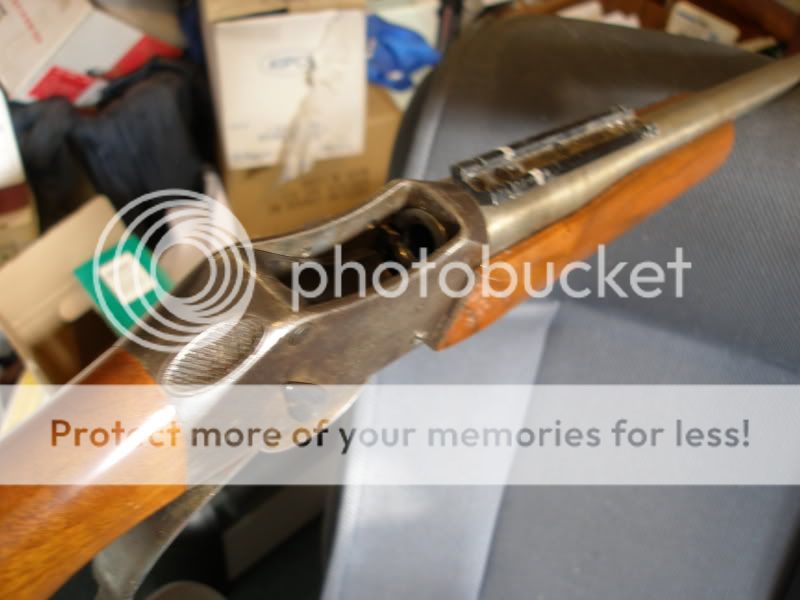
Thanks for the feedback guys. Since I posted I've been reading up on .357max. and it's attractive; fits the criteria for safety and reportedly an excellent performer out of a rifle barrel. My next question: I'm missing the tumbler(firing pin striker); would anybody be willing to trace theirs onto cardboard or paper for a pattern for me to make one? I'm also missing the "lever/tumbler axis pin keeper screw", this is the little screw w/a crescent-shaped cut-out in the head that rides in the groove on the left side of the cocked -indicator pin to hold it in the rec. I talked to WGP but no joy; anyone got an extra for sale? TIA for any help, I'll let you know how it goes...

antiqueguy
CGN Ultra frequent flyer
- Location
- windsor ontario
Thanks for the feedback guys. Since I posted I've been reading up on .357max. and it's attractive; fits the criteria for safety and reportedly an excellent performer out of a rifle barrel. My next question: I'm missing the tumbler(firing pin striker); would anybody be willing to trace theirs onto cardboard or paper for a pattern for me to make one? I'm also missing the "lever/tumbler axis pin keeper screw", this is the little screw w/a crescent-shaped cut-out in the head that rides in the groove on the left side of the cocked -indicator pin to hold it in the rec. I talked to WGP but no joy; anyone got an extra for sale? TIA for any help, I'll let you know how it goes...
id stick with a older BP round and load nitro for black with the 40% rule .357 max has a max pressure of 48,000 id stay away from it also pistol rounds are a normal thing in cadet actions why not use a rifle round your paying for a barrel anyway mit as well get something worth it
also you have to remember these rifles where in service for quite a while and even used with air crews in ww1 if your gun was .303 it was converted from the mk2 .577-450 the guns used in south africa in the zulu wars these guns had hard lifes id not stress them any more then needed
take a look at the rounds i noted in my last post above
With the small Martinis, the issue is size of the cartridge, what can be shoehorned into the breech. In Australia a rimmed .222 was a popular conversion for the .310 Cadet rifles.
There is something else to consider when selecting a cartridge for conversion - the back thrust against the breech. There are a couple of factors here; pressure is one, the area of pressure application is another. This is why the original Thompson Center single shots used high intensity small rounds, but more moderate larger ones.
A .357 Maximum is a relatively high pressure round, but it is rather small in diameter, so the actual backthrust may be less than a larger, more moderate round.
Get out your calculator, look up the pressure of your chosen cartridge, calculate the area of the inside of the base of the cartridge case (which is where the back pressure is applied), and determine how many pounds of backthrust there will be.
Another issue is the firing pin. For a higher pressure round, a small diameter firing pin is necessary. The Brits used a bar dovetailed across the face of the breechblock when they converted the .450s. Nowadays, a bushing threaded into the breechface would be more likely.
Trick is to find a rifle with a crisp action that has already been bubba'd beyond restoration. Come to think of it, I recently saw a sported .303. I might go have a look at it.
There is something else to consider when selecting a cartridge for conversion - the back thrust against the breech. There are a couple of factors here; pressure is one, the area of pressure application is another. This is why the original Thompson Center single shots used high intensity small rounds, but more moderate larger ones.
A .357 Maximum is a relatively high pressure round, but it is rather small in diameter, so the actual backthrust may be less than a larger, more moderate round.
Get out your calculator, look up the pressure of your chosen cartridge, calculate the area of the inside of the base of the cartridge case (which is where the back pressure is applied), and determine how many pounds of backthrust there will be.
Another issue is the firing pin. For a higher pressure round, a small diameter firing pin is necessary. The Brits used a bar dovetailed across the face of the breechblock when they converted the .450s. Nowadays, a bushing threaded into the breechface would be more likely.
Trick is to find a rifle with a crisp action that has already been bubba'd beyond restoration. Come to think of it, I recently saw a sported .303. I might go have a look at it.
antiqueguy
CGN Ultra frequent flyer
- Location
- windsor ontario
With the small Martinis, the issue is size of the cartridge, what can be shoehorned into the breech. In Australia a rimmed .222 was a popular conversion for the .310 Cadet rifles.
There is something else to consider when selecting a cartridge for conversion - the back thrust against the breech. There are a couple of factors here; pressure is one, the area of pressure application is another. This is why the original Thompson Center single shots used high intensity small rounds, but more moderate larger ones.
A .357 Maximum is a relatively high pressure round, but it is rather small in diameter, so the actual backthrust may be less than a larger, more moderate round.
Get out your calculator, look up the pressure of your chosen cartridge, calculate the area of the inside of the base of the cartridge case (which is where the back pressure is applied), and determine how many pounds of backthrust there will be.
Another issue is the firing pin. For a higher pressure round, a small diameter firing pin is necessary. The Brits used a bar dovetailed across the face of the breechblock when they converted the .450s. Nowadays, a bushing threaded into the breechface would be more likely.
Trick is to find a rifle with a crisp action that has already been bubba'd beyond restoration. Come to think of it, I recently saw a sported .303. I might go have a look at it.
i forgot about the breech face yes it would need bushing only time ive ever seen this done is with the bar even now although a threaded plug smaller then the casing head would be a good idea(this way all the force is not on the plug and in turn not trying to push it into the breech block)
also your going to have to fit parts to your gun if i where you id go over to the british militaria fourms best place to ask about martinis