mounting location for optics?

Maybe is a "dance" that you have got into? That base rail appears to have recoil slots - and they are not the same spacing so not a "pic" rail - so either end could go towards the front of the rifle - so I presume that the scope mount that you have chosen has at least one recoil lug to match into it? Whatever scope that you chose will have adjusting turrets - appears that the scope mount anticipates that the turrets will be between the rings? What ever scope that you chose will have an eye relief - a distance that your eye must be from the eye piece lens to get full view through the scope - at extremes that could vary from 2" to 6" with "normal" scopes. The comb on that rifle may or may not be high enough to allow you to rest your check on it while lining up that scope in that mount on that rail. So, by having already selected the components that you are going to use, - I think you sort of need to have decided all that already, certainly before the first hole gets drilled?? Can do "mock ups" with electrical tape, heavy rubber bands, etc. to find an arrangement that will work out?
 
Last edited:
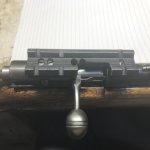
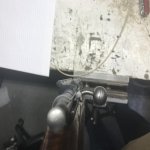
Pictures below might help? This is on a Cooey 39 - second picture shows I was looking for a Weaver long rail that would closely match to the radius of the receiver. Then, once attached to rifle, I scribed and cut out a section for the fired cartridge to eject. So, typical on a bolt action rifle is to have one ring above the front receiver ring - above the breech / rear of chamber area - and then typically the second ring is somewhere behind the magazine area. I doubt a big deal on a .22, but I am quite convinced on heavier recoiling rifles that want the front ring and base to be like a pillar - any offset mounts would be at the rear - slo-mo video that I have seen on internet shows that the front of scope wants to "dive" (actually the rifle muzzle is rising), so want something straight, up front to resist that - usually. I know all kinds of cantilever mounts and "see through" mounts have been installed on multiple rifles - just never did that on any of mine.

A note of caution - that front screw hole was NOT drilled into the barrel - it is a blind hole within the receiver ring only - pointy tip of the drill bit just barely broke through the inside of receiver ring to the barrel - and then that hole was threaded to its bottom, then the screw was ground so that it did not bottom out. The bolt was removed from the rifle and the two screw holes on the rear receiver bridge were drilled as through holes and tapped completely through - then cleaned up on the inside for the bolt to go back in there.

I am pretty certain that front hole was not included on that Weaver 92 base - I drilled a through hole and then I am quite sure that taper hole was done with a normal 135 degree twist drill - in a drill press - seems to hold "good enough"... I might have done the sequence the other way around - 135 degree taper first, then the smaller through hole - clearance size for #6-48 screw - do not remember - getting old sucks that way !!!!

3327AFC9-A818-4005-8001-1968631409FF_1_201_a.jpg


80D5AF93-04E4-4961-A10D-B29613B3161F_1_201_a.jpg
 

Attachments

  • 3327AFC9-A818-4005-8001-1968631409FF_1_201_a.jpg
    3327AFC9-A818-4005-8001-1968631409FF_1_201_a.jpg
    37.7 KB · Views: 140
  • 80D5AF93-04E4-4961-A10D-B29613B3161F_1_201_a.jpg
    80D5AF93-04E4-4961-A10D-B29613B3161F_1_201_a.jpg
    42.2 KB · Views: 139
Last edited:
Clever idea. Never considered just making clearence over the chamber.

Scope arrives tomorrow after 12 days of Canada post nonsense, will just play around with how the eye relief is for my natural head position.
 
If you can or want to do machining, I think "bulk" lengths of true picatinny rail are available - you will be able to mill the concave on the bottom to fit your receiver - drill and taper holes where-ever you see fit for the mounting screws. For bottom fit - seems some by Weaver bases might have tighter radius than the receiver they are made for - so end up with slight "air gap" at very top - bottom edges fit tight - might deform a smidgeon as the base screws get tightened down. Seems to be better to fit that way than to have the radius too big and get gaps along the bottom edges. Pretty common to use 6-48 screws to attach bases to receiver - although some Remingtons and maybe others use the slightly larger 8-40 size. You should be able to get quality screws suitable to attach scope bases in those two sizes. Always a bit PITA to get a scope base dead horizontal on a receiver, and then to get all the drilled and tapped holes perfectly straight, in line, at Top Dead Center on the receiver. As mentioned, do not really want to drill or tap into the barrel - the receiver only!!! Everyone who has done this had to have started their first one at some time!! Good luck!
 
So, once I got the scope in my hands and with its shorter eye relief, the base is best reversed from how I imagined, and is going to need about 1.5" of extra stock height for it to be comfortable (so it clears the rear sight).

I think for this gun, It'll be best to rather put a 11mm dovetail in it, use low rings and a lower power scope that doesn't have a 45mm end tube. I'll keep this 4-12x for my upcoming 308 that ideally has some sort of adjustable cheek stock/leather pad
 
A couple things - an 11mm dovetail is /was typically a European standard size - can look up on inter web - measures 11 mm wide at widest across the top - was cut with 60 degree slope dovetail cutters. North American standard usually called a 3/8" dovetail - but that is measured at extreme bottom - tips of cutter are .375" apart, and cut with 45 degree cutter, so top width a bit over 1/2". Some rifles, like CZ 452, came with either an 11 mm or a 3/8" dovetail - almost like depended on year or month or destination - most definitely are both sizes used on CZ 452 rimfire rifles. Rings are available for both 11 mm and for 3/8" dovetails - some, like Warne, can be used on either width by reversing the clamp. Some rings need / want a "flat topped" dovetail - others can tolerate a "curved" or "humped" top.

If you want to get really funky, some receivers, like the Cooey 600, have dovetails cut directly into the receiver itself - so the ring mounts attach directly to the receiver - no base in between. Ring mounts are available in various heights.

If you start to play with adding height to the comb, do not overlook that the bolt needs to open and come back - often want to actually be able to remove the bolt from rifle without removing action from stock, so, in some cases, that adds a parameter to what height that you can or want to add to the comb.

 
Last edited:
My perspective might be vastly different than yours, so take my comments with that bit of "salt" added. I have a couple 22 rimfire Magnums - the Ruger 77-22M has a Leupold 3-9 rimfire scope. The Ruger 96-22M has the Leupold 2-7 rimfire scope. A CZ-Scout is currently set up with a Leupold FX-II 4x28 rimfire scope. My Ruger 10-22 has aperture rear sight. My CZ-452 Silhouette has a 4.5-14 x 40 Meuller APV - but my Grandson has it now. My most recent is a BRNO No. 1 made in 1955 - in .22 Long Rifle - finally found Low and Medium height Warne Detachable rings for the 16 mm dovetail - have not settled on a scope for that old one, yet. There are a couple old school Cooey .22's here, and a couple Schultz and Larsen target .22 rifles that would have been pretty "schnazzy" in their day - either one is still, by far, more accurate than any others that I own, except not terribly "useful" with their double aperture sights and 1" diameter barrels.

"Not terribly useful", unless the task is to put 10 rounds into smallest possible group at precisely 50 meters - from a shooting table with sandbags I can almost score as well as the Olympic and World's shooter's were doing with these rifles - in the 1970's - but, they were running strings of 40 rounds laying on belly, sitting, kneeling and standing off-hand....
 
Last edited:
For most 22's I have always preferred the 3/8's dovetail blank stock Brownells provides. It comes in two contours with no holes... you make the holes where they need to be... and you only need two on a .22 rim fire.
 
Last edited:
Back
Top Bottom