Muzzle breaks, compensators, I need education

mikethebike

BANNED
BANNED
BANNED
EE Expired
Rating - 100%
38   0   0
Location
vancouver
Please, I need some education on muzzle brakes and compensators, could someone explain what they are used for, how they work, and the physics on how they function, the differences with all the crazy amount of different muzzle brakes out there, and graphics and pictures would help *I'm slow*


This is an honest request for information to educate myself, please no silly remarks on how stupid I am.

(yes I've read wikipedia, I didn't understand it, I'm stupid, yes I know..)
 
Muzzle Brakes - used to reduced the recoil of the rifle through the use of muzzle gases. In short, gases expelled from the muzzle push forward on the internal baffles of the muzzle brake (usually vented to the sides of the brake), pushing the rifle forward as it is under recoil, reducing the felt recoil of the rifle.

Compensators - used to reduce the muzzle rise of a rifle through the use of muzzle gasses. These gasses are usually vented upwards to help "push" the muzzle down, while the rifle is moving upwards.


There is a LOT more to it than that, but that's about as simple as I can make it.

Most devices you see out there now are hybrids that offer some recoil reduction and some level of compensation for muzzle rise. EVERY manufacturer will tell you their device is the best. The good manufacturers (the ones that actually know what they are doing) should be able to tell you which barrel length their device was optimized for. If they don't know that (and say they are good on all barrel lengths) then they usually don't know much about the science behind what they built.
 
Last edited:
^^^ thanks great answer,
Now another question, why would someone create one that moves the barrel to the right or to the left?
 
^^^ thanks great answer,
Now another question, why would someone create one that moves the barrel to the right or to the left?

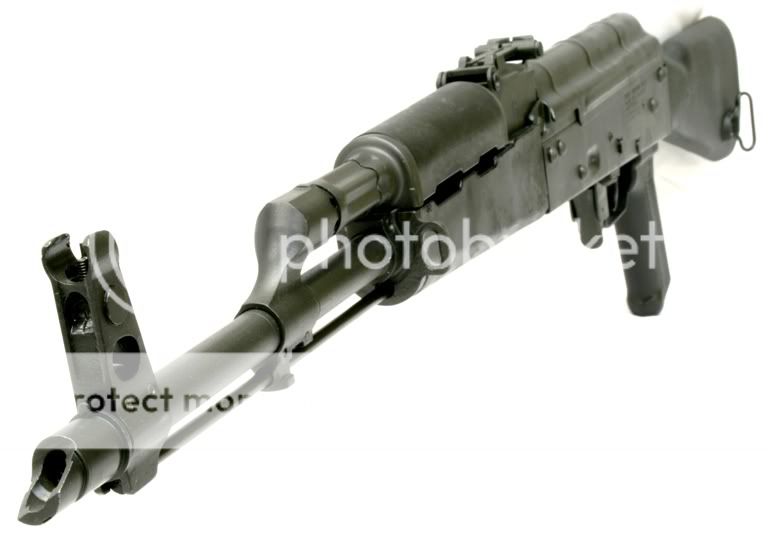
Well, if I understand you correctly, "move the barrel right or left" could be to help reduce the muzzle climb characteristics of certain rifles. The AK 47 for example, sometimes wears a "timed" slant brake compensator. The AK will ride high-right under FA recoil (if you are right handed), "timing" the compensator helps to push the muzzle low left, which helps to keep the rifle on target.

RomanianGP-1975AK-47.jpg
 
I see from that picture that its slanted to allow gases to expand high right, therefore pushing it low left, right?

Will the barrel under recoil generally move to the direction of the shooting arm?
example: I shoot right handed, barrel under recoil will move right?

Therefore to reduce my target re-acquisition time I would need a compensator that moves the barrel to the left to compensate?
 
Last edited:
Will the barrel under recoil generally move to the direction of the shooting arm?
example: I shoot right handed, barrel under recoil will move right?

Therefore to reduce my target re-acquisition time I would need a compensator that moves the barrel to the left to compensate?

Generally, you rifle will recoil up and towards your strong side, just based on body mechanics.

But it's not that simple, you can control a lot of muzzle movement just by changing your stance and grip. I never timed any of the brakes/comps on my AR and got very very good results from most of them. I don't time the A2 I have on 10.5" right now and I have no trouble controlling muzzle rise, but I do use a very aggressive stance/grip on the gun.

IMO, the juice is not worth the squeeze when it comes to brakes on shorter barrels. YMMV.
 
Generally, you rifle will recoil up and towards your strong side, just based on body mechanics.

But it's not that simple, you can control a lot of muzzle movement just by changing your stance and grip. I never timed any of the brakes/comps on my AR and got very very good results from most of them. I don't time the A2 I have on 10.5" right now and I have no trouble controlling muzzle rise, but I do use a very aggressive stance/grip on the gun.

IMO, the juice is not worth the squeeze when it comes to brakes on shorter barrels. YMMV.

Thanks for all the info.
 
Back
Top Bottom