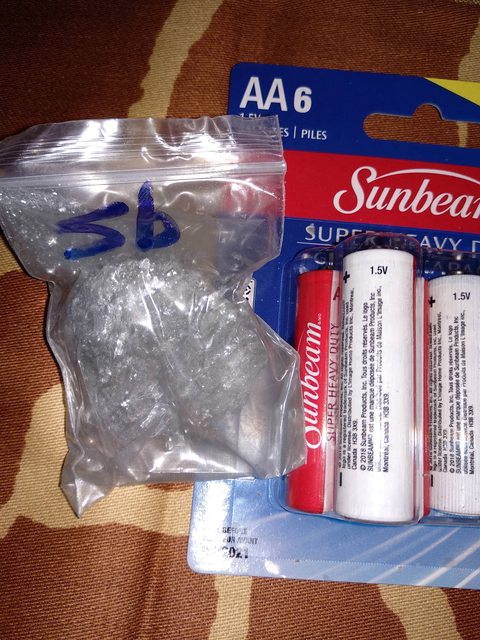
My antimony finally arrived

handofzeus

CGN Ultra frequent flyer
Rating - 100%
61   0   0
Well, as somebody who dislikes middlemen and trading this for that to get the other, I got tired of reading about alloys that contained antimony and went for the real thing. I bought $30 worth of 99.8% pure antimony to experiment with hardening my pure lead. Still waiting on the 2 lbs of pure tin from my buddy's scrapyard though. So for those interested in pure antimony here it is with some AA batteries for scale. Wanna know the super secret source of this elusive little bugger?.........wait for it!.......
qGfOybul.jpg

.....AMAZON.CA!
 
How much (grams/lb)do you get for $30 and how much lead does it harden to WW hardness?
Looks like its a lot more expensive than buying a few pounds of linotypo/monotype.
 
It's good stuff. I add it to my alloys. Only two places in the world where it is mined here in Nova Scotia and Australia. I picked mine up local not far from the mine. Some impurities in mine but considering how well it works I can live with skimming the impurities off. Linotype in another good source of hardening agent. Wish I had more of it.
 
How much (grams/lb)do you get for $30 and how much lead does it harden to WW hardness?
Looks like its a lot more expensive than buying a few pounds of linotypo/monotype.
100gr/3.52oz, no idea what the final yield of hard lead will be until I crunch some numbers (more likely that I will guesstimate though!)
 
It's good stuff. I add it to my alloys. Only two places in the world where it is mined here in Nova Scotia and Australia. I picked mine up local not far from the mine. Some impurities in mine but considering how well it works I can live with skimming the impurities off. Linotype in another good source of hardening agent. Wish I had more of it.

I have a buddy who works the presses at the Hamilton Spec and I ask him about Linotype every few months....his reply is the same after 8 years of asking. He tells me to check the museums and then he chuckles and demands that I quit bugging him about it.
 
I hear it can be very difficult to get it to properly blend into an alloy unless you have special fluxes. I've never tried it myself.

Auggie D.
 
Lyman No. 2 is 5% tin 5% antimony 90 % pure lead. At 1% mix 100 gr. will alloy 9.9 kg of pure lead, about 22 lb. You got to find a cheaper source for antimony!!
Antimony is important though if you heat treat and quench or water-drop your cast. Lead-tin alloy with a small amount of antimony will surface harden and give you bullet hardness above your apparent alloy.
I usually use wheel weights and add tin until I get the hardness I need. Wheel weight alloy already has a small percentage of antimony. For tin I am now trying some pewter as I got about 100 lb at an auction for $40, pewter is anywhere from 85 - 99 % tin and available in the form of mugs/plates/cups at thrift and junk stores.
Maybe I should try some pure pewter bullets but they would be about 60% of usual weight. My 311041 170gr would weigh roughly 100 gr but be hard enough there should be no leading. If I wasn’t afraid of soldering metal to my mould I just might.
 
Lyman No. 2 is 5% tin 5% antimony 90 % pure lead. At 1% mix 100 gr. will alloy 9.9 kg of pure lead, about 22 lb. You got to find a cheaper source for antimony!!
Antimony is important though if you heat treat and quench or water-drop your cast. Lead-tin alloy with a small amount of antimony will surface harden and give you bullet hardness above your apparent alloy.
I usually use wheel weights and add tin until I get the hardness I need. Wheel weight alloy already has a small percentage of antimony. For tin I am now trying some pewter as I got about 100 lb at an auction for $40, pewter is anywhere from 85 - 99 % tin and available in the form of mugs/plates/cups at thrift and junk stores.
Maybe I should try some pure pewter bullets but they would be about 60% of usual weight. My 311041 170gr would weigh roughly 100 gr but be hard enough there should be no leading. If I wasn’t afraid of soldering metal to my mould I just might.

Thanks for the ratios, very helpful.
 
OP, you'll find that bit you purchased will work but as mentioned it's expensive.

I used to be to anal about mixtures, especially with pure lead. The mix mentioned is fine for most purposes IMHO.

When I started casting and shooting more firearms with those bullets it soon became apparent the effort IMHO was being wasted.

As you say, you've tried several alloys but want to make the bullets with pure lead under controlled conditions. Commendable.

I finally settled on wheel weights, which are getting harder to come by, mixed with 10% PEWTER which does vary from source to source in the amount of lead it contains. I usually pick up my Pewter at places like the Salvation Army Thrift Shop and Value Village. The cost is averaging around $2 per pound. The quality of the Pewter will be easily evident by the quality of the article made from it and there will be a neat little triangle on the bottom of it declaring it's Pewter.

The items I find it in are candle sticks, picture frames, plates, commemorative beer mugs from Europe, flower vases etc.

My wife is married to a cheap basterd and this is about as cheap as it comes unless it comes free.

In early September I melted down close to `100 pounds of trinkets into 5 and 10 pound ingots. An Aluminum pot makes a great mold and the Pewter doesn't stick to it. I also have a couple of those trays that cast small one pound ingots.

I do cast harder for my 74 sharps. I use as much as 20% Pewter in that rifle because that's what it likes. I'm going to powder coat a bunch and see if I can't get away with less Pewter.

I recently picked up one of my holy grail rifles in VG condition in Victoria. It's and 1883 Hotchkiss Mod 3 repeating rifle, made by Winchester. This one has US Martial stamps. Supposedly it was built with using the 500 grain US military load as standard fodder.

I've checked several US military issue lead 45-70 bullets from around that time period and they seem to have a fairly standard hardness of 15 on the Brinnell Hardness scale, according to my gauge. That's supposedly the ideal hardness for proper obduration at the pressures being generated with black powder.

Sorry, didn't mean to hijack, hopefully I haven't. Your post got me thinking back to a time at least 4 decades back.

Powder coating is one of the best things to happen to cast lead in a long time. I tried Moly coat with ho hum results.


TURF THE LIBERALS IN 2019

Liberals really like POOR people, they're making more of them every day

If you can't vote CPC, stay at home in protest

 
It's good stuff. I add it to my alloys. Only two places in the world where it is mined here in Nova Scotia and Australia. I picked mine up local not far from the mine. Some impurities in mine but considering how well it works I can live with skimming the impurities off. Linotype in another good source of hardening agent. Wish I had more of it.

China is the worlds largest producer, as an fyi.
 
OP, you'll find that bit you purchased will work but as mentioned it's expensive.

I used to be to anal about mixtures, especially with pure lead. The mix mentioned is fine for most purposes IMHO.

When I started casting and shooting more firearms with those bullets it soon became apparent the effort IMHO was being wasted.

As you say, you've tried several alloys but want to make the bullets with pure lead under controlled conditions. Commendable.

I finally settled on wheel weights, which are getting harder to come by, mixed with 10% PEWTER which does vary from source to source in the amount of lead it contains. I usually pick up my Pewter at places like the Salvation Army Thrift Shop and Value Village. The cost is averaging around $2 per pound. The quality of the Pewter will be easily evident by the quality of the article made from it and there will be a neat little triangle on the bottom of it declaring it's Pewter.

The items I find it in are candle sticks, picture frames, plates, commemorative beer mugs from Europe, flower vases etc.

My wife is married to a cheap basterd and this is about as cheap as it comes unless it comes free.

In early September I melted down close to `100 pounds of trinkets into 5 and 10 pound ingots. An Aluminum pot makes a great mold and the Pewter doesn't stick to it. I also have a couple of those trays that cast small one pound ingots.

I do cast harder for my 74 sharps. I use as much as 20% Pewter in that rifle because that's what it likes. I'm going to powder coat a bunch and see if I can't get away with less Pewter.

I recently picked up one of my holy grail rifles in VG condition in Victoria. It's and 1883 Hotchkiss Mod 3 repeating rifle, made by Winchester. This one has US Martial stamps. Supposedly it was built with using the 500 grain US military load as standard fodder.

I've checked several US military issue lead 45-70 bullets from around that time period and they seem to have a fairly standard hardness of 15 on the Brinnell Hardness scale, according to my gauge. That's supposedly the ideal hardness for proper obduration at the pressures being generated with black powder.

Sorry, didn't mean to hijack, hopefully I haven't. Your post got me thinking back to a time at least 4 decades back.

Powder coating is one of the best things to happen to cast lead in a long time. I tried Moly coat with ho hum results.


TURF THE LIBERALS IN 2019

Liberals really like POOR people, they're making more of them every day

If you can't vote CPC, stay at home in protest

No worries about hijacking, Bearhunter. Happy to hear any feedback on the subject. All information is good. Now I have to go look at Hotchkiss photos! Cheers.
 
Adding Tin to Wheelweight does very little to harden it - it's real benefit is that it improves the flow quality of the alloy. Hardness is increased greatly by Antimony, but I've heard reports of difficulties in getting pure Antimony integrated into an alloy, so I look forward to your report.

I am mostly satisfied with the hardness of my Wheelweight Alloy, but when I want it harder, I have Linotype that's 12% Antimony that I add. Six (6) parts Wheelweight to one (1) part Linotype hardens it significantly. Quenching "pure" Wheelweight (an oxymoron) has similar results, but the increase in hardness is reported to be temporary.
 
I seem to remember being told or I read it somewhere that pure Antimony takes a lot more heat to melt then lead or ww. So I am wondering how you are melting it and adding to the lead? When I was casting for pistols we used Babbitt for the Antimony The hard part was getting the proper spec for the ratios in the Babbitt. Plus it had tin and lead in it as well. lot of math involved. Plus the Babbitt was easy to come by where we were.
 
Only two places in the world where it is mined here in Nova Scotia and Australia. I picked mine up local not far from the mine.

Not true, neither Canada nor Australia is a significant contributor to world supply. From the US Geological Society mineral profile:
Antimony is mined in 15 countries, but mine production is concentrated very heavily in China (85 percent of the world total in 2000); most of the remainder is accounted for by South Africa (4 percent), Russia (4 percent), and Bolivia (2 percent). With the closing in 2001 of the sole domestic mine, in which it was produced as a byproduct of silver, antimony is no longer mined in the United States.


I seem to remember being told or I read it somewhere that pure Antimony takes a lot more heat to melt then lead or ww.

Melting point of pure Sb is 630°C, which is in the range of barely achieveable, maybe, for the Lee pots I have worked with. Not sure how other brands will manage. You may need a contraption of your own building.
 
Last edited:
I use a Coleman naptha stove which gives me over 550 deg easily so if I need to hike it a bit I can fire up the oxy-mapp torch for awhile until she gets flowing. I also plan on pulverizing the Sb into crystalline powder to aid the process.
 
Back
Top Bottom