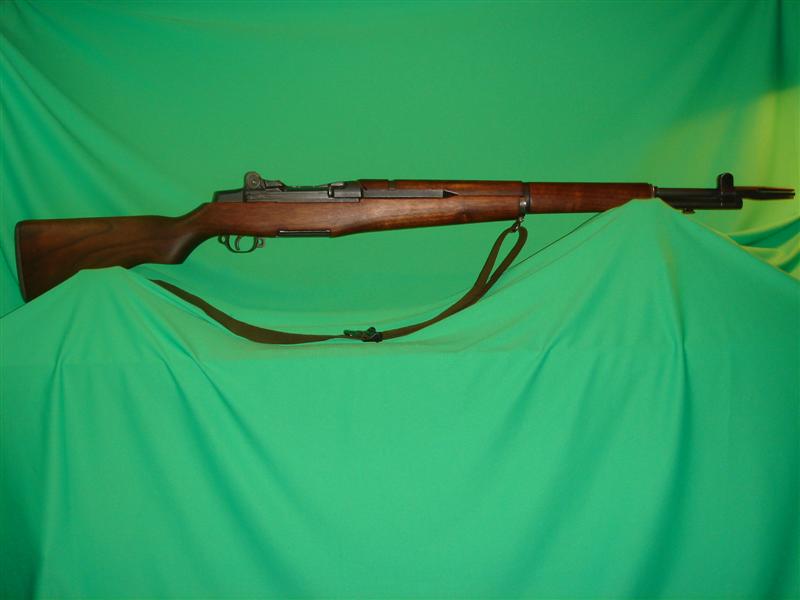
"Navy" Garand VS M-305

BadgerDog said:
Isn't a Navy Garand just a regular 30.06 caliber Garand officially converted to 7.62mm NATO?

Regards,
Badger

bingo! Unless he's talking about a Springfield Armory Inc. "recreation" (to put it lightly).
 
A real "Navy Garand" in 7.62 will often only have a chamber bushing changing it from .3006 to 7.62mm.

These have been known to leave at a high rate of speed with sometimes exciting results.

"Navy Garands" were also fitted with new 7.62mm barrels.

They are found both ways. In my opinion the one should be strictly a curiosity, while the other is a very viable service rifle.
 
Helooo guys, I was referrring to the ones with the .308 barrels, I guess there are at least 2 ways to get one, throug h Springfield Armory, or get a 7.62 bbl from somewhere and get it installed in a 'normal' Garand(don't know where you'd get one these days). I have heard the 7.62 Garand is quite a bit superior to the M-305 especially here in Canada. I was just referring to a vague term for 7.62 Garands generally. Thanks.
 
I had a genuine Navy Garand in the late 80's. It was a Springfield GI garand with a new barrel. The left side of the action was stamped 7.62 NATO. It had a steel insert in the action well to prevent loading of 30-06. The barrel was marked Canadian Arsenals, and was chambered for 7.62 Nato. I wish I still had it.
 
Gentlemen,

I could not find out anything about the "Navy" Garands on the Wolverine site. Where is it listed, and if so, for how much?

Regards,

Frank
 
fat tony said:
.............. or get a 7.62 bbl from somewhere and get it installed in a 'normal' Garand(don't know where you'd get one these days).

You have to be real careful if you're going to get a standard 30.06 Garand, that's re-barreled and converted from 30.06 to 7.62mm, particularly who does it. I bought one from a board member that had supposedly been done by a professional gunsmith, who apparently thought you just cranked the barrel on with "Locktite" and walked away. It cost me a lot of money unnecessarily to get it redone by another gunsmith, who had spent years working with Garands. He gave me written forensic report to send to the seller and his gunsmith for a claim, but I never bothered. I've never a problem with feeding or short stroking since. It nows shoots like wildfire and I get great groups using 7.62mm surplus. The moral ..... Caveat Emptor ......

1943 M1 Garand Rifle (Mfg by Springfield in July 1943)

"Professional conversion and re-barreled to .308 Caliber"


(Click PIC to Enlarge)


1943 M1 Garand Rifle .308 Conversion (lots more detailed pics ... click here)http://imageevent.com/badgerdog/unitedstatesservicerifles/m1garandrifleserial1770358

Regards,
Badger
 
Last edited:
supposedly been done by a professional gunsmith

The two professional descriptions that seem to be most loosely applied are "gunsmith" and "masseuse"....a misinterpretation of either can get you royally screwed.
 
I have a M-1 converted to 7.62. It is a fine shooter; won a Gold in the vintage rifle match at Connaught with it. It is my impression that a Garand in .308 is "softer" shooting than one in '06. As I understand it, the main purpose of a filler block is to prevent loading of .30-06 ammunition. The block in mine does no harm, as far as feeding goes. It certainly functions every bit as reliably as a .30 M-1. One could argue that a M-1 is a better made rifle than a 305, and if it is important to you, it carries 8 shots instead of the permitted 5. Fitted a .308 barrel to a M-1 receiver for a friend. Once it was indexed, my pull through reamer set made short work of finalizing headspace.
 
I have to agree with tiriaq on 7.62 conversions. I have a Breda with a Wilson 7.62 barrel in a Ramline plastic stock. Jason at Gunco did the conversion with a good chamber reamer. The combination is quite pleasant to shoot and the recoil does feel softer. I hope to find an S&K M1 scope mount for it.
 
fat tony said:
Any impressions as to the merits/drawbacks of each? On the subject of the Garand, I am referring more specifically to the "Navy" Garand which could possibly be ordered through Wolverine Supply.

I have one of each. Now if you're on a budget, go for the M305. As far as which one shoots better..... well I doubt there is much difference between the two on an even footing. Off the shelf or souped up the only real difference would be reloading on the range. The M305 is nice because it uses mags, but the M1 is nice because you have the 8rd enbloc.....

I like the M1 better, but I'm a bit of a Garand junkie these days, so I'm a little bias...
 
fat tony said:
Good Lord, BadgerDog, that's very nice, I like the sniper flash hider.

Thank you Sir....... :)

If you go the re-barrel route, just remember to make sure the job is done by an experienced Garand "smith".......... ;)

Regards,
Badger
 
Navy Garand rifles were conversions of the standard .30 Garand to 7.62 NATO. There were two versions: the Mk 2 Mod 0 and Mk 2 Mod 1. Mod 0 rifles used the chamber insert to shorten a .30 chamber to 7.62 NATO length. The chamber insert feature did not work well, because no matter what was tried, the insert came out. Three differnent methods were tried to get the inserts to stay in the modified chambers, but all were failures. The chamber insert has never worked in commercial barrels either. Barrels with chamber inserts should be avoided like the plague.

The Navy then contracted Springfield Armory, Springfield, Mass. to build dedicated 7.62 NATO barrels. These barrels were had chrome-plated chambers, bores, and the band around the gas port. Rifles with these barrels were known as Mk 2 Mod 1. Many of the Mod 0 rifles were converted to Mod 1 standard. The converted rifles had the navy nomenclature engraved along the left side below the elevation knob and above the stock.

Both Mod 0 and Mod 1 barrels had their gas ports drilled larger to assure functioning with 7.62 NATO ammuntion.

The other addition to the rifle was a spacer block made of either steel or plastic. The block was attached to the bullet guide. The block acted as a feed ramp for the 7.62 NATO ammunition and as a safety device to prevent loading of clips with .30 ammunition.

Commercial barrels are available to convert shot-out .30 barrels to .308/7.62 NATO. All commercial barrels have short chambers and must be finish reamed by a competent gunsmith for the correct headspace on the rifle. Although the rifle can be shot with .308/7.62 NATO ammo without using the spacer block in the rifle, it is not recommended. There is always some idiot who will try to load a converted Garand with .30 caliber ammo and then try to pound the bolt forward when the round does not chamber.

In either case, .30 or .308/7.62 NATO, the standard Garand 8-round clip can be used in this rifle without any modifications to it.

A genuine "Navy Garand" is a prized addition for collectors and they are typically great shooting pieces.

I have a converted Garand in .308/7.62 NATO and a standard Garand in .30 caliber. I happened to shoot both of them one day and the differences in recoil were interesting. The .30 caliber Garand had a recoil best discribed as a steady shove against your shoulder. The .308/7.62 NATO Garand's recoil was more of a sharp punch. The book says that either cartridge has approximately 15 foot-pounds of recoil which is probably correct. The way it's felt by the shooter is entirely different.
 
Back
Top Bottom