












































You are using an out of date browser. It may not display this or other websites correctly.
You should upgrade or use an alternative browser.
You should upgrade or use an alternative browser.
Neck turning. Suggestions?
- Thread starter 45C
- Start date

Munkey1973
CGN frequent flyer
- Location
- Regina, SK
21st Century Lathe... it does the job very well !
I prefer (and own) the model that you use your own cordless screwdriver.
They have one with own power supply but if that should ever fail, then how does a guy fix it ?
I prefer (and own) the model that you use your own cordless screwdriver.
They have one with own power supply but if that should ever fail, then how does a guy fix it ?
21st Century Lathe... it does the job very well !
I prefer (and own) the model that you use your own cordless screwdriver.
They have one with own power supply but if that should ever fail, then how does a guy fix it ?
Yes,and isn't the one with it's own power supply,like $700
Verses $100 for the drill operated?
TheNatural21
CGN Regular
- Location
- Fort Nelson, BC
I really like my Forster trimmer with the added neck turning and power drill pieces. It does a good job and is fast to use and set up.
Munkey1973
CGN frequent flyer
- Location
- Regina, SK
Yes,and isn't the one with it's own power supply,like $700
Verses $100 for the drill operated?
Yeah the powered one is $700 USD, but I'm not sure how you got $100 for the regular.
Factory direct its about two-fiddy USD...
http://www.xxicsi.com/17-338-cal.-neck-turning-lathe.html
But yeah, to hell with the powered unit... I just got a 4V Ryobi cordless screwdriver at Homedepot for about $70 years ago. Homedepot does not sell extra batteries... so I went to a local battery place here in Regina and got 2 extra of their in-house batteries for another $50 or so.
I use that cordless screwdriver for a very other things on the bench, with 4V I have to charge the batteries frequently but not as bulky and heavy as cordless drill. Plus the speed on low is 200 RMP which is what you want for neck turning on this lathe.
I got mine direct from 21st years ago before the Canadian market caught on.
I think that X reload is currently sold out... I believe Extreme Gun Shooting Centre in the 'Peg has some in stock. He sells alot of knock-off stuff but the 21st Century stuff is the real genuine deal.

I suggest you read the Redding bushing die FAQ (all of it) with emphasis on the section on neck turning. If you have a factory rifle with a standard SAAMI chamber it may not help. Also if you neck turn the case neck will expand more when fired and have to be reduced in diameter more. Meaning you will be working the neck more, on top of this the more the neck is reduced with a bushing die the greater the chance the bushing will induce neck runout.
Bushing dies work best with custom barrels with a tight neck chamber. And if you do decide to neck turn you are better off only skim turning the neck 50% to 75% and just removing the high spots. The more the neck thickness is reduced the greater the chance of donuts forming as the brass flows upward during sizing.
Bottom line, you would be better off buying high quality uniform brass and not turning the necks with a SAAMI chamber.
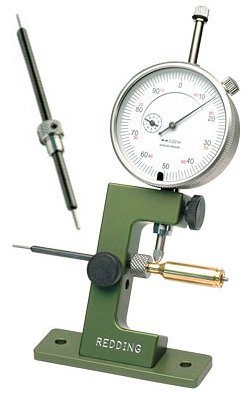
I sort my cases with a Redding neck thickness gauge below and look for the most uniform necks and avoid neck turning.
Tech Line & Tips (FAQs)
https://www.redding-reloading.com/tech-line-a-tips-faqs/146-concentricity-problems
Concentricity Problems
a.k.a Neck Runout With Bottleneck Cases
"We have conducted many tests over the years on the various factors contributing to concentricity problems with bottleneck cases. We have repeatedly found a definite correlation between the uniformity of the brass (or lack of it) and the resulting concentricity of the neck to the body of the case.
An interesting experiment also revealed that neck turning of brass that was intentionally sorted as non-uniform, showed little or no concentricity improvement when used in standard S.A.A.M.I. spec chambers. Conversely brass that was sorted and selected for uniformity remained uniform and concentric with or without a neck turning operation."
Bushing dies work best with custom barrels with a tight neck chamber. And if you do decide to neck turn you are better off only skim turning the neck 50% to 75% and just removing the high spots. The more the neck thickness is reduced the greater the chance of donuts forming as the brass flows upward during sizing.
Bottom line, you would be better off buying high quality uniform brass and not turning the necks with a SAAMI chamber.
I sort my cases with a Redding neck thickness gauge below and look for the most uniform necks and avoid neck turning.
Tech Line & Tips (FAQs)
https://www.redding-reloading.com/tech-line-a-tips-faqs/146-concentricity-problems
Concentricity Problems
a.k.a Neck Runout With Bottleneck Cases
"We have conducted many tests over the years on the various factors contributing to concentricity problems with bottleneck cases. We have repeatedly found a definite correlation between the uniformity of the brass (or lack of it) and the resulting concentricity of the neck to the body of the case.
An interesting experiment also revealed that neck turning of brass that was intentionally sorted as non-uniform, showed little or no concentricity improvement when used in standard S.A.A.M.I. spec chambers. Conversely brass that was sorted and selected for uniformity remained uniform and concentric with or without a neck turning operation."
Pay attention to the last paragraph below.
Save $$ By Using Lake City 5.56x45mm Once-Fired GI Brass
http://bulletin.accurateshooter.com/2019/10/save-by-using-lake-city-5-56x45mm-once-fired-gi-brass/
Accuracy Potential of Mil-Surp 5.56×45 Brass
So, how accurate can previously-fired GI surplus brass be in a good National Match AR-15? Well, here’s a data point from many years ago that might be of interest. A High Power shooter who wrote for the late Precision Shooting magazine took a Bill Wylde-built AR match rifle to a registered Benchrest match. His first 5-round group ever fired in a BR match was officially measured at 0.231″ at 200 hundred yards. This was fired in front of witnesses while using a moving target backer that confirmed all five rounds were fired.
He recounted that his ammo was loaded progressively with factory 52gr match bullets and a spherical powder using mixed years of LC brass with no special preparation whatsoever. Obviously, this was “exceptional”. However, he had no difficulty obtaining consistent 0.5-0.6 MOA accuracy at 200 yards using LC brass and a generic “practice” load that was not tuned to his rifle.
Save $$ By Using Lake City 5.56x45mm Once-Fired GI Brass
http://bulletin.accurateshooter.com/2019/10/save-by-using-lake-city-5-56x45mm-once-fired-gi-brass/
Accuracy Potential of Mil-Surp 5.56×45 Brass
So, how accurate can previously-fired GI surplus brass be in a good National Match AR-15? Well, here’s a data point from many years ago that might be of interest. A High Power shooter who wrote for the late Precision Shooting magazine took a Bill Wylde-built AR match rifle to a registered Benchrest match. His first 5-round group ever fired in a BR match was officially measured at 0.231″ at 200 hundred yards. This was fired in front of witnesses while using a moving target backer that confirmed all five rounds were fired.
He recounted that his ammo was loaded progressively with factory 52gr match bullets and a spherical powder using mixed years of LC brass with no special preparation whatsoever. Obviously, this was “exceptional”. However, he had no difficulty obtaining consistent 0.5-0.6 MOA accuracy at 200 yards using LC brass and a generic “practice” load that was not tuned to his rifle.
I use a Forster. I clamp the tool in a vice...and use a Lee shell holder / lock stud to hold the brass while I turn it (very slowly). If turning for a factory chamber, all that is required is a skim “clean-up”. However, sometimes a bit more off the neck reduces NK tension which can sometimes benefit consistency.
Regarding this... "We have conducted many tests over the years on the various factors contributing to concentricity problems with bottleneck cases. We have repeatedly found a definite correlation between the uniformity of the brass (or lack of it) and the resulting concentricity of the neck to the body of the case.An interesting experiment also revealed that neck turning of brass that was intentionally sorted as non-uniform, showed little or no concentricity improvement when used in standard S.A.A.M.I. spec chambers. Conversely brass that was sorted and selected for uniformity remained uniform and concentric with or without a neck turning operation...
I find this entirely misleading.
Ignore neck to body runout on cases until you have fired it in your rifle. All chambers have concentric neck to body and all fired brass will have concentric neck to body. (As long as the ejector does not dent your necks at extraction.)
It's your resizing process that creates the runout.
The more you resize your necks the more runout you will create... Regardless of what die you use.
If you run an expander mandrel in after you sized, your cases will have even more runout after than before.
If you want low neck to body runout, you need a tight neck chamber, then you only have to resize a couple thousandths. If you are sizing down 0.002" you cannot end up with 0.003" runout... Just not possible.
If you have a sloppy chamber and neck size, you will be increasing the amount of resizing that is required and thereby increasing the runout, but you will have more consistent neck tension.
I find this entirely misleading.
Ignore neck to body runout on cases until you have fired it in your rifle. All chambers have concentric neck to body and all fired brass will have concentric neck to body. (As long as the ejector does not dent your necks at extraction.)
It's your resizing process that creates the runout.
The more you resize your necks the more runout you will create... Regardless of what die you use.
If you run an expander mandrel in after you sized, your cases will have even more runout after than before.
If you want low neck to body runout, you need a tight neck chamber, then you only have to resize a couple thousandths. If you are sizing down 0.002" you cannot end up with 0.003" runout... Just not possible.
If you have a sloppy chamber and neck size, you will be increasing the amount of resizing that is required and thereby increasing the runout, but you will have more consistent neck tension.
Regarding this... "We have conducted many tests over the years on the various factors contributing to concentricity problems with bottleneck cases. We have repeatedly found a definite correlation between the uniformity of the brass (or lack of it) and the resulting concentricity of the neck to the body of the case.An interesting experiment also revealed that neck turning of brass that was intentionally sorted as non-uniform, showed little or no concentricity improvement when used in standard S.A.A.M.I. spec chambers. Conversely brass that was sorted and selected for uniformity remained uniform and concentric with or without a neck turning operation...
I find this entirely misleading.
Ignore neck to body runout on cases until you have fired it in your rifle. All chambers have concentric neck to body and all fired brass will have concentric neck to body. (As long as the ejector does not dent your necks at extraction.)
It's your resizing process that creates the runout.
The more you resize your necks the more runout you will create... Regardless of what die you use.
If you run an expander mandrel in after you sized, your cases will have even more runout after than before.
If you want low neck to body runout, you need a tight neck chamber, then you only have to resize a couple thousandths. If you are sizing down 0.002" you cannot end up with 0.003" runout... Just not possible.
If you have a sloppy chamber and neck size, you will be increasing the amount of resizing that is required and thereby increasing the runout, but you will have more consistent neck tension.
If you fire the case on the right below, the bullet will still be off-center with the bore. If you neck turn the same fired case the bullet will still be out of alignment with the bore. How many times do you have to fire a non-uniform case and hope the neck is aligned with the case body.
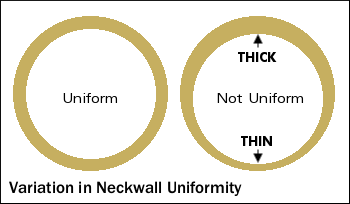
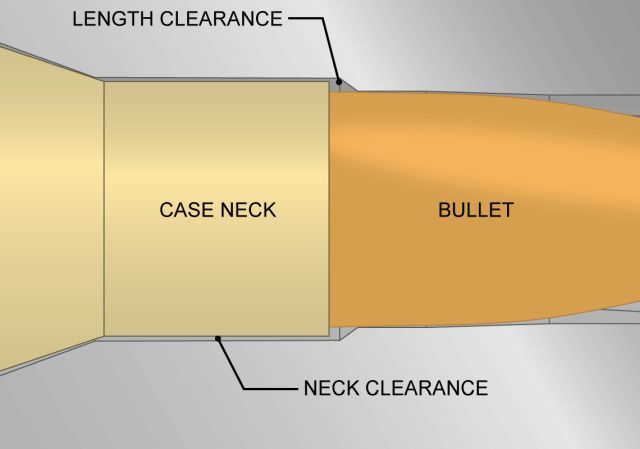
If you have very little case neck thickness variations the neck might end up concentric with the case body. The amount the case neck can move and shift depends on the bullet clearance in the throat and neck clearance in the chambers neck.
Bottom line, the information I posted was directly from Redding who makes the reloading dies and does all the testing. Meaning they should know what they are talking about. Why do you think so many competitive shooters tell you to buy high-quality uniform brass. I have had Remington .223 cases with over .009 neck thickness variations.

With a standard spec, factory chamber, neck turning is a waste of time IMHO.
I do have rifles that I turn the necks for, but they're match rifles with chambers cut by my own custom reamers. I have to turn the case necks to chamber the cartridge.
I like to leave an overall clearance of .002 or .001 all the way around any point on the circumference. These rifles all have throats that are cut so that the bullet is seated up against the leade and when the bolt is cammed into battery, the bullet is pushed back into the neck. This is about as straight as you can get the bullet aligned with the axis of the bore.
I don't shoot magnum cartridges. I don't handle heavy recoil well. Not only that, but I believe a certain amount of freebore is purposely built into magnum throats.
I have a good friend with a match chambered 300 Win Mag, built on a Stiller action. It will not chamber factory ammo and requires a special insert in the neck to swage the neck down enough to clear the throat.
Of course, he has to turn the necks of his cases, Lapua, to accommodate the .308 diameter bullet, with enough tension to get to proper operating pressures. That rifle is an incredible shooter in his hands. I believe he has over .100 in of freebore built in to where he seats his bullet's ogive to.
It's my impression that a tight throat and a properly true to the axis of the bore chamber, has more to do with accuracy than run out. Every rifle I have with custom necks/throats shoots better than I am capable of holding at this point in my life, even from a solid bench/rest.
The most accurate off the shelf, non custom rifle I have is a Tikka T3, chambered for the 6.5x55 and it won't chamber some factory cases, because the necks are to big. It really doesn't matter because I've never shot factory loaded ammo through it. I use Lapua cases, because they last a long time, are consistent in thickness as well as weight (makes sense).
When I take them straight from the box, some of them will hang up at the neck. No bullet inserted. Again, not a problem, as they fit fine when they've been sized and later loaded with the components. There is at least a .125 in freebore in that chamber.
After doing a chamber cast, with cerrosafe, the neck diameter of the chamber allows .004 in overall clearance, or .002 in all the way around. The throat has .002 in of overall clearance.
I've heard some people say their Tikka T3 rifles don't shoot well. I've owned 5 of them and settled on the 6.5x55 because of recoil. The others, were also very accurate, especially the 30-06 Springfield. I don't doubt there are some inaccurate units out there. Surprising thought because I believe Tikka tests every rifle for accuracy before it leaves the factory.
I do have rifles that I turn the necks for, but they're match rifles with chambers cut by my own custom reamers. I have to turn the case necks to chamber the cartridge.
I like to leave an overall clearance of .002 or .001 all the way around any point on the circumference. These rifles all have throats that are cut so that the bullet is seated up against the leade and when the bolt is cammed into battery, the bullet is pushed back into the neck. This is about as straight as you can get the bullet aligned with the axis of the bore.
I don't shoot magnum cartridges. I don't handle heavy recoil well. Not only that, but I believe a certain amount of freebore is purposely built into magnum throats.
I have a good friend with a match chambered 300 Win Mag, built on a Stiller action. It will not chamber factory ammo and requires a special insert in the neck to swage the neck down enough to clear the throat.
Of course, he has to turn the necks of his cases, Lapua, to accommodate the .308 diameter bullet, with enough tension to get to proper operating pressures. That rifle is an incredible shooter in his hands. I believe he has over .100 in of freebore built in to where he seats his bullet's ogive to.
It's my impression that a tight throat and a properly true to the axis of the bore chamber, has more to do with accuracy than run out. Every rifle I have with custom necks/throats shoots better than I am capable of holding at this point in my life, even from a solid bench/rest.
The most accurate off the shelf, non custom rifle I have is a Tikka T3, chambered for the 6.5x55 and it won't chamber some factory cases, because the necks are to big. It really doesn't matter because I've never shot factory loaded ammo through it. I use Lapua cases, because they last a long time, are consistent in thickness as well as weight (makes sense).
When I take them straight from the box, some of them will hang up at the neck. No bullet inserted. Again, not a problem, as they fit fine when they've been sized and later loaded with the components. There is at least a .125 in freebore in that chamber.
After doing a chamber cast, with cerrosafe, the neck diameter of the chamber allows .004 in overall clearance, or .002 in all the way around. The throat has .002 in of overall clearance.
I've heard some people say their Tikka T3 rifles don't shoot well. I've owned 5 of them and settled on the 6.5x55 because of recoil. The others, were also very accurate, especially the 30-06 Springfield. I don't doubt there are some inaccurate units out there. Surprising thought because I believe Tikka tests every rifle for accuracy before it leaves the factory.
bigedp51,
While I appreciate the nice pictures, you are misinterpreting the information.
If you have a sloppy neck, the neck has no bearing on bullet alignment to the bore.
What aligns the bullet to the bore is the free bore. The longer a bullet sticks out of the neck... IE longer the free bore, the better the free bore can help accuracy. That's why short rounds like the 6BR are so favored... They are short enough to be chambered with long throats.
This is why guys like Erik Cortina put out videos saying runout does not matter. I don't agree with that blanket statement, but that's why he says it.
If you want to eliminate all doubt, you need to neck turn and you need a tight neck. This way, the neck can essentially extend the guiding influence of the free bore. To do this, the neck clearances need to be minimal.
If you really want to get into it, we need to discuss free bore diameter as well. A tight free bore will better align the bullet than a sloppy free bore. We just don't want the free bore diameter so tight that a fat bullet will be constricted and possibly pushed back into the case. That would obviously be dangerous.
Another factor to consider about neck clearances is that the neck itself creates a gas seal, or pressure seal. The less it moves under pressure, the faster it will create that seal and the less energy is allocated to the expansion of the brass. Therefore, as minor as this effect may be, it is a contributing factor to low velocity spreads.
While I appreciate the nice pictures, you are misinterpreting the information.
If you have a sloppy neck, the neck has no bearing on bullet alignment to the bore.
What aligns the bullet to the bore is the free bore. The longer a bullet sticks out of the neck... IE longer the free bore, the better the free bore can help accuracy. That's why short rounds like the 6BR are so favored... They are short enough to be chambered with long throats.
This is why guys like Erik Cortina put out videos saying runout does not matter. I don't agree with that blanket statement, but that's why he says it.
If you want to eliminate all doubt, you need to neck turn and you need a tight neck. This way, the neck can essentially extend the guiding influence of the free bore. To do this, the neck clearances need to be minimal.
If you really want to get into it, we need to discuss free bore diameter as well. A tight free bore will better align the bullet than a sloppy free bore. We just don't want the free bore diameter so tight that a fat bullet will be constricted and possibly pushed back into the case. That would obviously be dangerous.
Another factor to consider about neck clearances is that the neck itself creates a gas seal, or pressure seal. The less it moves under pressure, the faster it will create that seal and the less energy is allocated to the expansion of the brass. Therefore, as minor as this effect may be, it is a contributing factor to low velocity spreads.
Last edited:





















