Need help identifying a gun

polskiogorki

CGN Ultra frequent flyer
Rating - 100%
208   0   2
Location
North bay
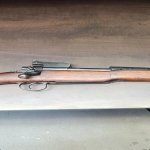
Was just given this gun,
Other than being a 303 no idea what it is
And if it has any value. Numbers don't match
Screenshot_20210517-110810_Gallery.jpg
Screenshot_20210517-110751_Gallery.jpg
Screenshot_20210517-110740_Gallery.jpg
Screenshot_20210517-110723_Gallery.jpg
Screenshot_20210517-111319_Gallery.jpg
 

Attachments

  • Screenshot_20210517-110810_Gallery.jpg
    Screenshot_20210517-110810_Gallery.jpg
    17.1 KB · Views: 362
  • Screenshot_20210517-110751_Gallery.jpg
    Screenshot_20210517-110751_Gallery.jpg
    41.1 KB · Views: 363
  • Screenshot_20210517-110740_Gallery.jpg
    Screenshot_20210517-110740_Gallery.jpg
    28.3 KB · Views: 362
  • Screenshot_20210517-110723_Gallery.jpg
    Screenshot_20210517-110723_Gallery.jpg
    30.7 KB · Views: 363
  • Screenshot_20210517-111319_Gallery.jpg
    Screenshot_20210517-111319_Gallery.jpg
    27.1 KB · Views: 362
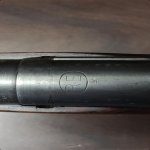
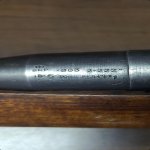
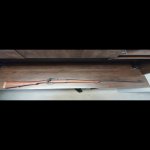
The stock, of course is extensively "sporterized". From pictures, metal parts look to be all there - looks like the military front sight, so barrel was not cut off. There will be at least 4 serial numbers - on bolt handle, on receiver, on barrel and on the front face of the rear sight - when ladder is standing up. I have one "E" with cut down stock that also has the receiver serial number stamped in the barrel channel. Because your receiver is marked "RE", it was made at the Remington factory in first half of WWI - the only time they were made - so would have left that factory with pretty much all the 60 or so parts (except screws and coil springs) with a small "R" stamp - but often swapped out in service, or after service - many, but not all, parts from an "E" or a "W" P14 would fit, or at least could be made to fit well enough to work. Looks like an Asterisk or a Star stamped below the RE - look into rear of chamber area - the rear end of the barrel will have a groove cut part way around the chamber area - the bolt should also have the same asterisk, if the serial numbers do not match - was the difference between the Mark I and the Mark I* versions - left bolt lug is different. Some of us have been looking for years for original WWI military P14 stock and hand guards - just do not see them available - is similar to, but not identical to, an M1917 stock, but they seem just as scarce. Contractors in Britain also made replacement stocks during WWII for the British re-build program that they did then. Numrich (gunpartscorp) does sell reproduction stocks and hand guards. Over past about 4 years I have bought maybe 8 or 9 P14 and M1917 like that one - paid $60 for one with totally rotted out barrel that a bullet will drop right through without touching, up to $300 for nice Winchester P14 that was more or less all there and more or less all "matching", but with cut down sporterized stock.



Your pictures make that look like someone's favourite hunting rifle - would be an excellent moose, deer or black bear rifle, for sure, so bore condition would be quite important in arriving at a value for it, as a "shooter".
 
Last edited:
That rifle is restorable to its original state, if you're so inclined. Likely cost you more for components than just buying a complete original

Mixed bolt and receiver numbers are not unusual and I've yet to check one and find the headspace bad. The parts on these rifles were designed to be interchangeable in the field if necessary.

If the bore is excellent, there are at least $300+ worth of parts on that rifle.

As is, those gems are selling in the $300+ range regularly. Sadly they bring a bit more when they've been drilled and tapped for scope bases and had their rear sight/ears removed to fit the profile of the Rem Mod 30, which was a commercial version of the same action.
 
There were a lot of them around the BC coast for the longest time. I fished crab with a guy who had one hanging up in his boat. It hadn't been taken down from the nails it was on for years. I took it down and dosed it with WD 40 and even improvised a pull-through and cleaned it up enough to get the bolt working again, but we never shot it. He did have a half a box of cartridges on the boat.

I knew someone in the same small town who had a rusted up relic of just the metal hanging up on his wall. He'd found it in the garden.

Another buddy bought an old gillnetter off an old guy and guess what was hanging up over the bunk? A rust encrusted P14.

I was dispatched out on the packer Lady Augusta one herring season and when I was making up my bunk there was a lump under the mattress. I investigated and what was it? A P14.
 
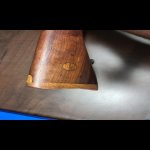
Is that a WOOD butt plate?

Yes and it's not unusual from rifles of the period when that original stock was cut down. The wood removed some weight and some folks that were handy with such things found it much more visually appealing.

Customizing those rifles was how most people got into shooting back in the 20 years after WWII, maybe even 30 years after. Those rifles were plentiful and CHEAP for the times. People were handier with hand tools back then, than they seem to be today. That rifle would have been a source of pride for whomever did the work and owned it at the time.
 
There were a lot of them around the BC coast for the longest time. I fished crab with a guy who had one hanging up in his boat. It hadn't been taken down from the nails it was on for years. I took it down and dosed it with WD 40 and even improvised a pull-through and cleaned it up enough to get the bolt working again, but we never shot it. He did have a half a box of cartridges on the boat.

I knew someone in the same small town who had a rusted up relic of just the metal hanging up on his wall. He'd found it in the garden.

Another buddy bought an old gillnetter off an old guy and guess what was hanging up over the bunk? A rust encrusted P14.

I was dispatched out on the packer Lady Augusta one herring season and when I was making up my bunk there was a lump under the mattress. I investigated and what was it? A P14.


In 1965, I bought my first full wood, as issued P14. I paid Mr Lever $5 for it and it was in 90% condition, inside and out. Mr Lever sold them out of the store on Dunsmuir Street for $17. Top dollar back then for a surplus firearm, because it was considered to be superior to any mark of Lee Enfield, which commonly was sold to the public for $10.

There was a reason the fishing boat owners bought up hundreds of them to carry on their boats to shoot seals and even Orcas, Dolphins, all of which tore up their nets or just because they were there and ate fish they wanted to catch.

FMJ ammo cost around 50 cents for a box of 48 and if they were lost or corroded beyond use or for some reason needed to be deep sixed, it was only $17.50 lost and easily replaceable for the same price.

 
In 1965, I bought my first full wood, as issued P14. I paid Mr Lever $5 for it and it was in 90% condition, inside and out. Mr Lever sold them out of the store on Dunsmuir Street for $17. Top dollar back then for a surplus firearm, because it was considered to be superior to any mark of Lee Enfield, which commonly was sold to the public for $10.

There was a reason the fishing boat owners bought up hundreds of them to carry on their boats to shoot seals and even Orcas, Dolphins, all of which tore up their nets or just because they were there and ate fish they wanted to catch.

FMJ ammo cost around 50 cents for a box of 48 and if they were lost or corroded beyond use or for some reason needed to be deep sixed, it was only $17.50 lost and easily replaceable for the same price.


I stared wistfully into the window of Lever's store in August 1965 but at 12 my mom wouldn't let me go in. We were staying in a hotel across the street. She wouldn't even let me buy a bayonet at Army and Navy for 99 cents. "But Mom, I NEED a bayonet!"
 
Back
Top Bottom