





























Need Help with old brit militaria.

Ace604

Regular
Rating - 100%
38   0   0
Hey guys n gals, looking for more info as my own google skills are beginning to tire me out.

I have a 1856 enfield saber bayonet. Look it up on google if you dont know what it is lol. Looking for general info and more detailed info on it and british service. It was passed down to me by my great grandfather. He served in the crimean war and ww1 for the british (later moving to canada). I understand the bayonet saw service in its theatre of war My questions is, A) When do you think this bayonet is from more likely. B) What rifle does the bayonet fit on C) How easy/how much to acquire one of these rifles D) What does the markings 1 8 on butt end of the saber/bayos handle mean, its the only markings i can see. E) What war do you think it likely saw.

I from what i gather understand it fits on a p56 enfield? Correct me if im wrong or add on please.. If this is the case how likely that it was ww1 (seems like an old timey gun to give your soldiers lol, but I can understand the brits being low on inventory and wanting to arm as many as possible.) OR is it more likely it saw crimea and was produced right before the war ended and was used on a more modern at the time time p56 or other .577 rifle.

Thanks for any and all info and for taking the time out to help me.

Cheers.
 
Last edited:
I think it fits on an Enfield .577 two band rifle, a standard English made infantry rifle of the period. A very popular weapon for both sides in the American Civil War as well. These rifles are not terribly hard to find. The bayonet would have never been used in WW1 as the British used the 1907 pattern bayonet for Lee Enfields in that conflict.
 
"Look it up on google if you dont know what it is lol"

How adept you are at inspiring others to share...

If your intent was serious you would offer a picture.

(It sounds like it has the potential to be a great story. If you really want to make it pop you have to cough up some pics)
 
Last edited:
394882_10152454677695635_601976795_n.jpg


543968_10152454678120635_1243143026_n.jpg


543900_10152454678525635_1388187127_n.jpg
 
Im hearing in certain places that brass indicates being part of a volunteer unit (aka volunteer soldiers not conscripts/regulars) Can anyone confirm this being so? Or is there another story to the brass.
 
This "yataghan"-style bayonet was indeed introduced for use with some of the patterns of .577 Enfield muzzle-loading rifles, but continued in use for the Snider breech-loading conversions of the appropriate (two-band) .577 Short Rifles. Short Rifles in the Land Service (both rifle muskets and snider conversions) were issued to Sergeants of Infantry Regiments and all "Other Ranks" (privates and NCO's) in Rifle Regiments - and also (with a bushed muzzle ring) to fit the smaller-diameter barrel of the Martini-Henry rifle once that supplanted the Snider-Enfield, right into the 1880's .... and even longer in Canada, which retained Snider-Enfields as its primary-issue military longarms until the late 1890's.

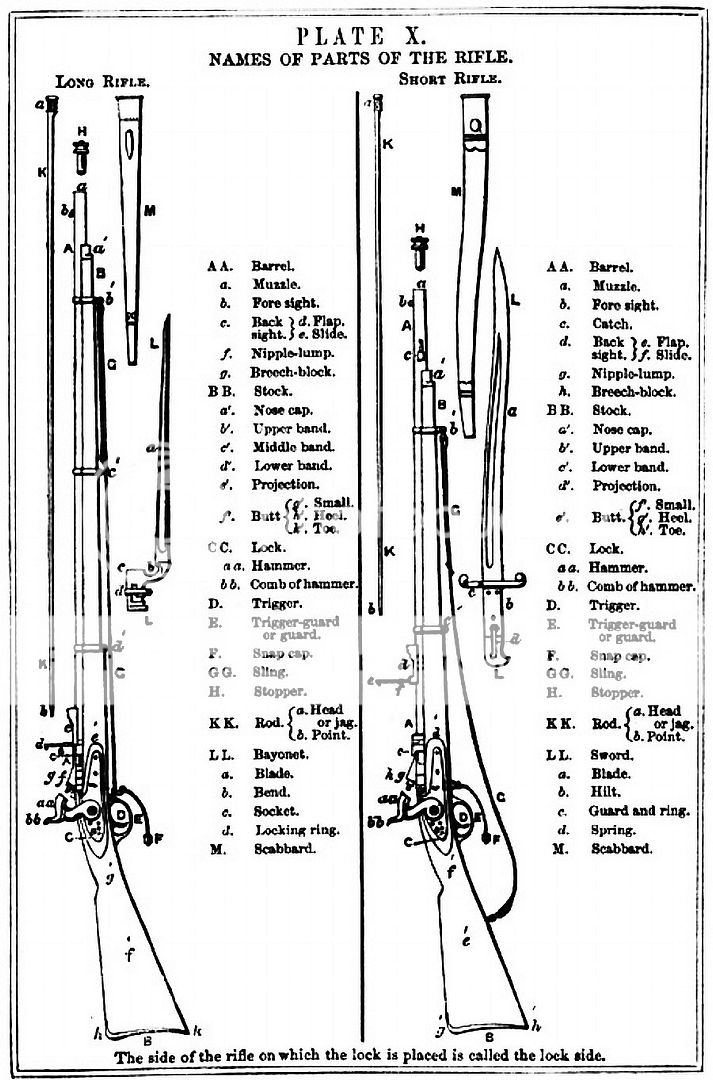
Period British diagram showing Land Service Snider-Enfield Long Rifle and Short Rifle, with their usual bayonets -
sniderparts.jpg


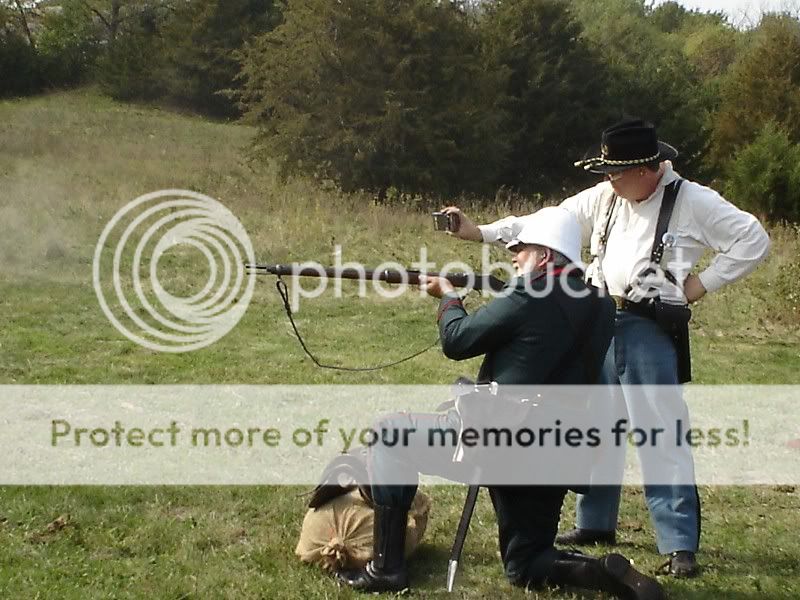
I shoot both Snider-Enfield and Martini-Henry in Grand Army of the Frontier competitions (sort of "Victorian-era Military Action Shooting") and as my primary persona has been that of a Sergeant of the Queen's Own Rifles of Canada, I have yataghan bayonets to fit both the Snider-Enfield Short Rifle, and also the Martini-Henry rifle - which is what I am shooting here .... note my bayonet -
Roger16.jpg


I'm afraid that your understanding about your Great-Grandfather's military service must be erroneous: the Crimean War was 1853-56, so if he had been old enough to serve in that conflict he would have to be at least 76 (or older) when WWI began in 1914! The earlier war that most Great War soldiers would have served in was the Second Anglo-Boer War (1899-1902).

If, indeed, the Pattern 1856 bayonet is what you have (see below) it should fit an Enfield (or Snider-Enfield) Land Service Short Rifle (unless altered to fit a Martini-Henry.) Original Pattern 1856 Enfield muzzle-loading rifle muskets are obtainable, but are fairly rare and expensive (primarily because the majority of serviceable Enfield muzzle-loaders were converted to Snider-Enfields) .... and an original bayonet may not fit properly on a modern reproduction of such a rifle. Original Snider-Enfield Short Rifles are comparatively common, though they are somewhat rarer - and accordingly more expensive - than standard 3-band rifles. (No modern-reproductions of any snider-enfield are made.)

Matter of fact, Jean Plamondon of P&S Guns & Militaria in Sherbrooke, Quebec (one of the best guys in the business to deal with, by the way) currently has four Snider-Enfield Short Rifles offered for sale - two of which saw Canadian service, and two with British service. Look at items 1822 and 1421 in the Canada section, and item 1606 and the item immediately following it without a stock number assigned to it in the United Kingdom section, on this page of his website - ht tp://psmilitaria.50megs.com/antiques.html (Note: URL rendered inactive to comply with non-sponsor live-linking rules here on CGN.) Not cheap, you will see, but that is pretty much the going price for a complete and shootable Snider-Enfield Short rifle these days.

However, are you positive that yours is a Pattern 1856 bayonet? There were no less than seven different patterns of the yataghan-style sword bayonet, which look almost identical but have slightly different locking lug configurations, for use on different rifles and carbines (.... not counting those which got adapted for use on Martini-Henry rifles) -
BayonetsandScabbards-1_zpsb0711ec3.jpg
 
Wow thank you grant, huge help. Yes that makes more sense he would have served in the second boer war. After talking to the "elders" of the family lol, it seems this is likely the case as you have mentioned. Can you take a look at the pics (if you have not done so) and tell me what you think about which bayo it is, id like to know which one exactly so i can buy the corresponding rifle. Those prices are a tad high, and the ammo I have looked up looks to be 5$ a round lol, but im more than willing to spend that on what i consider a big part of my history. I really appreciate all your input here, you are the history buff I was exactly looking for lol.

unfortunately I dont have the scabbard to match the bayo. Also how fast do you think he will sell out of those rifles, I'd like to start saving up right now, but ive got 3 ww2 bolt actions im trying to acquire as well, so this rifle may need to wait 4 or 5 months.
 
Last edited:

You're welcome, Ace!

I should caution that there is a strong possibility that this bayonet is simply something your Great Grandfather collected, rather than an item he actually used during his own military service. It seems likely he was in the army after even the Martini-Henry was the primary-issue British military rifle (about 1874/75 through to about 1888/90) - let alone the Snider-Enfield (about 1866/68 through to the mid-to-late 1870's) or the muzzle-loading Enfield Rifles such bayonets were originally designed for (1850's and 1860's.) Also, soldiers didn't get to keep equipment like this after their military service, it remained the property of the War Department.

Important: are the guard and pommel actually brass (as seems to be suggested above) or are they simply discoloured steel? How do those parts compare to the metal of the rib running between the pressed-leather grip scales? (That particular part is actually a continuation of the blade, and accordingly must be steel. To my knowledge, the only Enfield/Snider-Enfield sword bayonet with brass components was the Pattern 1853 Artillery bayonet mentioned in the above list ..... but its hilt and guard configuration were significantly different -
UKArtilleryrighthilt_zps10760abf.jpg


Also, do you happen to know what branch of service your G-G served in? e.g. Artillery? Infantry?

I didn't see the pics until after I posted my last message, as they apparently went up while I was composing it. Before I venture an opinion, I'll need you take some accurate measurements - preferably using a calliper - which will help with identification. In particular, can you measure:
- the inside diameter of the muzzle ring
- the distance from the bottom of the muzzle ring to the back of the blade/hilt
- the width of the "T-slot" at the rear - the wide parts and the narrow part
- the "depth" of the T-slot, top to bottom
- the length of the T-slot, front to back

I also need you to take a clear photo showing the top of the pommel, like this -
yataghanbayonetpommels_zps74142aff.jpg

As you can see, the configuration there is important to identification.

Are there any markings at all at the base of the blade, just ahead of the guard? If so, can you get any clear close-up photos of them, or describe them in detail?

As for acquiring one of the rifles listed by Jean at P&S, he could have them on offer for quite a while. They do come up from time to time, with him and other dealers. I suspect Snider-Enfield rifles are actually more common in Canada than just about anywhere else in the world, because we kept them in service so long, and by the time they were replaced they were too obsolete be in demand as surplus ..... until they became collectable. (Mind you, there are a lot of Sniders out there which have been "sporterized" ..... they are cheaper, but definitely not what you want to go with a nice bayonet such as you appear to have - especially since their collector value has been destroyed and the bayonet lug almost always disappears in such a alteration, along with a good part of the barrel and forestock, usually!)

In any event, we need to confirm just what type of bayonet you do have, before we'll know what type of rifle it fits on.
 
Last edited:

You are a absolute treasure of information Grant lol. Good to know I got an expert on the case :p

Theres is documented photos of him apparently in full uniform with the rifle and bayonet in question attached. I am desperately trying to locate these within the family as they would drastically help. That being said i would guess its the same one pictured and thus was indeed part of his military service. However without further evidence from my family stocks of historical photos and such, I cant be sure.

I believe it is indeed brass as you can see in the pics. Its dull brass but I definately believe it to be brass and not steel. The rib (im assuming the metal between the pressed leather by the barrel bushing) is flush with the pressed leather. The hole for the actual locking mechanism seems slightly odd as it dosnt look 100% even. Like the groove that glides onto the barrel bayonet block is uneven it almost looks like in size (could just be me noticing small imperfections or maybe this is something significant?) If youre looking directly at the blade from the base of the hilt (aka the same as my picture with the #18 in it) The left side (button side) groove seems a tad smaller than the right side groove. But again this may be a small imperfection that is of no value

Looking at the pictures you posted, i can compare and these are what i notice. It is not like the first one (going from the left to right), because it does not have the two levels(elevated metal just before the ribbing) of metal before the ribs.

The second one seems possible, as you can see my bayo the barrel bushing damn near is flush with the ribs/pressed leather and the blade, with the bottom of it being flush at one point with the ribbing which seems to be uncommon on any other of the bayo's. This is the only one that looks similar to the bushing on mine, and this is why I believe this is the proper bayonet I have. Only things throwing me off, is the weird step down from the ribbing to the actual groove, seems like there is a step there while on mine there is not, the pressed leather and ribbing just instantly drop off into a slightly rounded stop and of course the groove (not like #3, but exactly like #5). Sorry if im overloading with stuff that dosnt make sense.. hard to explain it all. I will def take a couple more pics for yourself to examine.

#3 the bushing is too high up from the ribbing and blade

#4 the rounded and skinny bottom on the female part of the bayonet is far off from what mine is.

#5 is the only other one beside #2 that looks a lot like the one I own, but the bushing is too thick and small compared to mine I would assume from looks.

If i were to guess I would say its #2, but the fact that the female part on #2 dosnt look like #5 (which my bayo does look like) Throws me off to.

Man that felt like a lot of rambling lol.. hope its of some use to you.

I do not know what he served in, i would assume infantry..

Ill take a caliper to it asap and get those stats to you, should be the defining step I would hope.

No unfortunately no markings that I can see, I will take the old tape off my grandma had put on it for marking and see if anything is underneath, unlikely though. Just the number 18 on the very base of the hilt as pictured.

Well thats good news, I will start saving up now and hopefully in a few months i can buy teh rifle that fits this bayonet, yay canada lol. Yuck sporterized :( poor ol sniders.

Alright well huuuuuuuuuge thanks again Grant, cant thank you enough seriously, you are pretty much being a historian for myself haha. Without people like yourself I would still think this was a WW1 bayonet incorrectly. I highly value history, and my families history even more so this means a lot to me. I am hugely appreciative of all your time you put into helping me out here, and one day im sure our final verdict will make it into my grandkids ears lol. Cant wait to solve this riddle.
 
Hi:

It doesn't surprise me that #2 in the photo seems like the right configuration, as it was one of the most common patterns. (Also, #4 is a special pattern for the relatively rare Lancaster rifle which had a bayonet lug which was round in cross-section, and #5 is an example of a bayonet which has had its muzzle ring bushed to fit the smaller diameter barrel of the .450 Martini-Henry rifle, so it isn't surprising that they don't look right.)

It will be great if the photo(s) of your G-G in uniform can be located. If they do show him with a rifle fitted with this type of bayonet, I suspect it may be from a time when he was in some sort of Volunteer unit or Militia Battalion (very common service for British men who weren't "full time career soldiers"). Such units were very often mobilized for active service during actual times of war, which would explain his war service. In Volunteer and Militia units, use of a more obsolete type of rifle (and bayonet) would be the norm. Also, in the case of Volunteer units at least, rifle and related equipment would likely be the personal property of the man, not government issue., which would certainly explain him retaining the bayonet. That would also explain the brass components (if that is what they are) and the lack of additional markings - such as arsenal production marks and inspection marks - which should be present on a bayonet produced either in a government arsenal or under commercial contract for the War Department.

I'll await your further photos and measurements.
 
That is what as known as a 'yataghan blade', named after a Turkish sword with a double bend in the blade. It was originally produced for use on the Snider Enfield - Britain's first breechloading rifle [1856-1871ish]. It was also used on the Martinit-Henry rifle [1871 - 1910] but was not very popular because it was noticeably heavier than the triangle bayonet but not noticeably more effective. It and the triangle were replaced by the 'sword' bayonet developed for the Lee-Metford and Lee Enfield rifles. The yataghan blades were used by militia and regular regiments all over the Empire and probably as late as WWII in India. The brass hilt, was referred to as the 'volunteer' variant, as copies of the original, made in brass, were privately purchased by some colonial milita units, often called 'Volunteer ..." regiments [e.g. Calcutta Volunteer Rifles]. At least 30 countries used some version of a yataghan bayonet in the second half of the nineteenth century.

Here's a site which will tell you far more than you probably need or want to know about them: http://www.ebay.com/itm/Enfield-Mar...-/140911654494?&maxbid=55.00&autorefresh=true

Peter Monahan
 
Matter of fact, Jean Plamondon of P&S Guns & Militaria in Sherbrooke, Quebec (one of the best guys in the business to deal with, by the way)

I know someone out here who Jean bought a very special Lee Enfield from. He could have offered him any price as he didn't know what it was or what it was worth. Jean offered him $1000. for it, which was a fair price at the time. He could have offered him $200. and he probably would have taken it and never been the wiser. I don't think there is a better measure of honesty and fairness than that.
 
.... It was originally produced for use on the Snider Enfield - Britain's first breechloading rifle [1856-1871ish] .....

Here's a site which will tell you far more than you probably need or want to know about them: http://www.ebay.com/itm/Enfield-Mar...-/140911654494?&maxbid=55.00&autorefresh=true
Peter: Your link goes to an e-bay auction for some Enfield parts! Can you check and amend it to the link you meant to post?

Also, a correction to your information: As I indicated above, the yataghan bayonet was originally for use on the muzzle-loading Pattern 1856 Enfield "Short Rifle" (and certain other models) but the majority of Enfield muzzle-loaders were Pattern 1853 "Long Rifles" which used a triangular-bladed bayonet. Conversion of Enfield rifles into breechloaders using the Snider system did not begin until 1866. The Snider-Enfield was the primary-issue longarm of the British Army later than 1871 because, although Britain first introduced a prototype Martini-Henry rifle in 1871, the Mark I Pattern of the Martini-Henry was not finally approved and put into full production until 1873/74. I don't believe that the Martini-Henry was on general issue throughout the British Army until the latter half of the 1870's.

Here are the entries from the War Department's List of Changes in Artillery Materiel, Small Arms and Other Military Stores which detail the initial adoption of the Snider conversion, and the Mark I cartridge for it:

snidr01.jpg


snidr02.jpg
 
Alright, measurements report time. Tried to be accurate and such with them, but im a noob with teh calipers lol

Measurements:

Inside diameter of the bayonet ring, 0.735

Overall diameter (all the way to the outer) of the ring - 0.93

Female (tslot) groove length (from rib to end of bayo) - 1.007

Femal Groove (tslot) Width (wide part only, didnt get the narrow part.) - 0.35

Female groove (tslot) depth - 0.33

Rib length (barrel ring to the stop of the t slot (front of the t slot)) - 3.051

Ill post up a pic as requested asap,, i know i missed some, but did you need any other measurements ?

Thanks bud :)
 
Ace:

Have you had a chance to take any additional photographs, especially a good clear one showing the bayonet hilt and barrel ring from the same perspective as the five bayonets in the black and white photo in Post #13? Also, have you been able to track down any of the images in which your great-grandfather is apparently holding a rifle with this bayonet affixed?

I've now measured the yataghan bayonets I have (four in total, although one is a reproduction which I bushed myself to fit a Martini-Henry rifle.) Of my three bayonets which are all in original configuration to fit a .577 Enfield and/or Snider-Enfield Short Rifle, the smallest inside diameter of the three barrel rings is 0.82" .... this is on a bayonet manufactured at Enfield Armoury, and thus is the one I'd expect to be closest to "government specs". The other two (both private contract examples) run about 0.83" and 0.86" respectively. All of my yataghan bayonets have steel hilts, guards and barrel rings ..... that being correct for standard government issue.

Accordingly if your barrel ring has only a 0.735" inside diameter, it definitely will not fit on a .577 Enfield or Snider-Enfield Short Rifle, and must have been bushed down (or manufactured) to fit a smaller-diameter barrel. The most likely possibility - especially if this bayonet was actually used by your great-grandfather during his military career - is that it fits a Martini-Henry rifle, which are nominally .45 caliber and thus have a smaller barrel diameter. However, at 0.735" it seems like it would be a pretty sloppy fit on a Martini-Henry, which has an outside barrel diameter of only about 0.715" (or a bit less) at the point the ring encircles the barrel when the bayonet is affixed. Although the yataghan bayonet I have modified to fit a Martini-Henry is not an original, I got a pretty good fit, with the inner diameter of my modified barrel ring (although a bit out-of round) measuring about 0.714" to 0.720". I'll have to see if I can locate some indication in my books regarding the "specified" inside ring diameter on bayonets bushed to fit the Martini-Henry. If your barrel ring is brass, I suppose it is entirely possible that it may have worn and/or stretched in use. Indeed, there does seem to be a bit of deformation of the T-slot in your brass hilt, judging from the second of the photos you posted above.

Edit: By the way, I just remembered this very extensive bayonet website ..... go to this page and scroll down to the "UK" section, which shows quite a few of the variants of British yataghan patterns, including some Volunteer bayonets - http://www.old-smithy.info/bayonets/yataghan%20models.htm
 
Last edited:

Back
Top Bottom