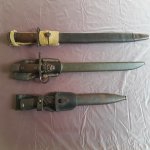
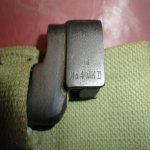
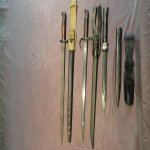
The bayonets are as follows:
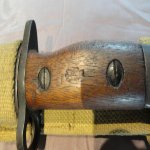
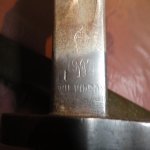
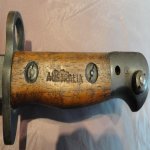
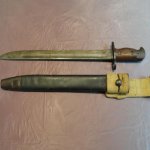
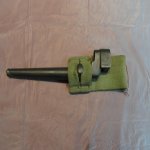
Top: British (most likely - could also be Indian or Australian, need to see markings) 1907 Pattern bayonet. If you take detailed photos of the markings, we can determine more about it. It does have an early variation scabbard with the so called almond stud on the upper mount. The webbing frog is a WW2 Patt. '37 - correct-ish, depending on the era of issue. Very much a dime a dozen bayonet, with millions produced during the First World War and production continuing during the Second as well. India and Australia produced lots during the Second World War - with India making a variety of variants including shortened bayonets. Value in excellent condition is generally no more than $200. If it is an early British made bayonet of the "quillion removed" variety, then it fetches more.
Middle: Imperial Japanese Type 30 "Arisaka" bayonet. Could be an early variant, or later - depends on finish and makings. Definitely an early pattern with the hooked quillion. Interesting thing about the hooked quillion, is that the design inspired the British to do the same with the first batch of 1907 bayonets as well (up until 1912-1914 or so) - also, Imperial Japanese soldiers learned how to use the hooked quillion to engage an opponents bayonet and wrench their rifle out of their hands with it.
Bottom: Nazi Germany S1884/98 III bayonet. Better known as a "K98" bayonet. Wide range of manufacturers and dates of manufacture - need photos. All bayonets and scabbards were serial'd by the manufacturers, matching pairs (bayonet and scabbard) are more valuable than non-matching. With the mounted pattern leather frog and a matching set (assuming it is) value tops out around $300 if in excellent condition.