New to bushing dies

uncle ben

Regular
Rating - 100%
5   0   0
Just switched from a lee full-size die to a Redding bushing die with carbide expander ball. Anyways I have a pile of 6.5 creedmoor to reload, mostly Hornady brass(400pieces) and Lapua brass(200pieces).

Does it make sense that I would need a different bushing size for the two different brands of brass?

When I use the .291 bushing on the lapua brass, everything works great, but when I size the Hornady brass with the same bushing, the projectile slides in the case and there is almost no neck tension. Is this normal?

Thanks for the help.
 
Yes it’s normal. There is a big difference in the neck wall thickness from Hornady to Lapua. Most Lapua I have measured were over 0.015 on average while Hornady were as low as 0.012. That was in .30 calibers (308 & 06) but with the neck tension calculation, you can see why it has a big effect with the 6.5CM.

You will need at least 2 bushings if you want to size them right depending on their consistency.
 
Almost all brass has different wall thicknesses at the neck; anywhere from 0.012 to 0.015" - so you need to be able to measure them. On top of this, a lot of the brass out there has variable wall thicknesses at the neck. In other words it can change depending on where you measure it by up to 0.002" in the extreme. High quality brass such as Lapua is pretty decent from what I have measured, most not changing more than 0.0005". Hornady 6.5CM brass has been pretty good, not varying more than 0.001" in the extreme.

Neck sizing using bushings therefore requires bushings sized to match the wall thickness of your brass. An example:

Bullet size (remains constant) at 0.264".
Brass wall thickness 0.012".
Neck tension wanted/required 0.002".
Therefor, bushing required: 0.264 + 0.012 + 0.012 - 0.002 = 0.286"

Bullet size (remains constant) at 0.264".
Brass wall thickness 0.015".
Neck tension wanted/required 0.002".
Therefor, bushing required: 0.264 + 0.015 + 0.015 - 0.002 = 0.292"

I would NOT be bushing neck sizing with poor quality and/or variable wall thickness brass. Your results are a perfect example of why. You have two options:

The first is that instead of bushing neck sizing, use an incredibly good piece of equipment made by Lee called a Lee (Neck) Collet Die. This is NOT to be confused with the Lee Factory Crimp Die which is for an entirely different thing. The Lee (Neck) Collet Die squeezes the neck on to a properly sized mandrel resulting in the proper 0.002" neck tension pretty much no matter what the neck thickness is. Since it is a collet die it also is not affected much by variable neck wall thickness. They can be a touch finicky when new and may require a bit of attention to clean up rough surfaces. I have 8 of them for various calibers now and only one needed a bit of fine sanding.

The other is a much more expensive process called neck turning.

Thirty dollars or so for a Lee Neck Collet Die is an absolute bargain. I cannot recommend it highly enough.

 
Uncle Ben

Bushing dies work best with custom tight neck chambers and neck turned brass. This is because if you reduce the neck diameter .004 or more with a bushing die you may induce neck runout. And the average factory rifle will let the case neck expand far more than .004.

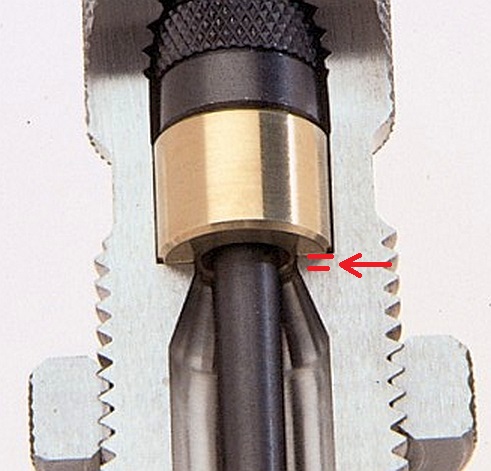
Below is a Redding bushing die cutaway showing that all the neck is not sized with a Redding bushing die. Meaning only about 75% to 80% of the neck is sized and this is normal.

Now look at the clearance or air space along the sides of the bushing, this will allow the bushing to move from side to side and even tilt when sizing the case neck.

The Redding bushing die FAQ tells you if you do not neck turn to reduce the neck diameter .004 and use the expander that comes with the die and push the neck defects to the outside of the neck.

This is why more reloaders use a Lee collet die and a Redding body die than bushing dies. Meaning no neck turning and less neck runout with the Lee collet die.


O5m9mBL.jpg


FL Bushing Dies vs. Honed FL Dies
https://www.accurateshooter.com/technical-articles/reloading/fl-bushing-dies-vs-honed-fl-dies/

Bottom line, you "might" not have runout problems with your bushing die, BUT it is my experience with off the shelf factory rifles and bushing dies I have more neck runout than with standard Forster full length dies.

 
Back
Top Bottom